
Form W-4P, filled in online.
Withholding Certificate for Periodic Pension or Annuity Payments
Type in the panel and watch each answer land on the page. Filling in and signing is free; downloading needs a free account, which includes 5 downloads a month.
Or fill it another way:
- Category
- HR & personnel
- Fillable fields
- 42
- Pages
- 4
- Paper size
- US Letter, 8.5 × 11 in
Five ways to fill this form.
-
Fill it in here
Type in the panel and watch it land on the form. Sign it, then download.
Free to fill and sign Start filling -
Many at once, from a spreadsheet
One row per person, one finished PDF for each.
Paid plan · you can walk through it Start with a spreadsheet -
Send it to someone to fill in
Email a link. They fill it in without an account and you get the answers back.
Paid plan · you can walk through it Send a request -
From your own software
Fill it over the API. One request returns the finished PDF.
Paid plan -
Let an AI assistant do it
Connect ChatGPT or Claude once, then describe what goes on the form.
With a free account
Key facts
| Property | Details |
|---|---|
| Form number | Form W-4P |
| Official name | Withholding Certificate for Periodic Pension or Annuity Payments |
| Issuing agency | Internal Revenue Service, Department of the Treasury |
| Current revision | 2026 revision; form footer shows Created 12/4/25 |
| Number of pages | 4 pages |
| Filing frequency | As needed when starting payments or changing withholding elections |
| Related instructions | General and Specific Instructions built into Form W-4P; see also Publication 505 and Publication 15-T |
| Primary recipient | The payer of the pension, annuity, or IRA periodic payment |
What is this form?
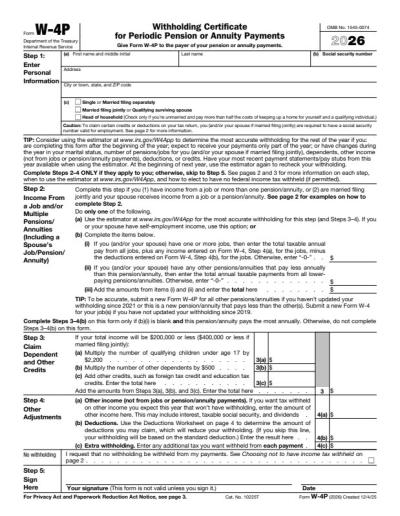
Form W-4P, officially titled Withholding Certificate for Periodic Pension or Annuity Payments, is an Internal Revenue Service (IRS) form used by payees to tell a pension payer, annuity issuer, IRA custodian, or plan administrator how much federal income tax to withhold from periodic payments. The current official form is the 2026 revision (Form W-4P (2026), created 12/4/25). It applies to taxable periodic payments from pensions, commercial annuities, profit-sharing and stock bonus plans, and certain IRA payments that are made at regular intervals over a period of more than one year. It is not the form for lump-sum or other nonperiodic distributions.
The form is organized into five main steps. Step 1 collects personal information and filing status. Step 2 deals with income from a job and/or multiple pensions or annuities, including a spouse's job or pension if filing jointly. Step 3 lets the payee claim dependent and other credits, and Step 4 covers other adjustments such as other income, deductions, extra withholding, or the election for No withholding. Step 5 is the signature section that makes the form valid. Page 4 includes the Step 4(b)—Deductions Worksheet, which feeds into Step 4(b) on page 1.
In practice, Form W-4P does not calculate tax due on its own. Instead, it helps the payer estimate withholding under IRS rules so the payee does not underwithhold or overwithhold during the year. The instructions warn that too little withholding can leave the taxpayer owing money when filing Form 1040 and may trigger an underpayment of estimated tax penalty. If no valid Form W-4P is provided, or if the payer does not have a valid social security number, the payer generally withholds as if the filer were single with no adjustments in Steps 2 through 4.
Who needs to fill this out?
- People receiving taxable periodic pension payments from an employer retirement plan should complete Form W-4P if they want withholding based on their actual filing status, credits, deductions, or extra withholding preferences.
- Recipients of taxable periodic annuity payments, including certain commercial annuities paid monthly, quarterly, or annually over more than one year, use this form to set or update federal withholding.
- IRA owners receiving periodic IRA payments may use Form W-4P when those payments are made in regular installments rather than as on-demand or lump-sum withdrawals.
- Married taxpayers filing jointly should complete it when a spouse also has wages, a pension, or an annuity, because Step 2 specifically adjusts for a spouse's job/pension/annuity and affects withholding accuracy.
- People changing their withholding midyear should submit a new Form W-4P after marriage, divorce, retirement, a change in dependents, a second pension, or changes in deductions, credits, or other income.
- People who want no federal income tax withheld may use the No withholding checkbox if permitted, then complete only Steps 1(a), 1(b), and 5. The instructions note that U.S. citizens and resident aliens generally cannot elect no withholding for payments delivered outside the United States and its territories.
- People who should not use this form include recipients of nonperiodic payments or eligible rollover distributions who should use Form W-4R instead, and nonresident aliens and foreign estates, who are directed to Publication 515 and Publication 519 rather than Form W-4P.
- People who may not need to file it include payees satisfied with default withholding or a prior valid election already on file; however, without a proper update, withholding may remain at an outdated rate.
Where and how to submit
Form W-4P is submitted to the payer of the periodic payment, not to the IRS. Depending on the payment source, that recipient may be an employer plan administrator, pension trustee, insurance company, annuity issuer, financial institution, or IRA custodian. There is no IRS mailing address for routine Form W-4P submission. If a payer offers an online portal, substitute form, or telephonic withholding election process that follows IRS guidance, the payee may use that method instead of mailing a paper form. Otherwise, the payee should return the completed and signed paper form directly to the payer using the payer's own mailing or upload instructions.
There is also no annual IRS filing deadline for Form W-4P because it is not an annual tax return. Submit it before the first periodic payment if you want customized withholding from the start, and submit a new one whenever your withholding needs to change. The payer keeps the form and uses it to calculate withholding on future payments. If you skip filing it, the payer generally uses the default federal withholding treatment described in the instructions.
How to fill it out
- Step 1 — Enter Personal Information: Enter your first name, last name, address, city/state/ZIP code, and social security number in Step 1(a) and Step 1(b). In Step 1(c), check one filing status box only: Single or Married filing separately, Married filing jointly or Qualifying surviving spouse, or Head of household. This choice controls the standard deduction and tax rates used for withholding.
- Step 2 — Income From a Job and/or Multiple Pensions/Annuities: Complete this step only if you have income from a job, more than one pension or annuity, or a spouse with wages or pension income on a joint return. You may use the IRS Tax Withholding Estimator, or complete Step 2(b)(i) for annual taxable pay from jobs, Step 2(b)(ii) for annual taxable payments from lower-paying pensions or annuities, and Step 2(b)(iii) to add those amounts. If this pension does not pay the most annually, leave Steps 3 through 4(b) blank on this form.
- Step 3 — Claim Dependent and Other Credits: If your total income will be $200,000 or less or $400,000 or less if married filing jointly, complete Step 3(a) by multiplying qualifying children under age 17 by $2,200, complete Step 3(b) by multiplying other dependents by $500, and enter other allowable credits such as foreign tax credit or education credits on Step 3(c). Add the three amounts and enter the total on the final line of Step 3.
- Step 4 — Other Adjustments: Use Step 4(a) to enter other expected income not from jobs or pension/annuity payments, such as interest, taxable Social Security, or dividends, if you want withholding to cover that income. Use Step 4(b) only if you expect deductions beyond the standard deduction; enter the amount from line 17 of the Deductions Worksheet on page 4. Use Step 4(c) to request any fixed extra withholding from each payment.
- Step 4 — No withholding election: If you want to elect No withholding, check the box in that section instead of completing withholding adjustments. The instructions say to then complete only Steps 1(a), 1(b), and 5. Use this carefully, because the form warns that too little withholding can lead to tax due and possible penalties.
- Step 4(b) — Deductions Worksheet on page 4: If you use Step 4(b), work through the worksheet lines in order. Line 1a covers qualified tips up to $25,000; line 1b covers qualified overtime compensation up to $12,500 ($25,000 if married filing jointly); line 1c covers qualified passenger vehicle loan interest up to $10,000. Later lines include seniors' additional amounts on lines 3a and 3b, Schedule 1 adjustments on line 5, itemized deductions on lines 6a through 6e, standard deduction amounts on line 11, additional standard deduction on line 12, and the final carryover amount on line 17.
- Step 5 — Sign Here: Sign and date the form in Step 5. The form expressly states that it is not valid unless you sign it. Give the signed form to the payer; do not send it with your Form 1040 unless the payer specifically requests a copy for records.
Important deadlines & penalties
- No fixed annual return deadline: Form W-4P should be submitted before withholding begins or as soon as a withholding change is needed. It is effective through the payer rather than filed on a yearly IRS due date.
- Best practice for new retirees or new annuitants: Give the form to the payer before the first scheduled periodic payment so withholding starts correctly from the first check or deposit.
- If you choose no withholding or underwithhold: you may need to make estimated tax payments. The IRS states estimated tax installments are generally due on April 15, June 15, September 15, and January 15 of the following year. For the 2026 tax year, those dates are April 15, 2026, June 15, 2026, September 15, 2026, and January 15, 2027.
- Underpayment penalty: if too little tax is paid during the year, the IRS may assess the Underpayment of Estimated Tax by Individuals Penalty. The IRS calculates it based on the amount of the underpayment, how long it was underpaid, and the published quarterly interest rates for underpayments.
- Safe-harbor rule: the IRS says many taxpayers avoid the underpayment penalty if their filed return shows they owe less than $1,000, or if they paid at least 90% of the current year's tax or 100% of the prior year's tax, whichever is less. If prior-year AGI exceeded $150,000 ($75,000 if married filing separately), substitute 110% for 100%.
- Late-payment consequences: even though Form W-4P itself has no late-filing penalty, underwithholding can still leave tax due on Form 1040 and may lead to failure-to-pay penalties, interest, or both on the unpaid balance.
- Special circumstances: the IRS may reduce or waive an underpayment penalty in limited cases, such as certain casualty, disaster, unusual circumstances, disability, or retirement-after-age-62 situations described in the Instructions for Form 2210.
Common mistakes to avoid
- Using Form W-4P for the wrong kind of payment: periodic payments belong on Form W-4P, but nonperiodic payments and eligible rollover distributions belong on Form W-4R. Using the wrong form can cause the payer to apply the wrong withholding rules.
- Checking the wrong box in Step 1(c): an incorrect filing status changes the standard deduction and tax rates used in withholding, which can create a year-end balance due or an unnecessarily large refund.
- Completing Steps 3 through 4(b) on multiple forms: the instructions say these steps should generally be completed only on the highest-paying pension/annuity when there is no job, or on the job's Form W-4 when wages are involved. Duplicating credits or deductions across multiple forms can sharply underwithhold.
- Entering job wages on Step 4(a): Step 4(a) is only for other income not from jobs or pension/annuity payments. Putting wage income there after already accounting for it in Step 2(b)(i) can overstate withholding adjustments.
- Ignoring the page 4 worksheet limits: amounts on lines 1a, 1b, 1c, 3a, 3b, 6b, 11, 12, and 13 have specific dollar caps or income thresholds. Entering unrestricted estimates can reduce withholding more than the IRS rules allow.
- Failing to sign Step 5: the form states it is not valid unless you sign it. An unsigned form may be rejected, leaving default withholding in place.
- Leaving out the SSN or providing an incorrect SSN: the instructions say the payer will generally withhold as single with no adjustments in Steps 2 through 4 if no SSN is provided or the IRS reports the SSN as incorrect.
Expert tips
- Use the IRS Tax Withholding Estimator when your situation is not simple: the form itself points to www.irs.gov/W4App for cases involving midyear changes, part-year payments, Social Security, dividends, capital gains, business income, or self-employment.
- Update every payer separately: the instructions require a separate Form W-4P for each pension, annuity, or other periodic payment. Updating one payer does not update the others.
- Coordinate wages and pensions carefully: if you or your spouse has a job, the IRS says to complete Steps 3 through 4(b) on the job's Form W-4, not on Form W-4P. This avoids claiming the same deductions or credits twice.
- Use Step 4(c) for precision: if you are close to the right withholding amount but still want a cushion, entering a flat dollar amount in Step 4(c) is often simpler and safer than inflating Step 4(a) or reducing Step 4(b).
- Check whether no withholding is actually wise: electing the No withholding box may increase cash flow now, but if you do not replace that with estimated payments, you may owe tax and penalties later.
- Review the Deductions Worksheet line by line: page 4 now includes specific entries for qualified tips, qualified overtime compensation, qualified passenger vehicle loan interest, and additional amounts for seniors age 65 or older. Do not rely on an older W-4P without checking the current worksheet.
- Keep the official references handy: Publication 505 explains withholding and estimated tax, Publication 15-T explains withholding methods used by payers, and the Instructions for Form 2210 explain penalty exceptions if withholding proves too low.
Related forms & next steps
- Form W-4R — Withholding Certificate for Nonperiodic Payments and Eligible Rollover Distributions; used instead of Form W-4P for lump sums and other nonperiodic distributions.
- Form W-4 — Employee's Withholding Certificate; used for wage withholding and often coordinated with Form W-4P when the taxpayer also has a job.
- Form 1040-ES — Estimated Tax for Individuals; used if withholding from pensions or annuities is not enough or if the payee elects no withholding.
- Form 2210 — Underpayment of Estimated Tax by Individuals, Estates, and Trusts; used to calculate or request relief from an underpayment penalty.
- Form 1099-R — Reports distributions from pensions, annuities, retirement plans, IRAs, insurance contracts, and similar arrangements.
- Form 1040 — The annual individual income tax return where withholding from pensions and annuities is ultimately reconciled.
Frequently asked questions
What is Form W-4P used for?
It tells the payer of a periodic pension or annuity payment how much federal income tax to withhold from each payment.
Do I send Form W-4P to the IRS?
No. You give it to the payer of the pension, annuity, or IRA periodic payment. The payer keeps it and applies the withholding election.
When should I use Form W-4R instead of Form W-4P?
Use Form W-4R for nonperiodic payments and eligible rollover distributions. Form W-4P is only for periodic payments made at regular intervals over more than one year.
What happens if I do not submit Form W-4P?
Under the current instructions, the payer will generally withhold as if your filing status were single with no adjustments in Steps 2 through 4, unless an earlier valid election remains in effect for older payments.
Can I choose not to have any federal income tax withheld?
Usually yes, by checking the No withholding box and completing only the required identification and signature fields, but that can leave you owing tax later. U.S. citizens and resident aliens generally cannot elect no withholding for payments delivered outside the United States and its territories.
Do I need a separate Form W-4P for each pension?
Yes. The instructions say to submit a separate Form W-4P for each pension, annuity, or other periodic payment you receive.
Can I create Form W-4P in bulk?
Yes. PDFengine supports bulk generation of Form W-4P via Excel or CSV upload — upload a spreadsheet with one row per entry and PDFengine generates all PDFs at once. You can also automate bulk creation programmatically via the PDFengine API.
Ready to fill it in?
Fill in this formOfficial sources
- About Form W-4P, Withholding Certificate for Periodic Pension or Annuity Payments — IRS overview page with current revision links, related products, and update history.
- Form W-4P (2026) PDF — Official IRS form containing the step-by-step instructions, no-withholding election, and page 4 Deductions Worksheet.
- Publication 505, Tax Withholding and Estimated Tax — Official IRS guidance on withholding coordination, estimated tax, and avoiding underpayment.
- Publication 15-T, Federal Income Tax Withholding Methods — Official IRS withholding-method reference used by payers applying Form W-4P elections.
- Underpayment of estimated tax by individuals penalty — IRS penalty page explaining due dates, safe harbors, and how the underpayment penalty is calculated.
More forms in this category
-
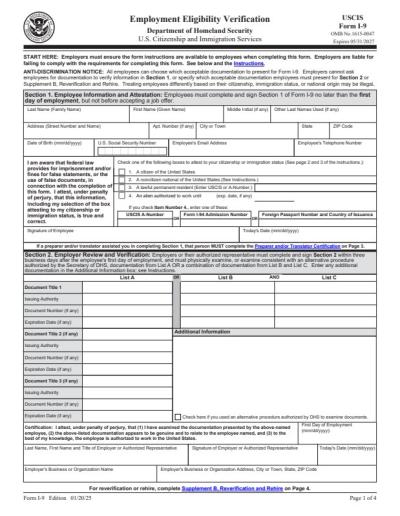 Form I-9Employment Eligibility Verification
-
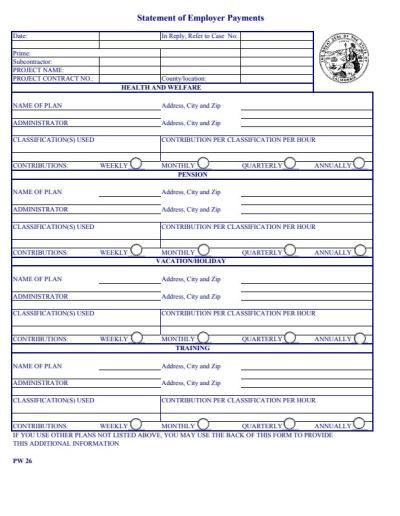 Contractor Fringe Benefit Statement (California DIR)Contractor Fringe Benefit Statement (California DIR) — official fillable PDF form
-
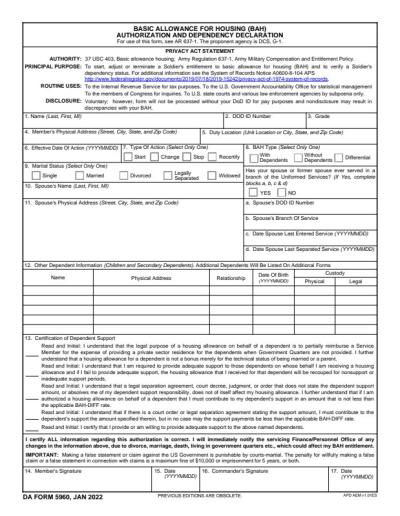 DA Form 5960 Basic Allowance for Housing Authorization and Dependency DeclarationDA Form 5960 Basic Allowance for Housing Authorization and Dependency Declaration is an of...
-
 DA Form 7598 Vehicle Load CardDA Form 7598 Vehicle Load Card is an official fillable form issued by U.S. Department of t...