
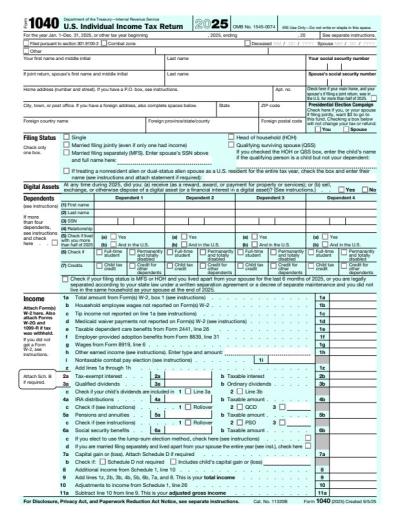
Form 1040, filled in online.
U.S. Individual Income Tax Return
Type in the panel and watch each answer land on the page. Filling in and signing is free; downloading needs a free account, which includes 5 downloads a month.
Or fill it another way:
- Category
- Tax
- Fillable fields
- 197
- Pages
- 2
- Paper size
- US Letter, 8.5 × 11 in
Five ways to fill this form.
-
Fill it in here
Type in the panel and watch it land on the form. Sign it, then download.
Free to fill and sign Start filling -
Many at once, from a spreadsheet
One row per person, one finished PDF for each.
Paid plan · you can walk through it Start with a spreadsheet -
Send it to someone to fill in
Email a link. They fill it in without an account and you get the answers back.
Paid plan · you can walk through it Send a request -
From your own software
Fill it over the API. One request returns the finished PDF.
Paid plan -
Let an AI assistant do it
Connect ChatGPT or Claude once, then describe what goes on the form.
With a free account
Key facts
| Form number | Form 1040 |
|---|---|
| Official name | U.S. Individual Income Tax Return |
| Issuing agency | Internal Revenue Service, Department of the Treasury |
| Current revision date | 2025 edition; IRS PDF created September 5, 2025 |
| Number of pages | 2 pages |
| Filing frequency | Annual |
| Who files it | Individuals, including joint filers, resident aliens, and other eligible taxpayers |
| Related instructions document | Instructions for Form 1040 and 1040-SR (2025) |
What is this form?
Form 1040, U.S. Individual Income Tax Return, is the main federal income tax return used by individuals to report income, claim deductions and credits, calculate total tax, and request a refund or show an amount due. This template is for Form 1040 (2025), the tax-year 2025 return generally filed in 2026. The IRS PDF itself identifies it as Form 1040 (2025), and the file metadata shows it was created on September 5, 2025. The return is organized across two pages: page 1 covers filing status, dependents, and income lines 1a through 11a; page 2 continues with tax and credits, payments, refund information, amount owed, third-party designee, signatures, and paid preparer information.
Specific sections of the form matter because the IRS uses them to tie the return to supporting schedules. For example, line 8 pulls in additional income from Schedule 1, line 10; line 10 pulls in adjustments from Schedule 1, line 26; line 17 takes tax from Schedule 2, line 3; line 20 takes credits from Schedule 3, line 8; and line 19 uses Schedule 8812 for the child tax credit or credit for other dependents. The form also includes direct questions and checkboxes that affect filing eligibility and deductions, such as the digital assets question near the top of page 1 and the standard deduction checkboxes on lines 12a through 12d.
In practice, Form 1040 is the IRS's core individual return. Wages from Form W-2 flow to line 1a, taxable interest goes to line 2b, ordinary dividends to line 3b, Social Security benefits to lines 6a and 6b, adjusted gross income is computed on line 11a, taxable income appears on line 15, total tax appears on line 24, total payments appear on line 33, refunds are handled on lines 34 through 36, and any balance due is shown on line 37. If you need to amend a filed return later, you generally do not change this form directly; you file Form 1040-X instead.
Who needs to fill this out?
- Most U.S. citizens and resident aliens whose 2025 gross income meets the IRS filing thresholds in Publication 501 must file. For 2025, the threshold is $15,750 for single filers under 65, $17,750 for single filers age 65 or older, $23,625 for head of household under 65, $25,625 for head of household age 65 or older, $31,500 for married filing jointly if both spouses are under 65, $33,100 if one spouse is 65 or older, and $34,700 if both spouses are 65 or older.
- Married filing separately taxpayers generally must file if gross income is at least $5.
- Qualifying surviving spouse filers generally must file if gross income is at least $31,500 if under 65 or $33,100 if age 65 or older.
- Dependents may have to file even below the main thresholds under the special dependent filing rules in Publication 501, especially if they have unearned income, self-employment income, or other situations listed in the IRS filing requirement tables.
- Self-employed individuals often must file even when income is modest, particularly if they have net earnings from self-employment that trigger self-employment tax reported through Schedule 2 and reflected on line 23.
- Taxpayers who do not otherwise have to file may still want to file to claim a refund of withholding shown on line 25, the earned income credit on line 27a, the additional child tax credit on line 28, or other refundable credits.
- People who generally do not need to file are those whose gross income is below the applicable threshold and who are not subject to a special filing trigger, do not owe self-employment or other taxes, and are not claiming a refund or refundable credit.
Where and how to submit
Most taxpayers submit Form 1040 electronically through IRS Free File, commercial tax software, or an authorized e-file provider. Electronic filing is the IRS-preferred method because math checks, missing-field checks, and direct deposit information are validated before transmission. Paper filing is still allowed, but the mailing address depends on where the taxpayer lives and whether a payment is enclosed. For taxpayers living in Alabama, Florida, Georgia, Louisiana, Mississippi, North Carolina, South Carolina, Tennessee, or Texas, a paper return without payment goes to Department of the Treasury, Internal Revenue Service, Austin, TX 73301-0002; with payment it goes to Internal Revenue Service, P.O. Box 1214, Charlotte, NC 28201-1214.
For taxpayers in many northeastern and midwestern states, a return without payment goes to Department of the Treasury, Internal Revenue Service, Kansas City, MO 64999-0002, while returns with payment generally go to Internal Revenue Service, P.O. Box 931000, Louisville, KY 40293-1000. For many western states, returns without payment go to Department of Treasury, Internal Revenue Service, Ogden, UT 84201-0002.
International and certain special filers use different addresses. If you live in a foreign country, use an APO or FPO address, file Form 2555 or 4563, or are a dual-status alien, a paper return without payment goes to Department of the Treasury, Internal Revenue Service, Austin, TX 73301-0215 USA; with payment it goes to Internal Revenue Service, P.O. Box 1303, Charlotte, NC 28201-1303 USA. Form 1040 is filed with the IRS, not with an employer. For tax year 2025 calendar-year filers, the standard filing deadline is April 15, 2026.
An automatic extension generally moves the filing deadline to October 15, 2026, but any tax owed still must be paid by April 15, 2026 to limit penalties and interest.
How to fill it out
- Step 1 — Filing status, identification, and dependents: At the top of page 1, enter the taxpayer's name, Social Security number, address, and filing status by checking one box under Filing Status. If filing jointly, complete the spouse's name and SSN fields too. Answer the digital assets question and complete the Dependents table, including each dependent's name, SSN, relationship, residency checkboxes, student or disability boxes, and whether the person qualifies for the child tax credit or credit for other dependents.
- Step 2 — Income section: Complete lines 1a through 8. Enter wages from Form W-2 on line 1a, taxable interest on line 2b, ordinary dividends on line 3b, IRA distributions on lines 4a and 4b, pensions and annuities on lines 5a and 5b, Social Security benefits on lines 6a and 6b, capital gain or loss on line 7a, and additional income from Schedule 1, line 10 on line 8. Add the relevant income entries to arrive at line 9 total income, then subtract Schedule 1 adjustments on line 10 to compute line 11a adjusted gross income.
- Step 3 — Standard deduction and taxable income: On page 2, carry line 11a to line 11b. Then work through lines 12a through 12e: check whether someone can claim you or your spouse as a dependent, whether a spouse itemizes separately, whether you are a dual-status alien, and whether either spouse was born before January 2, 1961 or is blind. Enter your standard deduction or itemized deductions on line 12e, add any qualified business income deduction on line 13a and additional deductions from Schedule 1-A on line 13b, total them on line 14, and compute taxable income on line 15.
- Step 4 — Tax and nonrefundable credits: Enter tax on line 16, including any special tax from Forms 8814 or 4972 if applicable, then enter additional taxes from Schedule 2, line 3 on line 17 and total them on line 18. Next, enter the child tax credit or credit for other dependents from Schedule 8812 on line 19 and other credits from Schedule 3, line 8 on line 20. Add those credits on line 21, subtract them from line 18 on line 22, and enter other taxes from Schedule 2, line 21 on line 23. Add lines 22 and 23 to reach line 24 total tax.
- Step 5 — Payments and refundable credits: Enter withholding from Form W-2 on line 25a, withholding from Forms 1099 on line 25b, and withholding from other forms on line 25c; total them on line 25d. Enter 2025 estimated tax payments and any amount applied from the 2024 return on line 26. Then complete refundable credits: EIC on line 27a, ACTC from Schedule 8812 on line 28, American opportunity credit from Form 8863, line 8 on line 29, refundable adoption credit from Form 8839, line 13 on line 30, and Schedule 3, line 15 on line 31. Add lines 27a through 31 on line 32, then add lines 25d, 26, and 32 on line 33 total payments.
- Step 6 — Refund or amount you owe: If line 33 is more than line 24, enter the overpayment on line 34. Put the amount to be refunded on line 35a, then complete the direct deposit fields: routing number on line 35b, account type on line 35c, and account number on line 35d. If you want part of the overpayment applied to next year's estimated tax, enter that on line 36. If instead tax exceeds payments, compute the balance due on line 37 and any estimated tax penalty on line 38.
- Step 7 — Authorization and signatures: Complete the Third Party Designee section only if you want another person to discuss the return with the IRS. Then sign and date in the Sign Here section, enter occupations, and include Identity Protection PINs if the IRS issued them. On a joint return, both spouses must sign. If a paid preparer completed the return, the Paid Preparer Use Only section must also be completed.
Important deadlines & penalties
- Regular due date: For most calendar-year taxpayers filing the 2025 Form 1040, the return is due April 15, 2026.
- Extension: File Form 4868 by April 15, 2026 to request an automatic 6-month extension, which generally moves the filing deadline to October 15, 2026.
- Important limit of an extension: An extension gives more time to file, not more time to pay. Tax expected to be owed should still be paid by April 15, 2026.
- Late-filing penalty: The IRS failure-to-file penalty is generally 5% of the unpaid tax for each month or part of a month the return is late, up to 25%. If the return is more than 60 days late, the minimum penalty for Form 1040 returns due after December 31, 2025 is generally $525 or 100% of the unpaid tax, whichever is less.
- Late-payment penalty: The failure-to-pay penalty is generally 0.5% of unpaid tax per month or part of a month, up to 25%. If you filed on time and have an approved installment agreement, the rate is generally reduced to 0.25% per month while the plan is in effect.
- Interest: IRS interest accrues on unpaid tax and on penalties until the balance is paid in full.
- Special situations: Disaster relief, combat zone service, and certain overseas filing circumstances can change deadlines. The Form 1040 instructions and IRS relief announcements control in those cases.
Common mistakes to avoid
- Entering the wrong filing status box under Filing Status on page 1. Choosing Single instead of Head of Household or Married Filing Separately instead of Married Filing Jointly can change the standard deduction on line 12e and the tax on line 16, often producing an incorrect balance due or refund.
- Mismatch between line 1a and Form W-2, box 1. Taxpayers sometimes enter gross pay instead of the taxable wage amount from Form W-2. That overstates income and can distort adjusted gross income on line 11a and taxable income on line 15.
- Forgetting Schedule transfers. Common misses include failing to bring Schedule 1, line 10 to line 8, Schedule 1, line 26 to line 10, Schedule 2, line 21 to line 23, or Schedule 3, line 15 to line 31. The result is usually understated tax, understated credits, or an IRS correction notice.
- Misreporting Social Security benefits on lines 6a and 6b. Some filers put the full benefit on line 6b instead of only the taxable amount. That can overstate total income and cause an inflated tax liability.
- Checking the wrong boxes on lines 12a through 12d. If someone can claim you as a dependent, if a spouse itemizes separately, or if age or blindness applies, those boxes affect the standard deduction rules. An incorrect box can cause the line 12e deduction to be wrong.
- Direct deposit errors on lines 35b through 35d. A wrong routing number, selecting checking instead of savings on line 35c, or entering an invalid account number can delay or reject the refund.
- Missing signatures or IP PIN entries. An unsigned paper return, a joint return signed by only one spouse, or a missing Identity Protection PIN when the IRS issued one can delay processing or cause rejection of the filing.
Expert tips
- Use the IRS instructions line by line. Form 1040 looks short, but many entries depend on other schedules. Before entering anything on lines 8, 10, 17, 19, 20, 23, 28, 29, 30, or 31, confirm the source schedule and source line.
- Review line 11a before anything else on page 2. Adjusted gross income drives deductions, credit eligibility, and phaseouts. If line 11a is wrong, the rest of the return is usually wrong too.
- Do not guess on line 16 tax. If you have qualified dividends on line 3a or capital gain on line 7a, the tax may need the Qualified Dividends and Capital Gain Tax Worksheet or Schedule D Tax Worksheet rather than the basic tax table.
- Double-check withholding totals on line 25. Compare line 25a to all Forms W-2 and line 25b to all Forms 1099. IRS mismatch notices often happen because one withholding form was omitted.
- Use Publication 501 for filing threshold and dependent questions. It is especially useful if you are near the filing threshold, can be claimed as a dependent, or need to confirm whether age 65 or older status applies for 2025.
- If you want a faster refund, complete lines 35b through 35d carefully and e-file. The IRS specifically validates direct-deposit data, and paper returns with bank errors are more likely to be delayed.
- If you cannot pay in full, still file on time. Filing by the due date avoids the larger failure-to-file penalty. After filing, consider IRS online payment options or an installment agreement to reduce continuing charges.
Related forms & next steps
- Instructions for Form 1040 and 1040-SR — official line-by-line instructions for the return.
- Schedule 1 (Form 1040) — additional income and adjustments to income; amounts flow to lines 8 and 10.
- Schedule 2 (Form 1040) — additional taxes; amounts can flow to lines 17 and 23.
- Schedule 3 (Form 1040) — additional credits and payments; amounts can flow to lines 20 and 31.
- Schedule A (Form 1040) — itemized deductions used instead of the standard deduction on line 12e.
- Schedule 8812 — child tax credit, credit for other dependents, and additional child tax credit feeding lines 19 and 28.
- Form 4868 — automatic extension of time to file an individual return.
- Form 1040-X — amended U.S. individual income tax return used to correct a previously filed Form 1040.
Frequently asked questions
What is Form 1040 used for?
Form 1040 is the primary federal individual income tax return. It reports income, deductions, credits, payments, refunds, and tax due for a specific tax year.
Who has to file Form 1040 for 2025?
It depends mainly on gross income, filing status, age, dependent status, and whether special triggers apply. For example, a single filer under 65 generally must file at $15,750 of gross income, while a married filing separately taxpayer generally must file at $5.
When is Form 1040 due?
For most taxpayers filing a 2025 calendar-year return, the due date is April 15, 2026. If you need more time to file, submit Form 4868 by that date for an automatic extension, but pay any expected tax by April 15, 2026.
Can I e-file Form 1040 instead of mailing it?
Yes. Most taxpayers can e-file through IRS Free File, commercial software, or an authorized e-file provider. E-filing is generally faster and reduces common math and omission errors.
What happens if I file Form 1040 late?
If you owe tax and file late, the IRS can charge a failure-to-file penalty, failure-to-pay penalty, and interest. The failure-to-file penalty is generally 5% per month up to 25%, and the minimum penalty for a return more than 60 days late can be significant.
Do I need extra schedules with Form 1040?
Often, yes. Common attachments include Schedule 1 for additional income and adjustments, Schedule 2 for other taxes, Schedule 3 for additional credits and payments, Schedule A for itemized deductions, and Schedule 8812 for child-related credits.
Can I create Form 1040 in bulk?
Yes. PDFengine supports bulk generation of Form 1040 via Excel or CSV upload — upload a spreadsheet with one row per entry and PDFengine generates all PDFs at once. You can also automate bulk creation programmatically via the PDFengine API.
Ready to fill it in?
Fill in this formOfficial sources
- IRS Form 1040 (2025) — official IRS form PDF with the actual fields, line numbers, and page layout.
- Instructions for Form 1040 and 1040-SR (2025) — official IRS instructions covering filing, line entries, tax worksheets, and penalties.
- Publication 501 (2025) — official filing requirement thresholds, dependent rules, and standard deduction guidance.
- Where to file Form 1040 — official IRS mailing addresses by state, payment status, and international filing situation.
- IRS failure-to-file penalty page — official explanation of late-filing penalty rates and minimum penalty amounts for Form 1040.



