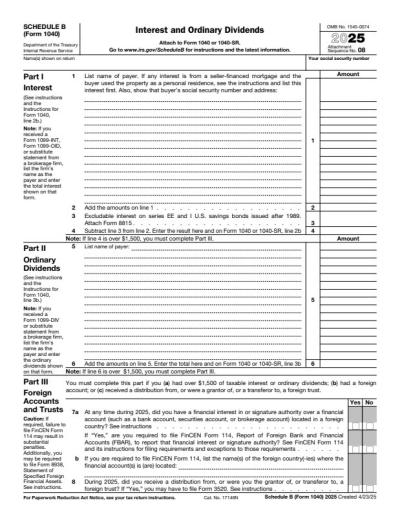
Schedule A (Form 1040), filled in online.
Itemized Deductions
Type in the panel and watch each answer land on the page. Filling in and signing is free; downloading needs a free account, which includes 5 downloads a month.
Or fill it another way:
- Category
- Tax
- Fillable fields
- 33
- Pages
- 1
- Paper size
- US Letter, 8.5 × 11 in

Five ways to fill this form.
-
Fill it in here
Type in the panel and watch it land on the form. Sign it, then download.
Free to fill and sign Start filling -
Many at once, from a spreadsheet
One row per person, one finished PDF for each.
Paid plan · you can walk through it Start with a spreadsheet -
Send it to someone to fill in
Email a link. They fill it in without an account and you get the answers back.
Paid plan · you can walk through it Send a request -
From your own software
Fill it over the API. One request returns the finished PDF.
Paid plan -
Let an AI assistant do it
Connect ChatGPT or Claude once, then describe what goes on the form.
With a free account
Key facts
| Property | Details |
|---|---|
| Form number | Schedule A (Form 1040) |
| Official name | Itemized Deductions |
| Issuing agency | Internal Revenue Service (IRS), Department of the Treasury |
| Current revision | 2025 revision shown on the official IRS PDF |
| Number of pages | 1 page |
| Filing frequency | Filed as needed with the annual federal individual income tax return |
| Who it attaches to | Form 1040 or Form 1040-SR |
| Related instructions | Instructions for Schedule A (Form 1040), Publication 502, and line-specific supporting forms such as Forms 4684, 4952, and 8283 |
What is this form?
Schedule A (Form 1040), officially titled Itemized Deductions, is the Internal Revenue Service (IRS) schedule used by individual taxpayers to claim deductible personal expenses instead of taking the standard deduction on Form 1040 or Form 1040-SR. The current IRS PDF used by this template is the 2025 revision. It is a one-page attachment that totals deductible amounts for medical and dental costs, certain state and local taxes, home mortgage interest, charitable gifts, casualty and theft losses from federally declared disasters, and a limited list of other itemized deductions.
The form is organized by line-based categories rather than separate numbered parts. Lines 1 through 4 cover medical and dental expenses and apply the 7.5% adjusted gross income floor using Form 1040 or 1040-SR, line 11b. Lines 5a through 7 cover taxes you paid, including the election to deduct state and local general sales taxes instead of state and local income taxes and the overall SALT limit on line 5e. Lines 8a through 10 cover deductible interest, lines 11 through 14 cover charitable contributions, line 15 covers certain disaster-related casualty and theft losses, line 16 covers other deductions listed in the IRS instructions, and line 17 shows the total itemized deduction amount that feeds back into the main return.
Who needs to fill this out?
- File Schedule A if your allowable itemized deductions are greater than your standard deduction and you want to claim the larger amount on Form 1040 or 1040-SR.
- File it if you are married filing separately and your spouse itemizes. In that situation, you generally must itemize as well, even if your own itemized deductions are lower than your standard deduction; line 18 is used for the election shown on the form.
- Use it if you paid deductible medical expenses, state and local taxes, mortgage interest, charitable contributions, or federally declared disaster losses that are reportable on the specific Schedule A lines.
- Attach it if a Schedule A line requires a supporting form, such as Form 4952 for investment interest on line 9, Form 8283 for certain noncash charitable gifts over $500 connected with lines 12 through 14, or Form 4684 for qualifying casualty losses on line 15.
- Do not file Schedule A if you are taking the standard deduction and have no reason to itemize.
- Do not use this schedule for deductions claimed elsewhere, such as business expenses on Schedule C, rental expenses on Schedule E, farm expenses on Schedule F, or the new 2025 deductions claimed on Schedule 1-A instead of Schedule A.
- Do not use this version if you are filing Form 1040-NR. Nonresident filers use Schedule A (Form 1040-NR), not Schedule A (Form 1040).
Where and how to submit
Schedule A is not filed by itself. It is attached to your federal individual income tax return — Form 1040 or Form 1040-SR — and submitted to the IRS with the rest of your annual return package. Most taxpayers file electronically through IRS Free File, Free File Fillable Forms, commercial tax software, or an authorized tax professional. E-filing is generally the fastest option and avoids separate mailing of the schedule because Schedule A is transmitted as part of the return.
If you file on paper, mail Schedule A together with Form 1040 or 1040-SR to the exact IRS address listed in the official "Where to File Paper Tax Returns With or Without a Payment" instructions for your state or foreign address and depending on whether you are enclosing a payment. There is no single national Schedule A mailing address. For the 2025 tax year, the standard federal filing deadline for the return package is April 15, 2026. Taxpayers who timely request an extension generally have until October 15, 2026, to file, but any tax due must still be paid by April 15, 2026.
How to fill it out
- Step 1 — Taxpayer identification: Enter the name exactly as shown on Form 1040 or Form 1040-SR and enter your social security number in the heading at the top of the schedule. This must match the main return so the IRS can associate the attachment correctly.
- Step 2 — Lines 1 to 4, Medical and Dental Expenses: On line 1, enter unreimbursed medical and dental expenses that are deductible under the Schedule A instructions and Publication 502. On line 2, enter the amount from Form 1040 or 1040-SR, line 11b. On line 3, multiply line 2 by 7.5% (0.075). On line 4, subtract line 3 from line 1 and enter zero if line 3 is more than line 1.
- Step 3 — Lines 5a to 7, Taxes You Paid: Enter either state and local income taxes or elect general sales taxes on line 5a by checking the box if you choose sales tax instead. Enter state and local real estate taxes on line 5b and personal property taxes on line 5c. Add lines 5a through 5c on line 5d, then apply the line 5e limitation: for 2025, the deduction is generally capped at $40,000, or $20,000 if married filing separately, subject to a phase-down at higher modified adjusted gross income. Add any deductible taxes from line 6 and total the section on line 7.
- Step 4 — Lines 8a to 10, Interest You Paid: Enter home mortgage interest and points reported on Form 1098 on line 8a. If you paid qualified home mortgage interest not reported on Form 1098, complete line 8b and provide the lender or seller information required by the instructions. Enter points not reported on Form 1098 on line 8c, add lines 8a through 8c on line 8e, then enter deductible investment interest on line 9 and attach Form 4952 if required before totaling line 10.
- Step 5 — Lines 11 to 14, Gifts to Charity: Report gifts by cash or check on line 11 and noncash gifts on line 12. Enter any charitable contribution carryover from a prior year on line 13. Add lines 11 through 13 on line 14. If any single contribution was $250 or more, keep the required written acknowledgment, and if total noncash contributions exceed $500, attach Form 8283.
- Step 6 — Lines 15 and 16, Losses and Other Itemized Deductions: Enter casualty and theft losses from a federally declared disaster on line 15, generally using Form 4684 to compute the deductible amount. On line 16, list only those other itemized deductions specifically allowed in the Schedule A instructions, such as certain gambling losses up to winnings or impairment-related work expenses for a disabled person.
- Step 7 — Lines 17 and 18, Total Itemized Deductions: Add lines 4, 7, 10, 14, 15, and 16 to arrive at total itemized deductions on line 17. Compare that amount with your standard deduction. If you itemize, carry the allowed total to Form 1040 or Form 1040-SR as instructed by the IRS. If line 17 is less than your standard deduction but you are choosing or required to itemize, complete the checkbox on line 18 when applicable.
Important deadlines & penalties
- 2025 tax year filing deadline: Schedule A must be filed with Form 1040 or Form 1040-SR by April 15, 2026, unless an extension or special relief applies.
- Extension deadline: If you request an extension by the regular due date, the filing deadline generally moves to October 15, 2026. The extension gives more time to file, not more time to pay.
- Tax due deadline: Any tax owed with a return that includes Schedule A is still due by April 15, 2026. Interest and failure-to-pay penalties can accrue even when a filing extension is approved.
- Late filing penalty: For individuals, the IRS failure-to-file penalty is generally 5% of the unpaid tax for each month or part of a month the return is late, up to 25%. If the return is more than 60 days late, the minimum penalty for a Form 1040 return due after December 31, 2025 is generally $525 or 100% of the unpaid tax, whichever is less.
- Late payment penalty: The IRS failure-to-pay penalty is generally 0.5% of unpaid tax per month, up to 25%. If both late-filing and late-payment penalties apply in the same month, the late-filing portion is reduced so the combined monthly charge is generally 5%.
- Installment agreement relief: If you filed on time and have an approved IRS payment plan, the failure-to-pay penalty can be reduced to 0.25% per month while the agreement is in effect.
- Special extensions: Taxpayers abroad, certain military personnel in combat zones, and taxpayers covered by federally declared disaster relief may receive later filing dates under separate IRS rules.
Common mistakes to avoid
- Entering all medical bills on line 1 without subtracting reimbursements: Insurance reimbursements, HSA/MSA amounts, or pretax employer-paid amounts cannot be deducted. Overstating line 1 can inflate line 4 and trigger an IRS adjustment.
- Using the wrong AGI figure on line 2: Line 2 must come from Form 1040 or 1040-SR, line 11b. Pulling AGI from the wrong line produces an incorrect 7.5% threshold on line 3 and can understate or overstate the deduction.
- Claiming both income tax and sales tax on line 5a: The instructions allow one or the other, not both. If you elect general sales tax, the box on line 5a must be checked and duplicate state income tax amounts should not also be claimed.
- Ignoring the line 5e SALT limitation: For 2025, the state and local tax deduction is generally limited to $40,000, or $20,000 if married filing separately, with a reduction for higher-income taxpayers. Entering the full line 5d amount when the cap applies causes an overstated deduction.
- Deducting home mortgage interest on line 8 without meeting the qualified home rules: If loan proceeds were not used to buy, build, or substantially improve the home, or if the interest was paid to the seller and the required identifying information is missing from line 8b, the deduction may be limited or disallowed.
- Forgetting attachments for lines 9, 12, or 15: Missing Form 4952 for investment interest, Form 8283 for required noncash contribution reporting, or Form 4684 for disaster losses can delay processing or lead to correspondence from the IRS.
- Listing nondeductible items on line 16: Line 16 is only for deductions specifically allowed in the Schedule A instructions. Personal expenses, federal income taxes, and miscellaneous deductions suspended by law do not belong there and may be disallowed.
Expert tips
- Run the standard deduction comparison before finalizing line 17: Schedule A is worthwhile only when line 17 beats your standard deduction or when you are required to itemize because of your filing status.
- Use Publication 502 for line 1 edge cases: It helps with long-term care premiums, medical travel, Medicare premiums, disability-related care, and other items taxpayers often underclaim or overclaim.
- For line 5a sales tax elections, keep receipts if you use actual expenses: The IRS allows either actual sales taxes paid or the optional sales tax tables, but actual-expense claims need records.
- Check line 8 carefully if your mortgage was refinanced or seller-financed: Points, acquisition debt limits, and lender-identification details can change what belongs on lines 8a, 8b, and 8c.
- Document charitable gifts before entering lines 11 through 13: Cash gifts need bank records or written acknowledgments, and any single gift of $250 or more needs a contemporaneous written acknowledgment from the charity.
- Review line 15 only if the loss relates to a federally declared disaster: Personal casualty losses are generally not deductible unless they meet the disaster rules in Form 4684 and the Schedule A instructions.
- Do not overlook carryovers and supporting forms: Prior-year charitable carryovers on line 13 and investment interest limitations on line 9 are common places where taxpayers leave money behind or claim the wrong-year amount.
Related forms & next steps
- Form 1040 — main U.S. individual income tax return to which Schedule A is attached.
- Form 1040-SR — version of the individual return for seniors that can also use Schedule A.
- Form 4868 — request for an automatic extension of time to file an individual return.
- Form 4952 — used to calculate deductible investment interest for Schedule A, line 9.
- Form 8283 — required for reporting certain noncash charitable contributions connected with Schedule A.
- Form 4684 — used to figure casualty and theft losses for Schedule A, line 15.
- Form 1040-X — used to amend a filed return if you need to correct itemized deductions later.
Frequently asked questions
What is Schedule A (Form 1040) used for?
It is the IRS schedule used to claim itemized deductions instead of the standard deduction. Taxpayers use it to total deductible medical expenses, certain taxes, mortgage interest, charitable contributions, qualified disaster losses, and a small group of other deductions allowed by the IRS instructions.
Should I itemize or take the standard deduction?
Use Schedule A only if your allowable line 17 total is greater than your standard deduction or if you are otherwise required to itemize, such as in some married-filing-separately situations. The lower-tax option is usually the better choice, but you should compare both methods before filing.
Can I deduct medical expenses on Schedule A?
Yes, but only the portion that exceeds 7.5% of your adjusted gross income. You enter total unreimbursed qualifying expenses on line 1, your AGI from Form 1040 or 1040-SR line 11b on line 2, and the deductible portion ends up on line 4 after the threshold calculation.
Can I deduct state income tax and sales tax on Schedule A?
No. On line 5a you may deduct state and local income taxes or elect to deduct state and local general sales taxes instead. The form does not allow both, and the combined SALT deduction on lines 5a through 5c is generally limited on line 5e.
Do I need receipts or extra forms for Schedule A?
Often, yes. Examples include Form 4952 for investment interest, Form 8283 for required noncash charitable reporting, Form 4684 for qualifying disaster losses, and written acknowledgments for charitable gifts of $250 or more. You should also keep receipts, year-end tax statements, Forms 1098, and proof of payment.
What happens if I file Schedule A late?
Because Schedule A is filed with your Form 1040 or Form 1040-SR, the normal individual return penalties apply. The IRS generally charges a failure-to-file penalty of 5% of unpaid tax per month up to 25%, plus a failure-to-pay penalty of 0.5% per month up to 25%, subject to coordination rules and possible minimum late-filing penalties.
Can I create Schedule A (Form 1040) in bulk?
Yes. PDFengine supports bulk generation of Schedule A (Form 1040) via Excel or CSV upload — upload a spreadsheet with one row per entry and PDFengine generates all PDFs at once. You can also automate bulk creation programmatically via the PDFengine API.
Ready to fill it in?
Fill in this formOfficial sources
- IRS Schedule A (Form 1040) PDF — official 2025 Schedule A form issued by the IRS.
- Instructions for Schedule A (Form 1040) — official line-by-line IRS instructions, limits, worksheets, and attachment rules.
- About Schedule A (Form 1040) — IRS overview page for the itemized deductions schedule.
- IRS File your tax return — official filing methods, the April 15, 2026 deadline for 2025 returns, and extension guidance.
- IRS Failure to file penalty — official penalty rates and minimum late-filing amounts for individual returns.