
Schedule B (Form 1040), filled in online.
Interest and Ordinary Dividends
Type in the panel and watch each answer land on the page. Filling in and signing is free; downloading needs a free account, which includes 5 downloads a month.
Or fill it another way:
- Category
- Tax
- Fillable fields
- 72
- Pages
- 1
- Paper size
- US Letter, 8.5 × 11 in
Five ways to fill this form.
-
Fill it in here
Type in the panel and watch it land on the form. Sign it, then download.
Free to fill and sign Start filling -
Many at once, from a spreadsheet
One row per person, one finished PDF for each.
Paid plan · you can walk through it Start with a spreadsheet -
Send it to someone to fill in
Email a link. They fill it in without an account and you get the answers back.
Paid plan · you can walk through it Send a request -
From your own software
Fill it over the API. One request returns the finished PDF.
Paid plan -
Let an AI assistant do it
Connect ChatGPT or Claude once, then describe what goes on the form.
With a free account
Key facts
| Property | Details |
|---|---|
| Form number | Schedule B (Form 1040) |
| Official name | Interest and Ordinary Dividends |
| Issuing agency | Internal Revenue Service, Department of the Treasury |
| Current revision | 2025 revision; IRS PDF marked Created 4/23/25 |
| Number of pages | 1 page |
| Filing frequency | Annual, only when required with Form 1040 or Form 1040-SR |
| Related instructions | 2025 Instructions for Schedule B (Form 1040), i1040sb |
| Main return lines affected | Form 1040 or 1040-SR line 2b and line 3b |
What is this form?
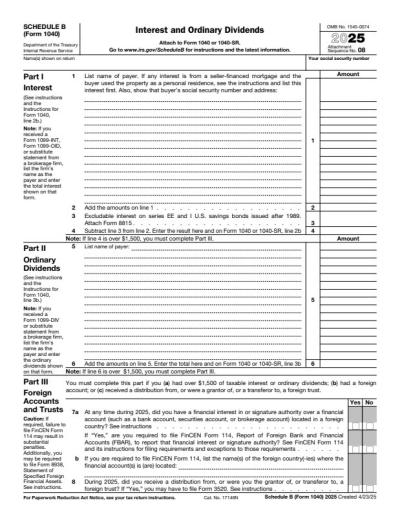
Schedule B (Form 1040), officially titled Interest and Ordinary Dividends, is the Internal Revenue Service attachment used to itemize certain interest income, ordinary dividend income, and foreign account or foreign trust disclosures that accompany an individual federal income tax return. The 2025 revision of Schedule B attaches to Form 1040 or Form 1040-SR and is issued by the Department of the Treasury, Internal Revenue Service. Its main function is twofold: first, to list the payer names and amounts behind taxable interest and ordinary dividends; second, to collect compliance questions in Part III about foreign financial accounts, FinCEN Form 114 filing, and foreign trusts.
The schedule is a 1-page form dated 2025 and marked Created 4/23/25 on the IRS PDF. Part I covers interest income on lines 1 through 4, including a subtraction on line 3 for excludable interest from eligible series EE and I U.S. savings bonds when Form 8815 applies. Part II covers ordinary dividends on lines 5 and 6. Part III contains line 7a foreign account questions, line 7b for the country or countries where the account is located, and line 8 for foreign trust reporting triggers. Amounts from line 4 and line 6 flow back to the main return, specifically Form 1040 or 1040-SR, line 2b for taxable interest and line 3b for ordinary dividends.
Schedule B is not required for every taxpayer who receives investment income. Many filers can report modest interest and dividends directly on Form 1040 without this attachment. The schedule becomes mandatory once specific reporting thresholds or disclosure triggers apply, especially when taxable interest or ordinary dividends exceed $1,500, when seller-financed mortgage interest must be identified, when nominee distributions or bond adjustments are involved, or when the taxpayer had certain foreign accounts or foreign trust transactions during the year.
Who needs to fill this out?
- File Schedule B if your taxable interest or ordinary dividends exceed $1,500 for the tax year. The IRS instructions state that you must use the schedule if you had more than $1,500 of taxable interest or more than $1,500 of ordinary dividends.
- File it if you received interest from a seller-financed mortgage and the buyer used the property as a personal residence. You must list that interest first and include the buyer's name, address, and taxpayer identification number details described in the instructions.
- File it if you are reporting accrued interest, original issue discount adjustments, or amortizable bond premium adjustments that change the amount otherwise reported from Form 1099-INT or Form 1099-OID.
- File it if you are claiming the exclusion for interest on series EE or I U.S. savings bonds issued after 1989 and are attaching Form 8815; line 3 of Schedule B is where the exclusion is reflected.
- File it if you received interest or ordinary dividends as a nominee for someone else. The instructions require you to report the full amount received in your name and then subtract the nominee amount on the schedule.
- File it if you had a financial interest in, or signature authority over, a foreign financial account, even if you did not exceed the $1,500 income threshold. Part III must also be completed if you received a distribution from, were a grantor of, or were a transferor to a foreign trust.
- You generally do not need Schedule B if your taxable interest and ordinary dividends are each $1,500 or less, you do not have a seller-financed mortgage reporting issue, do not need to show bond or nominee adjustments, and have no foreign account or foreign trust disclosure trigger.
Where and how to submit
Schedule B is not mailed separately. It must be attached to the taxpayer's annual Form 1040 or Form 1040-SR and filed with the Internal Revenue Service. If the return is filed electronically, Schedule B is transmitted as part of the e-file package through IRS Free File, IRS Direct File where available, commercial tax software, or an authorized IRS e-file provider. The line 7a foreign account disclosure does not replace an FBAR filing; if FBAR is required, it must be filed separately and electronically with FinCEN, not attached to the tax return.
For paper filing, there is no single nationwide Schedule B mailing address. The schedule goes in the same envelope as Form 1040 or Form 1040-SR and any other schedules, using the taxpayer's state-specific address from the current IRS Where to file paper tax returns with or without a payment tables. For a 2025 individual return, the standard federal filing deadline is April 15, 2026. If the taxpayer files Form 4868 on time, the return package, including Schedule B, is generally extended to October 15, 2026.
If line 8 triggers Form 3520, that form is separately filed at the address in its own instructions rather than attached to Form 1040.
How to fill it out
- Step 1 — Heading: Enter the Name(s) shown on return and Your social security number exactly as they appear on Form 1040 or Form 1040-SR. The identification on the schedule must match the main return so the IRS can connect the attachment to the correct taxpayer.
- Step 2 — Part I, line 1: On line 1, list each interest payer's name and the corresponding amount of taxable interest. If any interest is from a seller-financed mortgage on a buyer's personal residence, list that item first and include the buyer information required by the instructions. If a brokerage issued a consolidated statement, the brokerage firm name may be used as the payer with the total shown on the statement.
- Step 3 — Part I, lines 2 through 4: Add the line 1 entries and enter the total on line 2. If you qualify to exclude interest on eligible series EE or I U.S. savings bonds, enter the excludable amount on line 3 and attach Form 8815. Subtract line 3 from line 2 and enter the result on line 4; also transfer line 4 to Form 1040 or 1040-SR, line 2b. If line 4 is over $1,500, you must complete Part III.
- Step 4 — Part II, lines 5 and 6: On line 5, list each payer of ordinary dividends and the amount, generally from Form 1099-DIV, box 1a. Add the line 5 entries and enter the total on line 6. Then carry line 6 to Form 1040 or 1040-SR, line 3b. If line 6 exceeds $1,500, Part III is required.
- Step 5 — Part III, line 7a: Answer both Yes/No questions on line 7a. The first asks whether, at any time during 2025, you had a financial interest in or signature authority over a financial account located in a foreign country. The second asks whether you are required to file FinCEN Form 114 (FBAR). The instructions say to answer the first question even if you are not required to file FBAR.
- Step 6 — Part III, line 7b: If the answer to the second question on line 7a is Yes, enter on line 7b the name of each foreign country where the financial account or accounts were located. If there is not enough room, attach a separate statement.
- Step 7 — Part III, line 8 and final review: On line 8, answer whether during 2025 you received a distribution from, or were the grantor of, or transferor to, a foreign trust. If yes, you may also need Form 3520. Before filing, verify that nominee reductions are labeled correctly as Nominee Distribution, accrued interest reductions as Accrued Interest, original issue discount reductions as OID Adjustment, and bond premium reductions as ABP Adjustment, then attach Schedule B to your Form 1040 or 1040-SR.
Important deadlines & penalties
- 2025 return due date: Attach Schedule B to Form 1040 or Form 1040-SR by April 15, 2026, unless an extension or special relief applies.
- Automatic extension to file: Taxpayers can generally request more time by filing Form 4868 by April 15, 2026. This usually extends the filing deadline for the entire return package, including Schedule B, to October 15, 2026. The extension gives more time to file, not more time to pay tax due.
- Late-filing penalty for the return: If Schedule B should have been attached to a late Form 1040, the IRS failure-to-file penalty is generally 5% of the unpaid tax for each month or part of a month the return is late, up to 25%. If the return is more than 60 days late and the due date is after December 31, 2025, the minimum penalty is generally $525 or 100% of the unpaid tax, whichever is less.
- Late-payment penalty: If tax is owed and not paid by the original due date, the failure-to-pay penalty is generally 0.5% of unpaid tax per month, up to 25%, plus interest.
- FBAR timing if line 7a requires it: FinCEN Form 114 is generally due April 15 and receives an automatic extension to October 15. It is filed electronically with FinCEN, not with the IRS paper return.
- Foreign asset and trust penalties: The Schedule B instructions warn that failure to file Form 8938 may result in a $10,000 penalty, with additional penalties for continued failure after IRS notice. Foreign trust reporting on Form 3520 can trigger much steeper penalties, including percentages of the amount transferred to or received from the trust.
Common mistakes to avoid
- Leaving out Part III when line 4 or line 6 exceeds $1,500: The form specifically says Part III is required once taxable interest on line 4 or ordinary dividends on line 6 exceed $1,500. Omitting it can lead to an incomplete return and IRS follow-up.
- Reporting tax-exempt interest on line 1: Line 1 is for taxable interest only. Tax-exempt municipal bond interest belongs on Form 1040 or 1040-SR, line 2a, not on Schedule B. Putting it on line 1 overstates taxable income.
- Failing to label nominee reductions correctly: When subtracting income that belonged to someone else, the instructions require the notation Nominee Distribution. Using no label or subtracting the amount silently can make the schedule look inconsistent with Forms 1099 received by the IRS.
- Ignoring seller-financed mortgage details on line 1: If interest is from a seller-financed mortgage on a buyer's personal residence, the buyer's identifying information must be shown. The instructions warn that failing to show the buyer's name, address, and SSN, or failing to provide your SSN to the buyer, may result in a $50 penalty.
- Using the wrong dividend amount on line 5: Line 5 is for ordinary dividends, generally from Form 1099-DIV, box 1a. Taxpayers sometimes enter qualified dividends from box 1b instead, which causes a mismatch with the return.
- Answering line 7a incorrectly because the account was at a U.S. bank branch abroad or a foreign bank branch in the U.S.: The IRS instructions define whether the account is considered located in a foreign country based on the physical branch location. A wrong answer can create FBAR or Form 8938 compliance problems.
- Thinking line 8 is informational only: A Yes answer about a foreign trust distribution, grantor status, or transfer can mean a separate Form 3520 is required. Missing that filing can lead to significant penalties, not just a correction notice.
Expert tips
- Match payer totals to IRS information returns: Before filing, reconcile line 1 to Forms 1099-INT and 1099-OID, and reconcile line 5 to Forms 1099-DIV. If you change a reported amount, keep a clear worksheet showing why.
- Use the brokerage name when statements are consolidated: The IRS instructions allow a brokerage firm's name to be listed as the payer with the total amount from the substitute statement. That keeps Schedule B shorter and easier to review.
- Do not subtract adjustments without a label: If you reduce income for nominee amounts, accrued interest, original issue discount, or amortizable bond premium, label the subtraction exactly as the instructions describe. Clear labels reduce mismatch notices.
- Check whether Form 8815 actually helps before entering line 3: The savings bond interest exclusion has education-expense rules and income limits. If the exclusion does not apply, line 3 should be zero and the full amount remains on line 4.
- Read the Form 8938 rules separately from FBAR: Line 7a asks about foreign accounts, but the Schedule B instructions also warn that Form 8938 may be required even when FBAR rules differ. One filing does not replace the other.
- Use IRS Publication 550 and Publication 1212 for bond issues: These publications help when interest involves market discount, OID, acquisition premium, or bond premium, which are common sources of incorrect Schedule B entries.
- Attach a separate statement when line 7b space is not enough: If there are multiple foreign countries, do not abbreviate in a confusing way. A separate statement with the full country list is better than an incomplete line 7b entry.
Related forms & next steps
- Form 1040 — Main U.S. individual income tax return to which Schedule B is attached.
- Form 1040-SR — Senior version of the main individual return that also accepts Schedule B.
- Form 8815 — Exclusion of interest from series EE and I U.S. savings bonds issued after 1989.
- Form 8938 — Statement of Specified Foreign Financial Assets that may be required in addition to Schedule B Part III.
- Form 3520 — Annual return for certain transactions with foreign trusts and receipt of certain foreign gifts.
- Form 1099-INT — Information return commonly used to report taxable and tax-exempt interest amounts that feed Schedule B.
- Form 1099-DIV — Information return used to report ordinary dividends and other distributions relevant to Schedule B line 5.
Frequently asked questions
What is Schedule B (Form 1040) used for?
It is used to list taxable interest and ordinary dividends in detail and to answer foreign account and foreign trust questions that may apply to the taxpayer.
Who must file Schedule B with Form 1040?
You generally must file it if taxable interest or ordinary dividends exceed $1,500, or if you have certain foreign account, foreign trust, nominee, seller-financed mortgage, or bond-adjustment reporting issues.
Do I need Schedule B if I only received one Form 1099-INT?
Not always. If your taxable interest is $1,500 or less and none of the other Schedule B triggers apply, you may be able to report the amount directly on Form 1040 without attaching Schedule B.
What line on Form 1040 does Schedule B go to?
Line 4 of Schedule B flows to Form 1040 or 1040-SR, line 2b for taxable interest, and line 6 flows to Form 1040 or 1040-SR, line 3b for ordinary dividends.
Does Schedule B replace the FBAR filing?
No. Schedule B only asks disclosure questions in Part III. If you are required to file FinCEN Form 114, it must be filed separately and electronically with FinCEN.
What happens if I answer Yes on line 8 about a foreign trust?
A Yes answer may mean you must separately file Form 3520. The schedule itself does not satisfy the full foreign trust reporting requirement.
Can I create Schedule B (Form 1040) in bulk?
Yes. PDFengine supports bulk generation of Schedule B (Form 1040) via Excel or CSV upload — upload a spreadsheet with one row per entry and PDFengine generates all PDFs at once. You can also automate bulk creation programmatically via the PDFengine API.
Ready to fill it in?
Fill in this formOfficial sources
- About Schedule B (Form 1040) — IRS overview of when Schedule B is required.
- 2025 Schedule B (Form 1040) PDF — Official IRS form showing lines 1 through 8 and the 2025 revision details.
- 2025 Instructions for Schedule B (Form 1040) — Official line-by-line instructions, foreign account definitions, and related filing guidance.
- IRS Failure to File Penalty — Official penalty rates for late individual returns.
- FinCEN FBAR due date notice — Official FBAR due date and automatic extension information.



