
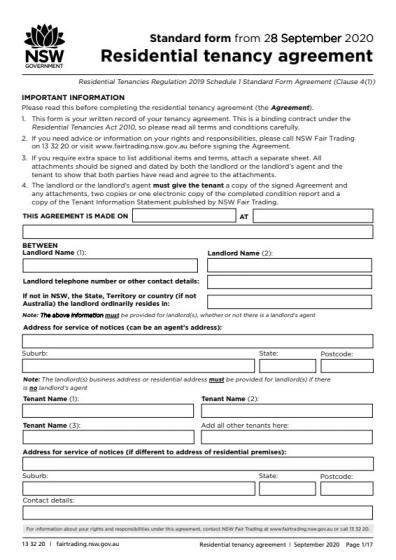
Au Nsw Residential Tenancy Agreement, filled in online.
Au Nsw Residential Tenancy Agreement — official fillable PDF form
Type in the panel and watch each answer land on the page. Filling in and signing is free; downloading needs a free account, which includes 5 downloads a month.
Or fill it another way:
- Category
- Contracts
- Fillable fields
- 130
- Pages
- 17
- Paper size
- A4, 210 × 297 mm
Five ways to fill this form.
-
Fill it in here
Type in the panel and watch it land on the form. Sign it, then download.
Free to fill and sign Start filling -
Many at once, from a spreadsheet
One row per person, one finished PDF for each.
Paid plan · you can walk through it Start with a spreadsheet -
Send it to someone to fill in
Email a link. They fill it in without an account and you get the answers back.
Paid plan · you can walk through it Send a request -
From your own software
Fill it over the API. One request returns the finished PDF.
Paid plan -
Let an AI assistant do it
Connect ChatGPT or Claude once, then describe what goes on the form.
With a free account
What is this form?
NSW Residential Tenancy Agreement is a fillable document issued or used by the landlord or agent using the prescribed New South Wales tenancy framework to record the legal terms under which residential premises are rented in New South Wales, including the parties, property, term, rent, bond, services, special terms, condition obligations, and signatures. The completed PDF creates a consistent record, but it does not replace the official instructions, supporting documents, professional advice, or a separate filing that may be required.
Before starting, gather the notices, identity details, account or registration records, dates, calculations, and attachments referenced by the form. Work from primary records and keep names, identifiers, monetary amounts, and dates consistent across every related document. PDFengine lets you enter the information online and download the completed PDF; it does not submit the form or decide whether the filer qualifies.
Review the current official version before use. Agencies and private parties may revise addresses, deadlines, fees, evidentiary requirements, and signature rules without changing the familiar form name. A technically complete PDF can still be rejected when it is late, unsigned, unsupported, sent to the wrong recipient, or prepared for the wrong reporting period.
Who needs to fill this out?
- NSW landlords and licensed property managers. Applicants should confirm that the form version and filing rules match their transaction or reporting period.
- Tenants entering a fixed-term or periodic residential tenancy. Applicants should confirm that the form version and filing rules match their transaction or reporting period.
- Housing providers and advisers reviewing tenancy documentation. Applicants should confirm that the form version and filing rules match their transaction or reporting period.
Where and how to submit
Each party should receive a complete signed copy of the agreement and accompanying condition report. The landlord or agent must handle any bond and disclosures under current NSW requirements and preserve the agreement for the tenancy period. Before delivery, confirm the recipient, deadline, submission method, required fee, signature format, and attachment list from current official instructions. Do not email sensitive personal, medical, financial, or identification data unless the recipient provides an approved secure method.
Save the final PDF with the filing or transaction date in its filename and keep the source records used to complete it. When delivery timing matters, preserve a portal receipt, certified-mail record, timestamp, or signed acknowledgement. If a correction is needed, prepare a clearly identified corrected version and follow the recipient’s replacement procedure rather than silently changing the retained copy.
How to fill it out
- Step 1 — Agreement date and place: Enter when and where the agreement is made and make sure the date aligns with the intended tenancy commencement. Use the source record named by the form, review formatting and dates, and do not guess when information is unavailable.
- Step 2 — Landlord Name and contact details: List every landlord or the authorized agent, together with the address for service and required contact information. Use the source record named by the form, review formatting and dates, and do not guess when information is unavailable.
- Step 3 — Tenant details and premises: Enter every tenant’s legal name and identify the rented premises, inclusions, parking, storage, and other areas covered by the tenancy. Use the source record named by the form, review formatting and dates, and do not guess when information is unavailable.
- Step 4 — Term, rent, and payment: Specify whether the tenancy is fixed or periodic, its dates, rent amount, payment frequency, accepted method, and payment location. Use the source record named by the form, review formatting and dates, and do not guess when information is unavailable.
- Step 5 — Bond, utilities, and special terms: Record the bond and responsibility for water, electricity, gas, and services; ensure additional terms do not contradict mandatory law. Use the source record named by the form, review formatting and dates, and do not guess when information is unavailable.
- Step 6 — Condition report and signatures: Provide the required condition report and disclosures, then obtain dates and signatures from all landlords or agents and tenants. Use the source record named by the form, review formatting and dates, and do not guess when information is unavailable.
Frequently asked questions
Is NSW Residential Tenancy Agreement filed automatically when I complete it in PDFengine?
No. PDFengine creates a downloadable PDF; you remain responsible for signing, attaching evidence, paying any fee, and delivering it through the method accepted by the recipient.
Which version of the form should I use?
Use the version required for the relevant tax year, transaction date, application period, or proceeding. Compare the revision date and instructions with the official source before submission.
Can I leave a field blank?
Leave a field blank only when the instructions make it optional or not applicable. If the recipient expects an explicit response, use the permitted notation and never invent information.
Do I need to sign the completed PDF?
Most forms that contain a certification or agreement require a signature and date. Check whether handwritten, approved electronic, representative, witness, or multiple-party signatures are required.
What supporting documents should I attach?
Attach only the records required for your circumstances, using the order and identification method in the official instructions. Keep originals unless the recipient specifically requires them.
How should I protect sensitive information on this form?
Use a trusted device, verify the recipient, choose a secure delivery channel, and restrict stored copies. Avoid ordinary email for unencrypted personal or financial information.
Can I create NSW Residential Tenancy Agreement in bulk?
Yes. PDFengine supports bulk generation of NSW Residential Tenancy Agreement via Excel or CSV upload — upload a spreadsheet with one row per form and PDFengine generates all PDFs at once. You can also automate bulk creation programmatically via the PDFengine API.
Ready to fill it in?
Fill in this formMore forms in this category
-
 REG 135 Bill of SaleREG 135 Bill of Sale is the official fillable form from California Department of Motor Veh...
-
 Addendum For Sale Of Other Property By BuyerAddendum For Sale Of Other Property By Buyer — official fillable PDF form
-
 CBP Form 301 — Customs BondOfficial CBP customs bond form used to document surety and bonded obligations.
-
 Contract to Buy and Sell Real Estate (Land)Contract to Buy and Sell Real Estate (Land) — official fillable PDF form