
California Traffic Accident Report, filled in online.
California Traffic Accident Report — official fillable PDF form
Type in the panel and watch each answer land on the page. Filling in and signing is free; downloading needs a free account, which includes 5 downloads a month.
Or fill it another way:
- Category
- General
- Fillable fields
- 129
- Pages
- 3
- Paper size
- US Letter, 8.5 × 11 in
Five ways to fill this form.
-
Fill it in here
Type in the panel and watch it land on the form. Sign it, then download.
Free to fill and sign Start filling -
Many at once, from a spreadsheet
One row per person, one finished PDF for each.
Paid plan · you can walk through it Start with a spreadsheet -
Send it to someone to fill in
Email a link. They fill it in without an account and you get the answers back.
Paid plan · you can walk through it Send a request -
From your own software
Fill it over the API. One request returns the finished PDF.
Paid plan -
Let an AI assistant do it
Connect ChatGPT or Claude once, then describe what goes on the form.
With a free account
What is this form?
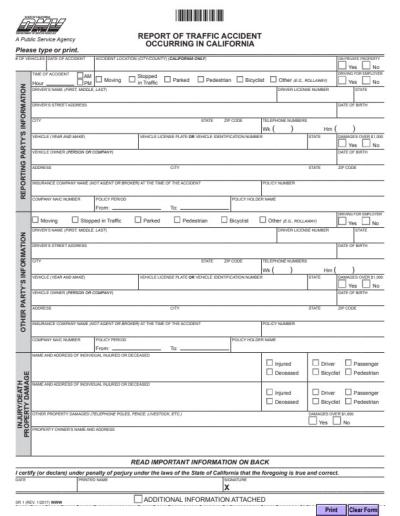
California Traffic Accident Report is an official form used to report a California traffic accident involving injuries, death, or reportable property damage to the DMV with driver, vehicle, and insurance details. In practical use, the form works as a structured record: it keeps names, dates, identifiers, checkboxes, and narrative answers in one place so the receiving agency or organization can review the facts without having to rebuild the story from emails or handwritten notes. That matters when the form becomes part of a tax file, licensing review, compliance packet, social-services case, HR record, or another official workflow tied to deadlines and supporting documents.
This template follows the official layout issued by the California Department of Motor Vehicles (DMV). Because PDFengine preserves the original field order and labels, you can type directly into the same boxes reviewers expect to see. Common fields such as # of Vehicles, Date of Accident (month), Accident Location (City/County) (California Only) and Moving, Stopped in Traffic are easier to check when they are entered cleanly instead of squeezed into a scanned copy. That reduces rework, makes signatures and dates easier to confirm, and gives you a cleaner PDF to save, share internally, or attach to a case or transaction record.
The form is still an official document, so the content should match the underlying facts and any supporting records. Use the fillable version to prepare a precise submission, not to improvise answers. If a field refers to an account number, case identifier, permit, license detail, payroll fact, medical note, delivery fact, or household detail, it should match the source records that sit behind the form. A polished PDF is helpful, but accuracy is what makes the finished document usable in the real workflow.
Who needs to fill this out?
- Drivers involved in a California collision that triggered DMV reporting rules. They benefit from a typed, reviewable version that keeps the official structure intact and makes supporting documents easier to match.
- Insurance, legal, or compliance staff preparing a cleaner draft before filing. They benefit from a typed, reviewable version that keeps the official structure intact and makes supporting documents easier to match.
- Families or fleet teams collecting facts, contact data, and policy information after a crash. They benefit from a typed, reviewable version that keeps the official structure intact and makes supporting documents easier to match.
- People who already made a police report but still need the separate DMV accident form. They benefit from a typed, reviewable version that keeps the official structure intact and makes supporting documents easier to match.
Where and how to submit
Submit the completed SR 1 through the California DMV process that applies to your accident, whether by DMV Virtual Office or by the mailing instructions printed on the official form. Keep a copy of the report, the SR 1A insurance page, and any attachments because police reports and insurance claims do not replace the DMV filing requirement.
Before sending it, compare the completed PDF with the records that support it: notices, invoices, payroll data, delivery papers, license information, provider notes, or case documentation. If the workflow later asks for corrections, having a saved draft and a clean final copy makes those updates much faster.
How to fill it out
- Step 1 — Accident basics: Use # of Vehicles, Date of Accident (month), Accident Location (City/County) (California Only), Time of accident: Hour to record when and where the crash happened and how many vehicles were involved. Review the values against the source records before moving on, because this part often determines whether the form is tied to the correct file, person, shipment, account, case, or medical record. Clean entries here also make later signatures, timelines, and follow-up questions much easier to handle.
- Step 2 — Scene status: Use Moving, Stopped in Traffic, Parked, Pedestrian, Bicyclist, Other (e.g., Rollaway) to show what each person or vehicle was doing at the moment of impact. Review the values against the source records before moving on, because this part often determines whether the form is tied to the correct file, person, shipment, account, case, or medical record. Clean entries here also make later signatures, timelines, and follow-up questions much easier to handle.
- Step 3 — Driver and vehicle details: Use Driver's name (First, Middle, Last), Driver license number, VEHICLE (YEAR AND MAKE), VEHICLE LICENSE PLATE OR VEHICLE IDENTIFICATION NUMBER to identify the reporting driver and the exact vehicle connected to the accident file. Review the values against the source records before moving on, because this part often determines whether the form is tied to the correct file, person, shipment, account, case, or medical record. Clean entries here also make later signatures, timelines, and follow-up questions much easier to handle.
- Step 4 — Insurance and ownership: Use INSURANCE COMPANY NAME (NOT AGENT OR BROKER) AT THE TIME OF THE ACCIDENT, COMPANY NAIC NUMBER, POLICY NUMBER, POLICY PERIOD From / To to capture the active coverage and ownership details that DMV may verify later. Review the values against the source records before moving on, because this part often determines whether the form is tied to the correct file, person, shipment, account, case, or medical record. Clean entries here also make later signatures, timelines, and follow-up questions much easier to handle.
- Step 5 — Injuries, damage, and signature: Use NAME AND ADDRESS OF INDIVIDUAL INJURED OR DECEASED, OTHER PROPERTY DAMAGED, PRINTED NAME, SIGNATURE to document the consequences of the accident and finalize the report for submission. Review the values against the source records before moving on, because this part often determines whether the form is tied to the correct file, person, shipment, account, case, or medical record. Clean entries here also make later signatures, timelines, and follow-up questions much easier to handle.
Frequently asked questions
Do I still need SR 1 if police already responded?
Yes. A police report, CHP report, or insurance claim does not replace the separate California DMV accident report when the DMV thresholds are met.
What information should I collect before filling out the form?
Gather the accident date, location, driver identification, vehicle details, insurance card information, and names of anyone injured or property owners involved.
What if some information about the other party is missing?
Complete as much as you can from the scene, photos, exchange information, or police paperwork. Do not guess; use the best confirmed information available.
Why does the insurance page matter?
Because the SR 1A section helps DMV verify whether financial responsibility was in effect at the time of the accident, which can affect license consequences and follow-up.
Should I keep proof of submission?
Yes. Save the completed report, attachments, and online confirmation or mailing proof in case DMV later asks when or how the report was filed.
Can I create Report of Traffic Accident Occurring in California (SR 1) in bulk?
Yes. PDFengine supports bulk generation of Report of Traffic Accident Occurring in California (SR 1) via Excel or CSV upload — upload a spreadsheet with one row per form and PDFengine generates all PDFs at once. You can also automate bulk creation programmatically via the PDFengine API.
Ready to fill it in?
Fill in this formMore forms in this category
-
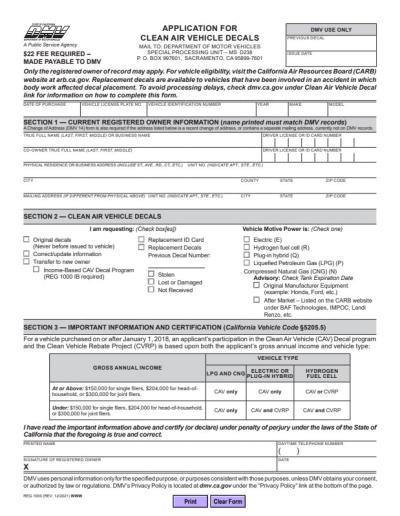 REG 1000 Application for Clean Air Vehicle DecalsREG 1000 Application for Clean Air Vehicle Decals is the official fillable form from Calif...
-
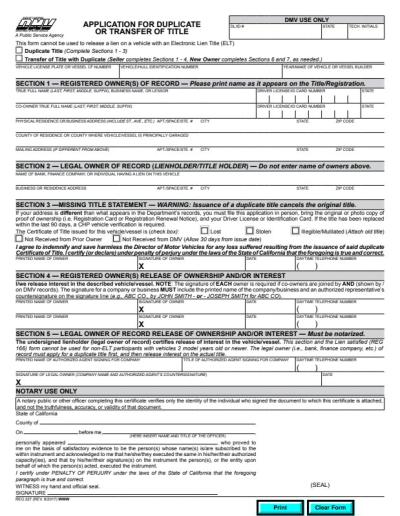 REG 227 Application for Duplicate or Paperless TitleREG 227 Application for Duplicate or Paperless Title is the official fillable form from Ca...
-
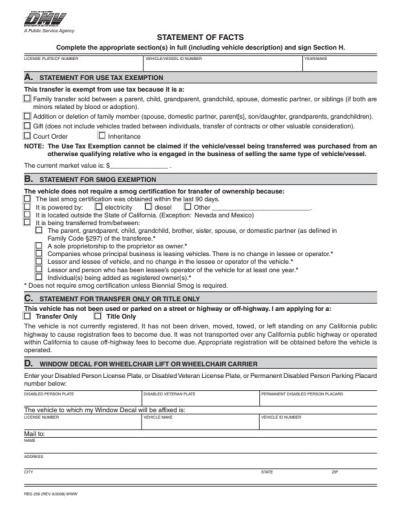 REG 256 Statement of FactsREG 256 Statement of Facts is the official fillable form from California Department of Mot...
-
 REG 256A Miscellaneous CertificationsREG 256A Miscellaneous Certifications is the official fillable form from California Depart...