
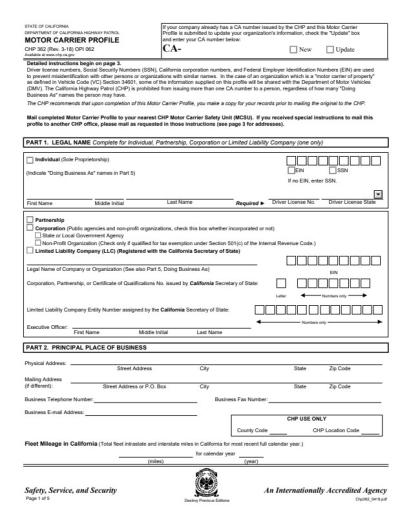
Chp 362 Motor Carrier Profile, filled in online.
Chp 362 Motor Carrier Profile — official fillable PDF form
Type in the panel and watch each answer land on the page. Filling in and signing is free; downloading needs a free account, which includes 5 downloads a month.
Or fill it another way:
- Category
- General
- Fillable fields
- 149
- Pages
- 5
- Paper size
- US Letter, 8.5 × 11 in
Five ways to fill this form.
-
Fill it in here
Type in the panel and watch it land on the form. Sign it, then download.
Free to fill and sign Start filling -
Many at once, from a spreadsheet
One row per person, one finished PDF for each.
Paid plan · you can walk through it Start with a spreadsheet -
Send it to someone to fill in
Email a link. They fill it in without an account and you get the answers back.
Paid plan · you can walk through it Send a request -
From your own software
Fill it over the API. One request returns the finished PDF.
Paid plan -
Let an AI assistant do it
Connect ChatGPT or Claude once, then describe what goes on the form.
With a free account
What is this form?
Chp 362 Motor Carrier Profile is an official form used to collect business, fleet, operation, and safety profile information for a motor carrier record. In practical use, the form works as a structured record: it keeps names, dates, identifiers, checkboxes, and narrative answers in one place so the receiving agency or organization can review the facts without having to rebuild the story from emails or handwritten notes. That matters when the form becomes part of a tax file, licensing review, compliance packet, social-services case, HR record, or another official workflow tied to deadlines and supporting documents.
This template follows the official layout issued by the California Highway Patrol (CHP). Because PDFengine preserves the original field order and labels, you can type directly into the same boxes reviewers expect to see. Common fields such as Legal Name, DBA Name, Motor Carrier Permit Number and Mailing Address, Terminal Address are easier to check when they are entered cleanly instead of squeezed into a scanned copy. That reduces rework, makes signatures and dates easier to confirm, and gives you a cleaner PDF to save, share internally, or attach to a case or transaction record.
The form is still an official document, so the content should match the underlying facts and any supporting records. Use the fillable version to prepare a precise submission, not to improvise answers. If a field refers to an account number, case identifier, permit, license detail, payroll fact, medical note, delivery fact, or household detail, it should match the source records that sit behind the form. A polished PDF is helpful, but accuracy is what makes the finished document usable in the real workflow.
Who needs to fill this out?
- Motor carriers opening, updating, or correcting their CHP profile. They benefit from a typed, reviewable version that keeps the official structure intact and makes supporting documents easier to match.
- Fleet compliance teams tracking operations and safety exposure. They benefit from a typed, reviewable version that keeps the official structure intact and makes supporting documents easier to match.
- Owners or managers responsible for vehicle counts, cargo types, and terminal information. They benefit from a typed, reviewable version that keeps the official structure intact and makes supporting documents easier to match.
- Administrative staff preparing carrier paperwork for review or audit. They benefit from a typed, reviewable version that keeps the official structure intact and makes supporting documents easier to match.
Where and how to submit
Submit the completed profile through the CHP workflow or carrier compliance process that requested it and keep a copy with your operating authority, fleet, and safety records. Because this form pulls together company structure, vehicle counts, cargo categories, and operation types, it is best completed from current carrier records rather than from memory.
Before sending it, compare the completed PDF with the records that support it: notices, invoices, payroll data, delivery papers, license information, provider notes, or case documentation. If the workflow later asks for corrections, having a saved draft and a clean final copy makes those updates much faster.
How to fill it out
- Step 1 — Business identity: Use Legal Name, DBA Name, Motor Carrier Permit Number, USDOT Number to match the profile to the correct carrier entity and operating identifiers. Review the values against the source records before moving on, because this part often determines whether the form is tied to the correct file, person, shipment, account, case, or medical record. Clean entries here also make later signatures, timelines, and follow-up questions much easier to handle.
- Step 2 — Contact and terminals: Use Mailing Address, Terminal Address, Telephone to show where the carrier can be reached and where operations are based. Review the values against the source records before moving on, because this part often determines whether the form is tied to the correct file, person, shipment, account, case, or medical record. Clean entries here also make later signatures, timelines, and follow-up questions much easier to handle.
- Step 3 — Operations profile: Use Interstate, Intrastate, Private Carrier, For-Hire Carrier to describe how the carrier operates and under which business model. Review the values against the source records before moving on, because this part often determines whether the form is tied to the correct file, person, shipment, account, case, or medical record. Clean entries here also make later signatures, timelines, and follow-up questions much easier to handle.
- Step 4 — Fleet and drivers: Use Power Units, Trailers, Drivers to capture the size of the fleet and the driver population covered by the profile. Review the values against the source records before moving on, because this part often determines whether the form is tied to the correct file, person, shipment, account, case, or medical record. Clean entries here also make later signatures, timelines, and follow-up questions much easier to handle.
- Step 5 — Cargo and certification: Use Hazardous Materials, General Freight, Signature, Title to identify what is being transported and finalize the profile with a responsible signer. Review the values against the source records before moving on, because this part often determines whether the form is tied to the correct file, person, shipment, account, case, or medical record. Clean entries here also make later signatures, timelines, and follow-up questions much easier to handle.
Frequently asked questions
What is the main purpose of CHP 362?
It creates or updates the carrier profile CHP uses to understand the company, its operation type, fleet size, and safety-related business facts.
Why do operating identifiers matter?
Carrier permits, DOT numbers, and related identifiers help connect the profile to the correct regulated entity and avoid mismatches during review.
Should I use estimated fleet counts?
It is better to use current documented counts from your fleet records. Rough guesses can cause follow-up questions or inconsistent compliance data.
Do cargo types and operation checkboxes matter?
Yes. They help explain the kind of work the carrier performs and can affect how the record is interpreted during oversight or inspection planning.
Should I keep a filed copy?
Yes. A retained copy makes later updates easier and helps explain what information was provided if the profile is questioned.
Can I create CHP 362 Motor Carrier Profile in bulk?
Yes. PDFengine supports bulk generation of CHP 362 Motor Carrier Profile via Excel or CSV upload — upload a spreadsheet with one row per form and PDFengine generates all PDFs at once. You can also automate bulk creation programmatically via the PDFengine API.
Ready to fill it in?
Fill in this formMore forms in this category
-
 REG 1000 Application for Clean Air Vehicle DecalsREG 1000 Application for Clean Air Vehicle Decals is the official fillable form from Calif...
-
 REG 227 Application for Duplicate or Paperless TitleREG 227 Application for Duplicate or Paperless Title is the official fillable form from Ca...
-
 REG 256 Statement of FactsREG 256 Statement of Facts is the official fillable form from California Department of Mot...
-
 REG 256A Miscellaneous CertificationsREG 256A Miscellaneous Certifications is the official fillable form from California Depart...