
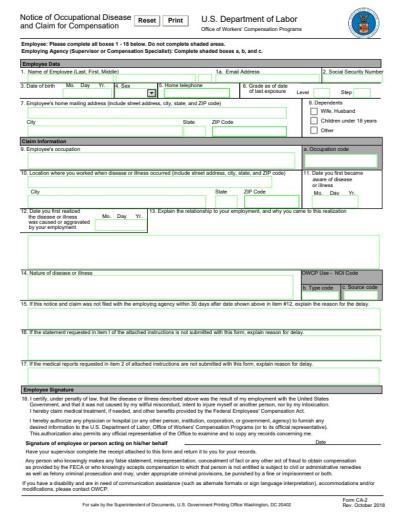
Form CA-2 — Notice of Occupational Disease and Claim for Compensation, filled in online.
Official OWCP claim form for reporting an occupational disease or illness connected to federal employment.
Type in the panel and watch each answer land on the page. Filling in and signing is free; downloading needs a free account, which includes 5 downloads a month.
Or fill it another way:
- Category
- HR & personnel
- Fillable fields
- 100
- Pages
- 5
- Paper size
- US Letter, 8.5 × 11 in
Five ways to fill this form.
-
Fill it in here
Type in the panel and watch it land on the form. Sign it, then download.
Free to fill and sign Start filling -
Many at once, from a spreadsheet
One row per person, one finished PDF for each.
Paid plan · you can walk through it Start with a spreadsheet -
Send it to someone to fill in
Email a link. They fill it in without an account and you get the answers back.
Paid plan · you can walk through it Send a request -
From your own software
Fill it over the API. One request returns the finished PDF.
Paid plan -
Let an AI assistant do it
Connect ChatGPT or Claude once, then describe what goes on the form.
With a free account
What is this form?
Form CA-2 is the OWCP claim form used when a federal employee believes a disease or illness developed because of work exposures or conditions over time rather than a single sudden event. The form records the employee's identity, the employing agency, work location, dates of exposure, medical diagnosis, claimed causes, and supporting witness or physician information.
On PDFengine, the original government layout stays intact while the AcroForm fields are mapped into a structured template. That matters for long or sensitive filings because you can review the same official layout that will actually be printed, shared, or filed later. Instead of typing into a flat scan, you keep a reusable PDF that can be checked carefully before signatures, witness blocks, attachments, or agency submission steps happen.
This is especially useful for forms like Form CA-2 — Notice of Occupational Disease and Claim for Compensation because they rarely stand alone. They usually sit next to medical evidence, employer records, court papers, identity documents, recruitment files, or care notes. A saved draft reduces version confusion, makes review easier for another person, and helps you keep the final PDF consistent with the supporting documents that explain why each answer was entered.
Who needs to fill this out?
- Federal employees claiming an occupational disease or illness tied to work conditions
- Agency compensation staff documenting exposure history and claim details
- Employees collecting medical and workplace facts before filing with OWCP
- Representatives helping a worker prepare a clean disease-claim record
Where and how to submit
Send CA-2 through the employing agency and the current OWCP/ECOMP process once the exposure history and supporting medical information are ready. Keep the finished PDF with physician reports, workplace exposure notes, witness statements, and any agency correspondence because occupational disease claims usually depend on a longer evidence trail than sudden-injury claims.
Before relying on the final version, compare it against the latest official guidance because filing addresses, online alternatives, evidence rules, and accepted versions can change. The safest workflow is to save the completed PDF together with the documents that support every material answer, so a later reviewer does not have to reconstruct the file from scratch.
In practice, the value of using the official PDF online is not only speed but control. You can pause, compare answers with source documents, ask another person to review the same draft, and keep a copy of exactly what was submitted or intended to be submitted. That is useful when a case is delayed, when a supervisor, lawyer, doctor, adviser, or family member needs to check one section, or when the form has to be recreated later from the original answers. Working in a structured template also reduces small transcription errors that become expensive later, especially on forms with many dates, names, checkboxes, or supporting references.
How to fill it out
- Step 1 — Start with the case and identity fields: Open the form by checking core fields such as Nam3 p1 L[0] and Nam3 p1 F[0]. Make sure the correct person, agency, employer, court, or benefit claimant is attached to the draft before you continue.
- Step 2 — Add the main contact or status details: Complete the next important fields, including Nam3 p1 M[0], so the official PDF reflects the right contact details, relationship, leave status, claim status, or filing context.
- Step 3 — Record the central facts of the form: Use fields such as Combo Box15[0] and Home telephone5[0] to capture the key facts this document is really about. Match those entries to source records rather than rewriting them from memory.
- Step 4 — Finish the operational or evidence-specific fields: Work through 6level[0] and the related fields around it so dates, references, explanations, medical or legal details, and any linked parties line up with the rest of the file.
- Step 5 — Review signatures, declarations, and cross-checks: Before the PDF is treated as final, check any declaration, signature, witness, medical, or submission fields against the evidence packet and confirm that names, dates, and checkboxes are internally consistent.
- Step 6 — Save a filing-ready copy: Keep a clean saved PDF before submission so another person can review it, supporting documents can be attached, and later questions can be answered from the exact same version of the form.
Frequently asked questions
When should CA-2 be used instead of CA-1?
CA-2 is generally used for occupational disease or illness that develops over time, while CA-1 is for a traumatic injury from a specific event.
What supporting documents are usually important?
Medical reports, exposure history, job details, and witness or supervisor information are often important to support the claim.
Does the employee need to identify work conditions clearly?
Yes. The form is stronger when the claimed exposure, duties, and dates are described consistently.
Can the agency add its own information?
Yes. Agency sections are part of the official claim workflow and help OWCP review the case.
Should records be kept after filing?
Yes. Occupational disease claims often involve follow-up requests, so a complete copy is worth keeping.
Can I create Form CA-2 — Notice of Occupational Disease and Claim for Compensation in bulk?
Yes. PDFengine supports bulk generation of Form CA-2 — Notice of Occupational Disease and Claim for Compensation via Excel or CSV upload — upload a spreadsheet with one row per form and PDFengine generates all PDFs at once. You can also automate bulk creation programmatically via the PDFengine API.
Ready to fill it in?
Fill in this formMore forms in this category
-
 Form I-9Employment Eligibility Verification
-
 Form W-4PWithholding Certificate for Periodic Pension or Annuity Payments
-
 Contractor Fringe Benefit Statement (California DIR)Contractor Fringe Benefit Statement (California DIR) — official fillable PDF form
-
 DA Form 5960 Basic Allowance for Housing Authorization and Dependency DeclarationDA Form 5960 Basic Allowance for Housing Authorization and Dependency Declaration is an of...