
Form 1065, filled in online.
U.S. Return of Partnership Income
Type in the panel and watch each answer land on the page. Filling in and signing is free; downloading needs a free account, which includes 5 downloads a month.
Or fill it another way:
- Category
- Business
- Fillable fields
- 433
- Pages
- 6
- Paper size
- US Letter, 8.5 × 11 in
Five ways to fill this form.
-
Fill it in here
Type in the panel and watch it land on the form. Sign it, then download.
Free to fill and sign Start filling -
Many at once, from a spreadsheet
One row per person, one finished PDF for each.
Paid plan · you can walk through it Start with a spreadsheet -
Send it to someone to fill in
Email a link. They fill it in without an account and you get the answers back.
Paid plan · you can walk through it Send a request -
From your own software
Fill it over the API. One request returns the finished PDF.
Paid plan -
Let an AI assistant do it
Connect ChatGPT or Claude once, then describe what goes on the form.
With a free account
Key facts
| Form number | Form 1065 |
|---|---|
| Official name | U.S. Return of Partnership Income |
| Issuing agency | Internal Revenue Service (Department of the Treasury) |
| Current revision date | 2025 form; IRS PDF footer shows Created 11/25/25 |
| Number of pages | 6 pages |
| Filing frequency | Usually annual |
| Who files | Partnerships and multi-member entities taxed as partnerships |
| Related instructions document | Instructions for Form 1065 (2025) |
What is this form?
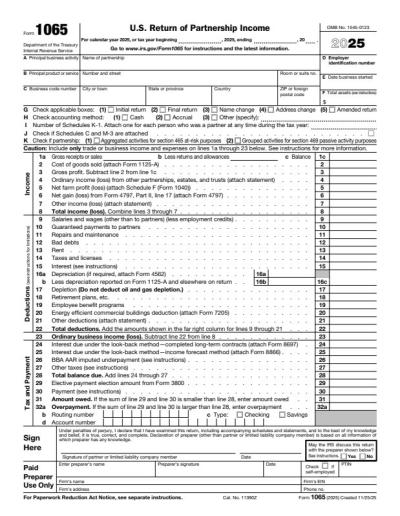
Form 1065, officially U.S. Return of Partnership Income, is the IRS information return used by partnerships to report the entity's income, deductions, gains, losses, credits, and other tax items for the year. The partnership usually does not pay federal income tax at the entity level; instead, it reports the totals on Form 1065 and allocates each partner's share through Schedule K-1. On the 2025 form, page 1 covers the core operating results, including income lines 1a through 8, deduction lines 9 through 23, and tax and payment lines 24 through 32.
Form 1065 is broader than a simple profit-and-loss summary. It also includes Schedule B for entity-level questions such as foreign activity, section 754 elections, digital asset transactions, information-return compliance, and whether the partnership is electing out of the centralized partnership audit regime. If the partnership does not elect out on Schedule B, question 33, it must complete the Designation of Partnership Representative section. Schedule K reports the partnership's total separately stated items, while each partner receives a matching Schedule K-1. Larger or more complex filers may also need supporting schedules such as Schedule B-1, Schedule B-2, Schedule M-3, Form 8825, Form 8990, Form 1125-A, Form 4562, or Schedule K-2/K-3.
The current IRS version in this template is the 2025 Form 1065, and the official PDF footer shows it was created on 11/25/25. The return itself is six pages long, ending with Schedule L, Schedule M-1, and Schedule M-2 on page 6. Those balance-sheet and reconciliation schedules are not optional for every filer, so partnerships should review Schedule B, question 4 carefully before leaving them blank.
Who needs to fill this out?
- Most domestic partnerships must file Form 1065 unless they had neither income nor expenditures treated as deductions or credits for federal tax purposes during the year.
- Domestic LLCs taxed as partnerships generally file Form 1065 when they have at least two members and have not elected corporate treatment on Form 8832.
- Foreign partnerships generally must file if they have effectively connected income, or U.S.-source income, unless they meet a specific IRS exception. One key exception applies when the partnership has no effectively connected income, has U.S.-source income of $20,000 or less for the year, and has less than 1% of partnership items allocable in the aggregate to direct U.S. partners.
- Section 501(d) religious or apostolic organizations file Form 1065 to report taxable income allocable to members.
- Qualified opportunity funds organized as partnerships must file Form 1065 and attach Form 8996 even if they had no income or expenses to report.
- Who does not file Form 1065: a qualified joint venture election by spouses filing jointly can avoid Form 1065; mere co-ownership of rental property without providing services is generally not a partnership; REMICs file Form 1066; and publicly traded partnerships treated as corporations under section 7704 file Form 1120 instead.
Where and how to submit
Form 1065 is filed with the IRS, not with the partners. Many partnerships file electronically, and beginning in 2024 the IRS generally requires e-filing if the partnership files 10 or more returns of any type during the year. Partnerships with more than 100 partners must e-file Form 1065, Schedules K-1, and related schedules. If a hardship waiver is needed, the IRS instructions direct waiver requests to the Ogden Submission Processing Center.
Partners separately receive their own Schedule K-1; do not send a partner only the full Form 1065 and assume that satisfies the furnishing requirement.
If filing on paper, the mailing address depends on the partnership's location and assets. Partnerships in many eastern states mail to Department of the Treasury, Internal Revenue Service Center, Kansas City, MO 64999-0011 when total assets are under $10 million and Schedule M-3 is not filed; otherwise those filers generally use Ogden, UT 84201-0011. Partnerships in western and southern states generally use Department of the Treasury, Internal Revenue Service Center, Ogden, UT 84201-0011. Partnerships in a foreign country or U.S. territory use Internal Revenue Service, P.O. Box 409101, Ogden, UT 84409.
A domestic partnership generally files by the 15th day of the 3rd month after year-end; for calendar-year partnerships, that is March 15, or the next business day when March 15 falls on a weekend or legal holiday.
How to fill it out
- Step 1 — Header and entity details: Complete items A through F at the top of page 1, including principal business activity, principal product or service, business code number, employer identification number, date business started, and total assets in item F. Check the correct boxes in item G for initial, final, amended, name-change, or address-change returns, choose the accounting method in item H, and enter the number of attached Schedules K-1 in item I.
- Step 2 — Income section on page 1: Enter gross receipts on line 1a, returns and allowances on line 1b, and the balance on line 1c. Report cost of goods sold on line 2 and attach Form 1125-A if required. Then complete lines 3 through 8 for gross profit, pass-through ordinary income from other entities, farm profit, Form 4797 gain or loss, other income, and total income.
- Step 3 — Deductions and ordinary business income: Enter deductions on lines 9 through 21, including salaries and wages on line 9, guaranteed payments to partners on line 10, rent on line 13, interest on line 15, and depreciation on lines 16a through 16c with Form 4562 when required. Add total deductions on line 22 and calculate ordinary business income or loss on line 23.
- Step 4 — Tax and payment lines: Complete lines 24 through 32 if the partnership owes look-back interest, has a BBA AAR imputed underpayment on line 26, owes other taxes on line 27, or is reporting an elective payment election amount from Form 3800 on line 29. Enter payments on line 30, then calculate either amount owed on line 31 or overpayment on line 32a. If claiming a direct deposit refund, complete the routing number, account type, and account number in lines 32b through 32d.
- Step 5 — Schedule B and audit-regime questions: Answer Schedule B, questions 1 through 33. Pay close attention to question 4, which determines whether Schedules L, M-1, and M-2 can be skipped; question 10 for section 754 and basis adjustments under sections 743(b) and 734(b); question 16 for Forms 1099; question 24 for Form 8990; question 25 for Form 8996; and question 33 for the election out of the centralized partnership audit regime. If the answer to question 33 is No, complete the Designation of Partnership Representative section with the PR's name, U.S. address, and phone number, and the designated individual information if the PR is an entity.
- Step 6 — Schedule K, Schedule L, M-1, M-2, and partner reporting: Report total separately stated items on Schedule K, lines 1 through 21, including ordinary business income on line 1, rental items, guaranteed payments on line 4, section 179 deduction on line 12, contributions on line 13, self-employment earnings on line 14, credits on line 15, international reporting on line 16, AMT items on line 17, distributions on line 19, and foreign taxes on line 21. If Schedule B, question 4 does not exempt the partnership, complete Schedule L, Schedule M-1, and Schedule M-2 on page 6. Finally, prepare a separate Schedule K-1 for each person who was a partner at any time during the tax year and make sure the K-1 totals reconcile to Schedule K.
Important deadlines & penalties
- Main filing deadline: A domestic partnership generally must file by the 15th day of the 3rd month after the end of its tax year. For a calendar-year 2025 return, the IRS instructions state the deadline is March 15, 2026, and because that date falls on a weekend, a return filed on March 16, 2026 is treated as timely.
- Schedule K-1 deadline: Schedules K-1 must be filed with the return and furnished to partners by the return's due date, including extensions. Missing or late K-1s can trigger separate penalties even if the main return is eventually filed.
- Automatic extension: File Form 7004 by the original due date of Form 1065 to request an automatic extension of time to file. The extension gives more time to file the return, not more time to pay any amount due on lines 24 through 31.
- Late filing penalty: The 2025 IRS instructions impose a penalty of $255 per month, or part of a month, per partner, for up to 12 months, when a required Form 1065 is filed late or is incomplete without reasonable cause.
- K-1 information penalty: The penalty for failing to furnish a timely or correct Schedule K-1 or K-3 is $340 per schedule. For intentional disregard, the penalty increases to $680 or, if greater, 10% of the aggregate amount required to be reported, with no maximum cap for intentional disregard.
- Special timing issues: If the due date lands on a Saturday, Sunday, or legal holiday, the next business day counts as timely. Fiscal-year partnerships use the same 15th-day-of-the-3rd-month rule based on their own year-end rather than March 15.
Common mistakes to avoid
- Misstating gross receipts on lines 1a through 1c: Some filers put net sales directly on line 1a and leave line 1b blank. That can distort gross receipts reporting and make the return inconsistent with books, sales tax records, or Forms 1099-K.
- Forgetting attachments tied to specific lines: Line 2 may require Form 1125-A, line 6 may require Form 4797, line 16a may require Form 4562, Schedule K line 2 may require Form 8825, and Schedule B question 24 may require Form 8990. Missing attachments often generate IRS correspondence and delay processing.
- Answering Schedule B question 4 incorrectly: Partnerships sometimes skip Schedules L, M-1, and M-2 without actually meeting all four tests in question 4, including timely K-1 furnishing and the under-$250,000 receipts and under-$1 million asset thresholds. That leaves page 6 incomplete and can make the filing defective.
- Mismatch between page 1, line 23 and Schedule K, line 1: Ordinary business income or loss on page 1, line 23 should flow to Schedule K, line 1. If those numbers differ without explanation, partner K-1 reporting is usually wrong too.
- Missing or incorrect partnership representative details: If the partnership does not elect out on Schedule B, question 33, it must complete the PR designation section. Leaving out the PR's U.S. address, phone number, or designated individual information for an entity PR can cause IRS follow-up.
- Incorrect partner count in item I or missing final K-1s: Item I must match the number of Schedules K-1 attached, including partners who held an interest at any time during the year. Omitting short-year, withdrawn, or final-year partners can trigger the per-K-1 penalty.
- Ignoring section 754 and basis-adjustment questions: Schedule B questions 10a through 10d ask for the election date and aggregate positive or negative basis adjustments under sections 743(b) and 734(b). Skipping those boxes can misstate partner capital and basis reporting, especially after transfers or distributions.
Expert tips
- Use Schedule B question 4 as a checklist before deciding page 6 is optional: You can skip Schedules L, M-1, and M-2 only if all four tests are satisfied, including total receipts under $250,000, total assets under $1 million, timely K-1 furnishing, and no Schedule M-3 filing requirement.
- Reconcile page 1 to Schedule K before preparing any K-1s: Start with page 1, line 23, then verify the separately stated items on Schedule K so partners do not receive K-1s that fail to tie back to the entity return.
- Watch guaranteed payments carefully: Page 1, line 10 is not the same as partner distributions on Schedule K line 19. Misclassifying one as the other can affect self-employment tax, partner basis, and capital reporting.
- Do not overlook item F total assets: The value in page 1, item F affects the paper-filing address and helps determine whether the return falls into the under-$10-million or $10-million-and-over mailing category in the IRS instructions.
- Review international triggers early: Schedule B questions on foreign accounts, foreign trusts, foreign partners, Forms 8858, 8865, 5471, 1042/1042-S, and Schedule K line 16 for K-2/K-3 can expand the filing package significantly. It is easier to identify those requirements before drafting K-1s.
- Use IRS instructions for capital-account consistency: Capital accounts on Schedule M-2 and each partner's Schedule K-1 item L should be prepared under the method required by the current instructions, and they should remain consistent with contributions, allocations, and distributions.
- Keep these IRS resources handy: the Instructions for Form 1065, the Partner's Instructions for Schedule K-1 (Form 1065), and topic-specific forms such as Form 7004, Form 8990, and Form 8996. Most recurring filing problems come from missing a required attachment, not from the arithmetic itself.
Related forms & next steps
- Schedule K-1 (Form 1065) — Reports each partner's share of income, deductions, credits, and other items from the partnership.
- Partner's Instructions for Schedule K-1 (Form 1065) — Explains how partners report items received on Schedule K-1.
- Form 7004 — Requests an automatic extension of time to file Form 1065.
- Form 1065-X — Used for certain amended partnership returns or administrative adjustment requests.
- Form 1125-A — Computes cost of goods sold when required for page 1, line 2.
- Form 8825 — Reports rental real estate income and expenses that flow to Schedule K line 2.
- Form 8990 — Calculates the limitation on business interest expense referenced in Schedule B questions 23 and 24.
- Form 8996 — Used by partnerships self-certifying as qualified opportunity funds under Schedule B question 25.
Frequently asked questions
Who has to file Form 1065?
Most domestic partnerships and multi-member LLCs taxed as partnerships must file Form 1065 unless they had no federal tax income and no deductible or creditable expenditures for the year. Some foreign partnerships must also file if they have effectively connected income or certain U.S.-source income.
Does Form 1065 mean the partnership pays income tax?
Usually no. Form 1065 is primarily an information return. The partnership reports results at the entity level, but the taxable items generally pass through to the partners on Schedule K-1, and the partners report them on their own returns.
When is Form 1065 due?
For most calendar-year partnerships, Form 1065 is due on March 15 following the close of the tax year, or the next business day if March 15 falls on a weekend or legal holiday. Fiscal-year partnerships use the 15th day of the third month after year-end.
What happens if a partnership files Form 1065 late?
The 2025 IRS instructions state a late-filing penalty of $255 per month, or part of a month, per partner, for up to 12 months, unless the partnership can show reasonable cause. Separate penalties can also apply for missing or incorrect Schedules K-1.
Can I e-file Form 1065?
Yes. Many partnerships can e-file, and some must do so. The IRS generally requires electronic filing when the partnership files 10 or more returns of any type during the year, and partnerships with more than 100 partners must e-file Form 1065 and related schedules.
Do I need to complete Schedule L, Schedule M-1, and Schedule M-2?
Not always. If the partnership answers Yes to all four parts of Schedule B question 4, it is not required to complete Schedules L, M-1, and M-2, item F on page 1, or item L on Schedule K-1. If any part of that test fails, page 6 generally needs to be completed.
Can I create Form 1065 in bulk?
Yes. PDFengine supports bulk generation of Form 1065 via Excel or CSV upload — upload a spreadsheet with one row per entry and PDFengine generates all PDFs at once. You can also automate bulk creation programmatically via the PDFengine API.
Ready to fill it in?
Fill in this formOfficial sources
- IRS About Form 1065 — Official IRS overview of who files Form 1065 and related schedules.
- Instructions for Form 1065 — Official filing instructions, deadlines, mailing addresses, penalties, and line-by-line guidance.
- Form 1065 PDF — The official 2025 IRS form showing page layout, line numbers, and schedules.
- Partner's Instructions for Schedule K-1 (Form 1065) — Official guidance for reporting partnership items to partners.
- IRS About Form 7004 — Official IRS page for the automatic extension request used with Form 1065.
More forms in this category
-
 VA Form 26-1880 — Request for a Certificate of EligibilityOfficial VA home loan form used to request a Certificate of Eligibility.
-
 VA Form 21-0966 — Intent to File a Claim for Compensation, Pension, or Survivors BenefitsOfficial VA form used to preserve a potential effective date before filing a full claim.
-
 Form 1120U.S. Corporation Income Tax Return
-
 Form 1120-SU.S. Income Tax Return for an S Corporation