
Form 1120-S, filled in online.
U.S. Income Tax Return for an S Corporation
Type in the panel and watch each answer land on the page. Filling in and signing is free; downloading needs a free account, which includes 5 downloads a month.
Or fill it another way:
- Category
- Business
- Fillable fields
- 386
- Pages
- 5
- Paper size
- US Letter, 8.5 × 11 in
Five ways to fill this form.
-
Fill it in here
Type in the panel and watch it land on the form. Sign it, then download.
Free to fill and sign Start filling -
Many at once, from a spreadsheet
One row per person, one finished PDF for each.
Paid plan · you can walk through it Start with a spreadsheet -
Send it to someone to fill in
Email a link. They fill it in without an account and you get the answers back.
Paid plan · you can walk through it Send a request -
From your own software
Fill it over the API. One request returns the finished PDF.
Paid plan -
Let an AI assistant do it
Connect ChatGPT or Claude once, then describe what goes on the form.
With a free account
Key facts
| Item | Details |
|---|---|
| Form number | Form 1120-S |
| Official name | U.S. Income Tax Return for an S Corporation |
| Issuing agency | Internal Revenue Service, Department of the Treasury |
| Current revision date | 2025 revision |
| Number of pages | 5 pages |
| Filing frequency | Annual, once for each tax year the S election is in effect |
| Main due date | 15th day of the 3rd month after the tax year ends |
| Related instructions document | Instructions for Form 1120-S (2025) |
What is this form?
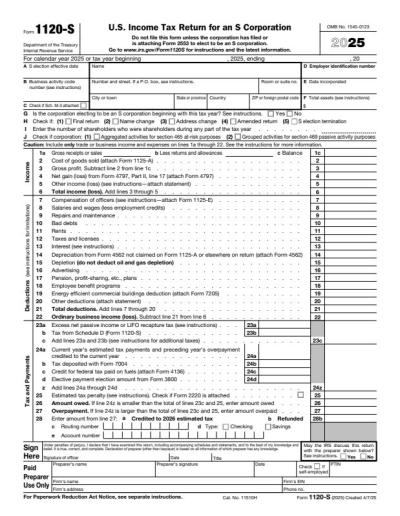
Form 1120-S, officially titled U.S. Income Tax Return for an S Corporation, is the annual federal income tax return used by a corporation or other eligible entity that made a valid S corporation election under Form 2553. The return reports the entity's income, deductions, gains, losses, credits, and other tax items for the year. Although an S corporation usually does not pay federal income tax at the entity level, Form 1120-S is how the IRS determines the corporation's results and how those items flow through to shareholders on Schedule K-1.
The current IRS product is the 2025 revision of Form 1120-S, a 5-page return. Page 1 covers the heading, entity information, Income, Deductions, and Tax and Payments sections, including line 22 for ordinary business income or loss and lines 23a through 28b for entity-level taxes, payments, and refunds. Page 2 contains Schedule B — Other Information, including questions about the accounting method, shareholder types, ownership in other entities, foreign accounts, digital assets, and whether Schedule K-2 is required.
Pages 3 through 5 contain the pass-through and reconciliation schedules. Schedule K summarizes separately stated items such as interest income, dividends, capital gains, section 179 deduction, charitable contributions, credits, tax-exempt income, distributions, and foreign taxes. Schedule M-1 reconciles book income to tax income, and Schedule M-2 tracks the accumulated adjustments account, previously taxed income, accumulated earnings and profits, and other adjustments account. Those schedules support the shareholder reporting that ultimately appears on each Schedule K-1 (Form 1120-S).
Who needs to fill this out?
- Domestic corporations and eligible entities with a valid S election in effect must file Form 1120-S for each tax year, even if they had little or no income, no taxable income, or no business activity during the year.
- A corporation that filed Form 2553 and had the election accepted by the IRS must use Form 1120-S beginning with the effective year of the election and for each later year until the election terminates or is revoked.
- S corporations with a short tax year must still file when they dissolve, revoke the election, terminate S status, or have another event that closes the tax year.
- S corporations with shareholders that are disregarded entities, trusts, estates, nominees, or similar persons must still file Form 1120-S and may also need Schedule B-1 and complete Schedule K-1 reporting.
- S corporations that owe entity-level tax such as excess net passive income tax, LIFO recapture tax, built-in gains tax, or tax from Schedule D still report those items on Form 1120-S rather than switching to another annual return.
- Who does not file Form 1120-S: corporations that never made a valid S election file Form 1120 instead; partnerships file Form 1065; sole proprietorships generally report on Schedule C; and entities must not file Form 1120-S for tax years before the S election becomes effective.
Where and how to submit
Form 1120-S is filed with the Internal Revenue Service, not with a state agency, employer, or shareholder. The IRS allows S corporations to e-file Form 1120-S, related schedules, attachments, and Form 7004. For returns filed on or after January 1, 2024, corporations that file 10 or more returns of any type during the calendar year are generally required to e-file unless they qualify for a waiver or exemption. Shareholders do not receive the Form 1120-S itself; they receive their own Schedule K-1 (Form 1120-S).
If filing on paper, the mailing address depends on the corporation's location and total assets. For corporations in Connecticut, Delaware, the District of Columbia, Georgia, Illinois, Indiana, Kentucky, Maine, Maryland, Massachusetts, Michigan, New Hampshire, New Jersey, New York, North Carolina, Ohio, Pennsylvania, Rhode Island, South Carolina, Tennessee, Vermont, Virginia, West Virginia, Wisconsin, the address is Department of the Treasury, Internal Revenue Service, Kansas City, MO 64999-0013 if total assets are under $10 million and Schedule M-3 is not filed; otherwise use Department of the Treasury, Internal Revenue Service, Ogden, UT 84201-0013. Corporations in all other U.S. states listed in the instructions use Department of the Treasury, Internal Revenue Service, Ogden, UT 84201-0013. Filers in a foreign country or U.S. territory use Internal Revenue Service, P.O. Box 409101, Ogden, UT 84409.
For calendar-year 2025 S corporations, the filing deadline is March 16, 2026 because March 15 falls on a Sunday.
How to fill it out
- Step 1 — Heading and entity information: Complete the top of page 1 with the tax year, corporation name, address, A S election effective date, B Business activity code number, D Employer identification number, E Date incorporated, and F Total assets. Check the boxes in H if this is a final, amended, name-change, address-change, or S-election-termination return, and enter the shareholder count at item I.
- Step 2 — Page 1 Income section: Enter gross receipts on line 1a, returns and allowances on line 1b, and the balance on line 1c. Then complete line 2 for cost of goods sold, line 4 for net gain or loss from Form 4797, and line 5 for other income or loss. Add lines 3 through 5 on line 6 to arrive at total income or loss.
- Step 3 — Page 1 Deductions and ordinary income: Complete deductible items on lines 7 through 20, including compensation of officers, salaries, rents, taxes and licenses, interest, depreciation from Form 4562, employee benefits, and other deductions. Add those lines on line 21 and subtract line 21 from line 6 to calculate line 22, Ordinary business income (loss).
- Step 4 — Tax and payments section: If applicable, enter entity-level taxes on line 23a for excess net passive income or LIFO recapture tax and line 23b for tax from Schedule D, then total them on line 23c. Report estimated tax payments on line 24a, any deposit with Form 7004 on line 24b, fuel tax credit on line 24c, and elective payment election amount from Form 3800 on line 24d. Use line 25 for any estimated tax penalty and finish the balance due or overpayment computation on lines 26 through 28b.
- Step 5 — Schedule B and compliance questions: On page 2, check the accounting method box for Cash, Accrual, or Other, then complete line 2a Business activity and line 2b Product or service. Answer every yes/no item on Schedule B, lines 3 through 16, including shareholder-type questions, ownership in corporations or partnerships, foreign accounts, Forms 8918 and 8996, and the digital asset question on line 16. If line 14a applies, attach Schedule K-2 unless the corporation qualifies for the exception on line 14b.
- Step 6 — Schedule K and shareholder items: Complete Schedule K for all separately stated items, beginning with line 1, Ordinary business income (loss) from page 1, line 22. Then finish the rental, interest, dividend, capital gain, section 179, charitable contribution, credit, AMT, tax-exempt income, distribution, and foreign tax lines through line 16f. These amounts must agree with the Schedule K-1 information given to shareholders.
- Step 7 — Schedule M-1, Schedule M-2, signature, and attachments: Reconcile book income on Schedule M-1 and update equity and adjustment accounts on Schedule M-2, lines 1 through 8. Sign the return in the Sign Here section, complete the Paid Preparer Use Only area if applicable, attach required forms such as Form 1125-A, Form 4797, Form 8825, Schedule D, and Schedules K-1, and keep copies of all supporting statements.
Important deadlines & penalties
- Standard due date: Form 1120-S is generally due by the 15th day of the 3rd month after the end of the tax year. For a calendar-year 2025 S corporation, the due date is March 16, 2026.
- Short-year and final returns: A dissolved S corporation generally files by the 15th day of the 3rd month after dissolution. If the S election terminates and the corporation reverts to C corporation status, the short-year Form 1120-S is due by the due date, including extensions, of the C corporation short-year return. A section 336(e) qualified stock disposition can create its own short-year deadline.
- Automatic extension: File Form 7004 by the regular due date to request an automatic 6-month extension of time to file. The extension moves only the filing deadline, not the due date for any tax shown on lines 23a through 23c or other amounts owed.
- Late filing penalty: For Form 1120-S returns due after December 31, 2025, the IRS states the penalty is $255 per shareholder, per month or part of a month, for up to 12 months, if the return is filed late or incomplete without reasonable cause. For returns due during calendar year 2025, the rate is $245 per shareholder per month.
- Other charges: If the corporation owes tax, interest accrues from the original due date even when an extension to file is granted. An estimated tax penalty may also apply and is reported on line 25, often with Form 2220.
- Weekend or holiday rule: If the due date falls on a Saturday, Sunday, or legal holiday, filing is timely on the next business day.
Common mistakes to avoid
- Using the wrong return type: corporations sometimes file Form 1120 even though the S election shown by item A is in effect. That can cause processing delays, notices, and mismatched shareholder reporting.
- Leaving item I blank or understating the shareholder count: the number of shareholders at item I affects penalty calculations and K-1 preparation. An incorrect count can increase exposure if the return is late or incomplete.
- Failing to answer every Schedule B yes/no question: unanswered items on Schedule B, lines 3 through 16 can make the return incomplete, which is a direct trigger for the Form 1120-S late-or-incomplete-return penalty.
- Reporting page 1 line 22 but not separately stating items on Schedule K: interest on line 4, dividends on lines 5a and 5b, capital gains on lines 7 through 8c, or section 179 on line 11 cannot simply be buried in ordinary income. Misclassification leads to incorrect K-1s and amended returns.
- Forgetting deposits on line 24b: corporations that file Form 7004 often forget to carry the extension payment to line 24b, Tax deposited with Form 7004, which can create a false balance due on line 26.
- Ignoring Schedule M-2 when distributions were made: if the corporation entered distributions on Schedule K, line 16d but does not update Schedule M-2, lines 1 through 8, shareholder basis and accumulated adjustments account reporting may be wrong.
- Mailing to the wrong IRS campus: paper filers sometimes ignore item F total assets and the state-based mailing table. Sending the return to the wrong address slows processing and can complicate proof of timely filing.
Expert tips
- Reconcile page 1 to Schedule K before filing: Schedule K, line 1 should match page 1, line 22 exactly unless the return itself is wrong.
- Check whether Schedule B-1 is needed early: if Schedule B, line 3 is yes because a shareholder was a disregarded entity, trust, estate, or nominee, prepare the extra shareholder disclosure before finishing the return.
- Do not skip line 14a review: international reporting is often missed. Determine whether Schedule K-2 is required and use line 14b only if the corporation truly qualifies for the exception.
- Use Form 1125-A and Form 1125-E when the line instructions call for them: line 2 and line 7 are common audit points when cost of goods sold or officer compensation is large but the required forms are missing.
- Track distributions separately from deductible expenses: shareholder cash draws usually belong on Schedule K, line 16d and in Schedule M-2; they are not business deductions on page 1, line 20.
- Use the IRS e-file and EFT options when possible: e-filing reduces mailing issues, and electronic payment records help support amounts shown on lines 24a through 24d.
- Keep the instruction set nearby: the Instructions for Form 1120-S, the Shareholder's Instructions for Schedule K-1 (Form 1120-S), and the IRS business e-file guidance answer most line-by-line issues faster than generic online summaries.
Related forms & next steps
- Form 2553 — Election by a Small Business Corporation; used to make the S corporation election that causes Form 1120-S filing.
- Form 7004 — Requests the automatic extension of time to file Form 1120-S.
- Schedule K-1 (Form 1120-S) — Reports each shareholder's share of income, deductions, credits, and other items.
- Schedule B-1 (Form 1120-S) — Identifies certain shareholders such as trusts, estates, nominees, and disregarded entities.
- Schedule D (Form 1120-S) — Reports capital gains, losses, built-in gains items, and related tax from page 1, line 23b.
- Form 8825 — Reports rental real estate income and expenses that flow to Schedule K, line 2.
- Form 1125-A — Cost of Goods Sold attachment for page 1, line 2.
- Instructions for Form 1120-S — Official IRS line-by-line instructions, filing addresses, due dates, and attachment rules.
Frequently asked questions
What is Form 1120-S used for?
It is the annual IRS return used by an S corporation to report its income, deductions, gains, losses, credits, and other tax items, and to pass those items through to shareholders.
Does an S corporation have to file Form 1120-S if it had no income?
Usually yes. If the S election was in effect for the year, the corporation generally must file Form 1120-S even if it had no receipts, no taxable income, or no business activity.
When is Form 1120-S due?
It is generally due on the 15th day of the 3rd month after the end of the tax year. For a calendar-year 2025 S corporation, that due date is March 16, 2026.
Can I file Form 1120-S electronically?
Yes. The IRS allows e-filing for Form 1120-S, related schedules, attachments, and Form 7004. Many S corporations are now required to e-file if they file 10 or more returns of any type during the calendar year.
What happens if I file Form 1120-S late?
The IRS may charge a penalty for each month or part of a month the return is late or incomplete. For returns due after December 31, 2025, the base penalty is $255 multiplied by the number of shareholders, for up to 12 months, unless the corporation shows reasonable cause.
Do shareholders receive a copy of Form 1120-S?
Shareholders typically receive Schedule K-1 (Form 1120-S), not the filed return package itself. The K-1 is the document they use to report their share of the S corporation's tax items on their own returns.
Can I create Form 1120-S, U.S. Income Tax Return for an S Corporation in bulk?
Yes. PDFengine supports bulk generation of Form 1120-S, U.S. Income Tax Return for an S Corporation via Excel or CSV upload — upload a spreadsheet with one row per entry and PDFengine generates all PDFs at once. You can also automate bulk creation programmatically via the PDFengine API.
Ready to fill it in?
Fill in this formOfficial sources
- About Form 1120-S — IRS overview of the return, purpose, and related products.
- Instructions for Form 1120-S (2025) — Official filing requirements, deadlines, mailing addresses, attachment order, and line instructions.
- Form 1120-S PDF — Official 2025 five-page form with page 1, Schedule B, Schedule K, Schedule M-1, and Schedule M-2 line references.
- IRS Failure to File Penalty — Official penalty page showing the monthly per-shareholder base penalty for late or incomplete Form 1120-S returns.
- About Form 7004 — Official IRS page for the automatic extension of time to file business returns, including Form 1120-S.
More forms in this category
-
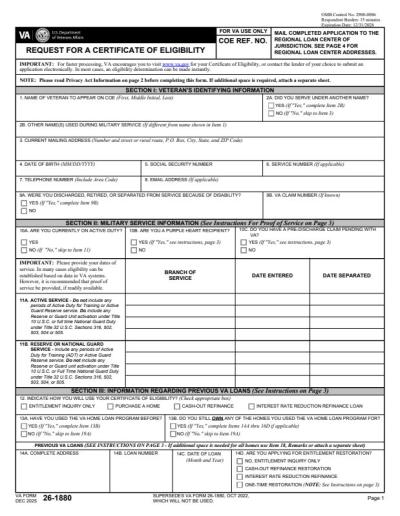 VA Form 26-1880 — Request for a Certificate of EligibilityOfficial VA home loan form used to request a Certificate of Eligibility.
-
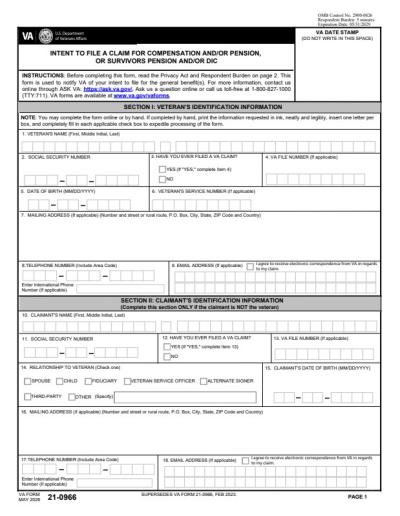 VA Form 21-0966 — Intent to File a Claim for Compensation, Pension, or Survivors BenefitsOfficial VA form used to preserve a potential effective date before filing a full claim.
-
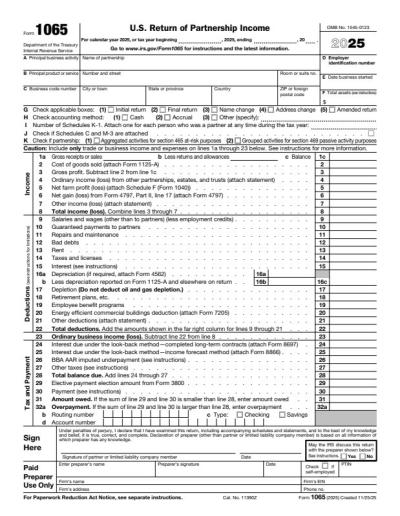 Form 1065U.S. Return of Partnership Income
-
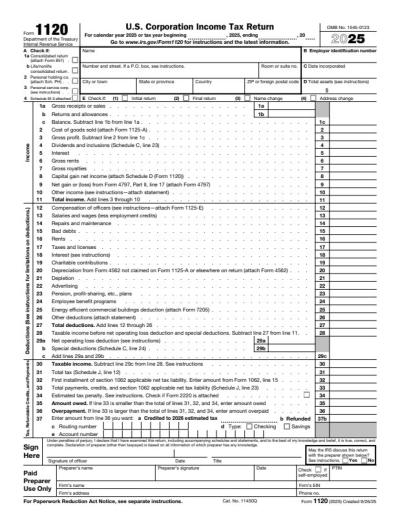 Form 1120U.S. Corporation Income Tax Return