
Form 1120, filled in online.
U.S. Corporation Income Tax Return
Type in the panel and watch each answer land on the page. Filling in and signing is free; downloading needs a free account, which includes 5 downloads a month.
Or fill it another way:
- Category
- Business
- Fillable fields
- 479
- Pages
- 6
- Paper size
- US Letter, 8.5 × 11 in
Five ways to fill this form.
-
Fill it in here
Type in the panel and watch it land on the form. Sign it, then download.
Free to fill and sign Start filling -
Many at once, from a spreadsheet
One row per person, one finished PDF for each.
Paid plan · you can walk through it Start with a spreadsheet -
Send it to someone to fill in
Email a link. They fill it in without an account and you get the answers back.
Paid plan · you can walk through it Send a request -
From your own software
Fill it over the API. One request returns the finished PDF.
Paid plan -
Let an AI assistant do it
Connect ChatGPT or Claude once, then describe what goes on the form.
With a free account
Key facts
| Form number | Form 1120 |
|---|---|
| Official name | U.S. Corporation Income Tax Return |
| Issuing agency | Internal Revenue Service, Department of the Treasury |
| Current revision date | 2024 revision |
| Number of pages | 6 pages |
| Filing frequency | Annually |
| Who generally files | Domestic C corporations and certain entities taxed as corporations |
| Related instructions document | Instructions for Form 1120 (IRS i1120) |
What is this form?
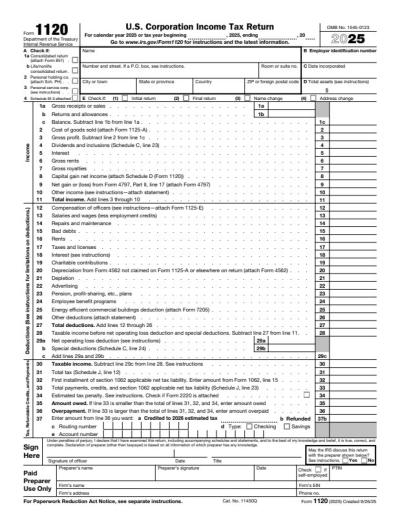
Form 1120 is the IRS's standard corporate income tax return for domestic C corporations. Its official title is Form 1120, U.S. Corporation Income Tax Return. Corporations use it to report gross receipts, deductions, taxable income, tax, credits, payments, and any balance due or overpayment for the tax year. The version used in this template is the 2024 revision of Form 1120.
The return is more than a cover sheet. Page 1 walks through core income, deductions, taxable income, and the final tax or refund calculation on lines 1a through 37. The form then continues with Schedule C for dividends, inclusions, and special deductions; Schedule J for tax computation and payments; Schedule K for other corporate tax questions; and, unless an exception applies, Schedules L, M-1, and M-2 for book balance sheets, reconciliation, and retained earnings. Many corporations also attach supporting forms such as Form 1125-A for cost of goods sold, Form 1125-E for officer compensation, and Form 4562 for depreciation.
In practical terms, Form 1120 tells the IRS how a corporation got from its books to its taxable income and whether it has fully paid its federal income tax. It also acts as the hub return for related international, credit, estimated tax, and corporate alternative minimum tax reporting when those items apply.
Who needs to fill this out?
- Domestic C corporations generally must file Form 1120 every year, even if they have no taxable income and even if they are in bankruptcy.
- Entities that elected corporate tax treatment on Form 8832 must file Form 1120 unless they are required or allowed to use a specialized corporate return instead.
- Corporations engaged in farming usually still use Form 1120 rather than a separate farm return.
- Qualified Opportunity Funds organized as corporations must file Form 1120 and attach Form 8996, even if they had little or no activity.
- Corporations with qualified opportunity investments may need Form 8997 attached to their return.
- Foreign-owned domestic disregarded entities generally do not file a normal income tax return, but a covered entity may have to file a pro forma Form 1120 with Form 5472 attached for section 6038A reporting.
- Who does not file Form 1120: S corporations file Form 1120-S; partnerships and multi-member LLCs taxed as partnerships file Form 1065; disregarded single-member LLCs usually report on the owner's return unless they elected corporate status; and specialized entities may instead file forms such as 1120-F, 1120-L, 1120-PC, 1120-REIT, 1120-RIC, 1120-H, or 990-T.
Where and how to submit
Form 1120 is filed with the IRS, not with shareholders, employees, or a state agency. Most corporations should e-file. The IRS states that, for returns filed on or after January 1, 2024, corporations that file 10 or more returns of any type during the calendar year generally must e-file Form 1120 unless they qualify for a waiver or exemption. If the corporation mails a paper return, the address depends on its principal business location and, in some cases, total assets.
For paper filing, corporations in many eastern states with less than $10 million in total assets and no Schedule M-3 generally mail to Department of the Treasury, Internal Revenue Service, Kansas City, MO 64999-0012. Those same states with $10 million or more in assets or that file Schedule M-3 generally mail to Department of the Treasury, Internal Revenue Service, Ogden, UT 84201-0012. Corporations in western and southern states generally mail to Ogden, UT 84201-0012. A corporation in a foreign country or U.S. possession generally mails to Internal Revenue Service, PO Box 409101, Ogden, UT 84409.
The due date is usually the 15th day of the 4th month after the end of the tax year, with a special June 30 year-end rule discussed below.
How to fill it out
- Step 1 — Header and entity status: Complete the tax year dates at the top, enter the corporation's Name, EIN, address, Date incorporated, and Total assets. Check the boxes in the upper-left area if this is a consolidated return, personal holding company, personal service corporation, or if Schedule M-3 attached applies. In box E, mark whether this is an initial return, final return, name change, or address change.
- Step 2 — Income section, lines 1a through 11: Report Gross receipts or sales on line 1a, subtract Returns and allowances on line 1b to arrive at line 1c, then enter Cost of goods sold on line 2 and attach Form 1125-A if required. Continue through lines 3 to 10 for dividends, interest, rents, royalties, capital gain net income, Form 4797 gains, and other income. Add those items on line 11 Total income.
- Step 3 — Deductions and taxable income, lines 12 through 30: Complete deductions for Compensation of officers on line 12, Salaries and wages on line 13, and the remaining deductions through line 26, including Depreciation on line 20 with Form 4562 attached when required. Add lines 12 through 26 for line 27 Total deductions, compute line 28, then enter any Net operating loss deduction on line 29a and Special deductions from Schedule C, line 24 on line 29b. The result is line 30 Taxable income.
- Step 4 — Schedule C dividends and special deductions: If the corporation received dividends or inclusions, complete Schedule C, lines 1 through 24. This schedule feeds back into page 1 because Schedule C, line 23 goes to page 1, line 4 Dividends and inclusions, and Schedule C, line 24 goes to page 1, line 29b Special deductions. If you claim a dividends received deduction, confirm the percentage category and any limitation before carrying totals back.
- Step 5 — Schedule J tax, credits, and payments: Compute the corporation's tax on Schedule J. Enter regular tax on line 1a, add any other chapter 1 taxes or CAMT items where applicable, then subtract credits on lines 5a through 6. The final Schedule J, line 12 Total tax carries to page 1, line 31. Then finish the payments section on Schedule J, lines 13 through 23; line 23 Total payments and credits carries to page 1, line 33.
- Step 6 — Schedule K other information and required attachments: Answer every applicable yes/no question on Schedule K, questions 1 through 31, including accounting method, ownership disclosures, foreign ownership, Forms 1099 compliance, digital asset question 27, and corporate alternative minimum tax questions 29a through 29c. These answers often trigger attachments such as Schedule G, Form 5472, Form 8990, Form 8991, Form 8996, Form 4626, or Form 7208.
- Step 7 — Book schedules, balance due or refund, and signature: Unless Schedule K, question 13 lets the corporation skip them, complete Schedule L, Schedule M-1, and Schedule M-2. Back on page 1, enter any Estimated tax penalty on line 34 if Form 2220 applies, then compute Amount owed on line 35 or Overpayment on line 36. Decide how much to credit to next year or refund on line 37, then have an authorized officer sign and date the return. If a paid preparer completed the return, the preparer section must also be completed.
Important deadlines & penalties
- General due date: Form 1120 is generally due on the 15th day of the 4th month after the end of the corporation's tax year. A calendar-year corporation typically files by April 15.
- June 30 year-end corporations: If the corporation's tax year ends on June 30, the return is generally due on the 15th day of the 3rd month after year-end, which is typically September 15.
- Weekend or holiday rule: If the due date falls on a Saturday, Sunday, or legal holiday, filing on the next business day is timely.
- Extension: File Form 7004 by the original due date to request an automatic extension. Most corporations get an automatic 6-month extension to file. Under current IRS Form 7004 guidance, certain June 30 C corporations may qualify for a 7-month extension. An extension to file is not an extension to pay.
- Late filing penalty: If tax is due, the IRS generally charges 5% of the unpaid tax for each month or part of a month the return is late, up to 25%. For returns required to be filed in 2025, the minimum penalty for a return filed more than 60 days late is generally the lesser of the tax due or $510.
- Late payment penalty: The IRS generally charges 0.5% of unpaid tax per month, up to 25%, plus interest. If both late-filing and late-payment penalties apply in the same month, the combined penalty is generally capped at 5% for that month.
- Estimated tax penalty: A corporation may owe an estimated tax penalty reported on page 1, line 34 if required estimated payments were not made. Use Form 2220 to determine whether the penalty applies and to compute it.
Common mistakes to avoid
- Reporting gross receipts incorrectly on lines 1a to 1c: Some filers put net sales on line 1a and leave line 1b blank. That distorts the form's required gross-to-net presentation and can create mismatch issues if the IRS compares books or other filings.
- Claiming cost of goods sold on line 2 without supporting Form 1125-A: If inventory or production costs apply, line 2 often needs a properly completed attachment. Missing backup can delay processing or trigger an IRS notice.
- Forgetting to tie Schedule C back to page 1: Schedule C, line 23 must flow to page 1, line 4, and Schedule C, line 24 must flow to page 1, line 29b. If those numbers do not match, taxable income on line 30 will be wrong.
- Putting officer pay in the wrong place: Compensation of officers belongs on line 12, while general payroll goes on line 13 Salaries and wages. Misclassification can cause inconsistencies with Form 1125-E and other payroll records.
- Taking depreciation on line 20 without Form 4562 when required: Line 20 specifically references Form 4562. Missing or inconsistent depreciation schedules can lead to disallowed deductions or IRS correspondence.
- Skipping Schedule K questions that trigger attachments: Questions such as 7 (25% foreign ownership), 15a/15b (Forms 1099), 27 (digital assets), and 29a-29c (CAMT) are not boilerplate. An incomplete answer can mean a missing Form 5472, Form 8990, Form 8991, Form 4626, or other required attachment, which can carry separate penalties.
- Leaving Schedules L, M-1, and M-2 blank without qualifying under Schedule K, question 13: Only smaller corporations meeting the receipts-and-assets test can skip those schedules. If you do not qualify, omitting them leaves the return incomplete and may invite an IRS follow-up.
Expert tips
- Use the corporation's books to map each page 1 line before you start typing: Form 1120 is easier when you first group trial-balance accounts into lines 1a through 10 and lines 12 through 26.
- Check Schedule K, question 13 early: If total receipts and total assets are each under $250,000, the corporation may not need Schedules L, M-1, and M-2. That can save time, but only if the threshold is clearly met.
- Review ownership questions before filing: Schedule K questions 4, 5, and 7 regularly trigger overlooked disclosures. If ownership changed during the year, confirm whether Schedule G or Form 5472 is needed before finalizing the return.
- Do not wait until the end to compute Schedule J: Credits on Schedule J lines 5a through 6 can materially change the amount due, and payment entries on lines 13 through 23 need to match EFTPS, deposits with Form 7004, and refund claims.
- Use Form 2220 proactively: Even if the corporation expects a refund, it can still owe an estimated tax penalty. Checking this before filing helps avoid an unexpected IRS bill after processing.
- Match line 12 to Form 1125-E and line 20 to Form 4562: These two support forms are frequent audit trail checkpoints. If the attachments do not reconcile to the return, fix that before submission.
- Use IRS instructions and e-file validations together: The Instructions for Form 1120, the IRS e-file rules, and the official where-to-file page are often more useful than third-party summaries because they reflect current attachment and mailing rules.
Related forms & next steps
- Form 7004 — requests an automatic extension of time to file Form 1120.
- Form 1125-A — reports cost of goods sold that flows to page 1, line 2.
- Form 1125-E — supports compensation of officers reported on page 1, line 12.
- Schedule D (Form 1120) — reports capital gains and losses for corporations.
- Form 2220 — calculates underpayment of estimated tax penalties that may be reported on line 34.
- Form 5472 — required for certain 25% foreign-owned U.S. corporations and foreign-owned domestic disregarded entities.
- Form 4626 — calculates corporate alternative minimum tax when Schedule K questions 29a through 29c require it.
- Instructions for Form 1120 — the IRS line-by-line instruction booklet for this return.
Frequently asked questions
Who has to file Form 1120 if the corporation had no income?
Most domestic C corporations still must file Form 1120 even when they had no taxable income for the year. The filing requirement is based on corporate status, not just profit.
When is Form 1120 due for a calendar-year corporation?
For a calendar-year corporation, Form 1120 is generally due on April 15. Fiscal-year corporations usually file by the 15th day of the 4th month after year-end, except corporations with a June 30 year-end generally file by September 15.
Can I get an extension for Form 1120?
Yes. File Form 7004 by the original due date to request an automatic extension of time to file. The extension usually gives the corporation 6 more months to file, but tax still must be paid by the original due date to limit penalties and interest.
Do small corporations have to complete Schedules L, M-1, and M-2?
Not always. If the corporation answers yes to Schedule K, question 13 because its total receipts and total assets are each under $250,000, it is generally not required to complete Schedules L, M-1, and M-2. Corporations above that threshold usually must complete them.
What happens if Form 1120 is filed late?
If tax is due, the IRS can assess a late-filing penalty of 5% of unpaid tax per month, up to 25%, plus a late-payment penalty of 0.5% per month and interest. A separate estimated tax penalty may also apply if required installments were not paid.
Does Form 1120 have to be e-filed?
Often, yes. For returns filed on or after January 1, 2024, corporations that file 10 or more returns of any type during the calendar year generally must e-file Form 1120 unless an IRS waiver or exemption applies.
Can I create Form 1120 in bulk?
Yes. PDFengine supports bulk generation of Form 1120 via Excel or CSV upload — upload a spreadsheet with one row per entry and PDFengine generates all PDFs at once. You can also automate bulk creation programmatically via the PDFengine API.
Ready to fill it in?
Fill in this formOfficial sources
- IRS Form 1120 (2024) — official 2024 form showing page layout, line numbers, and schedules.
- IRS Instructions for Form 1120 — official filing rules, due dates, e-file requirements, and line-by-line guidance.
- IRS where to file Form 1120 — official mailing addresses for paper-filed returns.
- IRS About Form 7004 — official extension form overview for requesting extra time to file.
- IRS About Form 2220 — official overview of estimated tax underpayment penalties for corporations.
More forms in this category
-
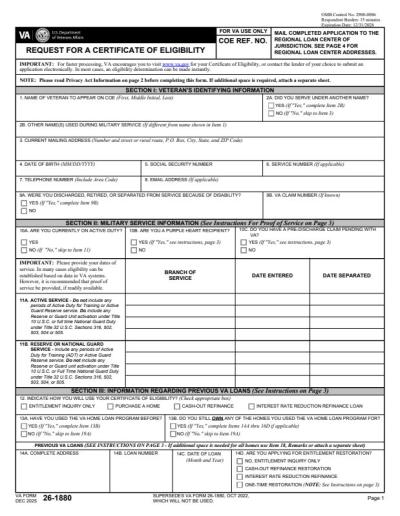 VA Form 26-1880 — Request for a Certificate of EligibilityOfficial VA home loan form used to request a Certificate of Eligibility.
-
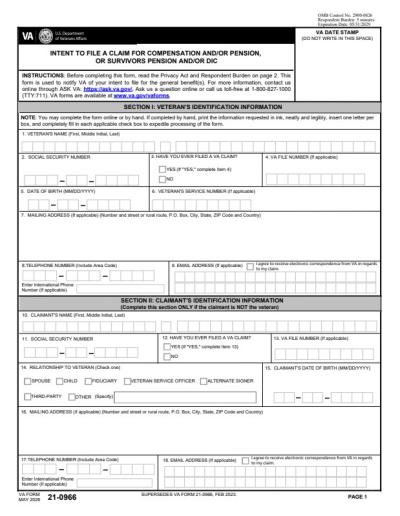 VA Form 21-0966 — Intent to File a Claim for Compensation, Pension, or Survivors BenefitsOfficial VA form used to preserve a potential effective date before filing a full claim.
-
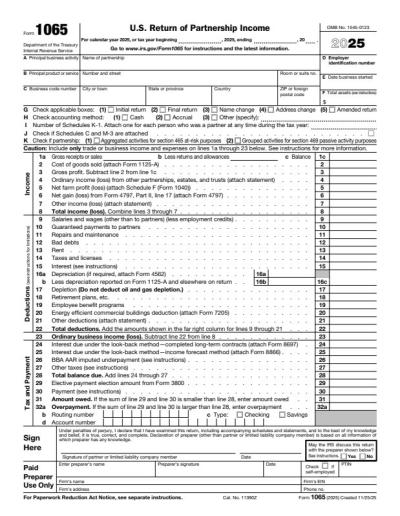 Form 1065U.S. Return of Partnership Income
-
 Form 1120-SU.S. Income Tax Return for an S Corporation