
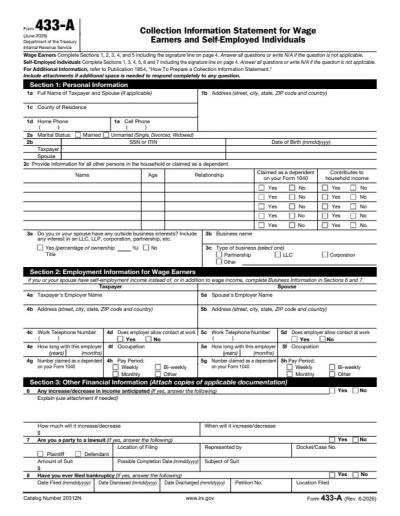
Form 433-A, filled in online.
Collection Information Statement for Wage Earners and Self-Employed
Type in the panel and watch each answer land on the page. Filling in and signing is free; downloading needs a free account, which includes 5 downloads a month.
Or fill it another way:
- Category
- Government
- Fillable fields
- 506
- Pages
- 8
- Paper size
- US Letter, 8.5 × 11 in
Five ways to fill this form.
-
Fill it in here
Type in the panel and watch it land on the form. Sign it, then download.
Free to fill and sign Start filling -
Many at once, from a spreadsheet
One row per person, one finished PDF for each.
Paid plan · you can walk through it Start with a spreadsheet -
Send it to someone to fill in
Email a link. They fill it in without an account and you get the answers back.
Paid plan · you can walk through it Send a request -
From your own software
Fill it over the API. One request returns the finished PDF.
Paid plan -
Let an AI assistant do it
Connect ChatGPT or Claude once, then describe what goes on the form.
With a free account
Key facts
| Form number | Form 433-A |
|---|---|
| Official name | Collection Information Statement for Wage Earners and Self-Employed Individuals |
| Issuing agency | Internal Revenue Service (Department of the Treasury) |
| Current revision date | June 2026 |
| Number of pages | 8 pages |
| Filing frequency | As requested in a collection case; not an annual return |
| Related instructions document | Publication 1854, How to Prepare a Collection Information Statement |
| Business form counterpart | Form 433-B for corporations, partnerships, and other non-sole-proprietor businesses |
What is this form?
Form 433-A, Collection Information Statement for Wage Earners and Self-Employed Individuals, is the IRS financial disclosure form used in collections cases to measure a taxpayer's ability to pay an assessed tax debt. The June 2026 revision asks for a detailed picture of household income, living expenses, cash, investments, credit, real estate, vehicles, digital assets, and—if applicable—business income and assets. IRS Collection, Appeals, or a revenue officer may request it when you are seeking an installment agreement, asking for currently not collectible status, responding to enforced-collection activity, or proposing another collection alternative.
The form is organized by functional sections rather than tax-return schedules. Section 1 collects personal and household data, Section 2 covers wage-earner employment details, Section 3 asks about lawsuits, bankruptcy, foreign residence, incarceration, and asset transfers, and Section 4 inventories personal assets such as bank accounts, investments, digital assets, life insurance, real property, vehicles, and other valuable property. Section 5 is the monthly income and expense statement that the IRS uses to compare actual spending with allowable standards.
If you are self-employed, the form goes further. Section 6 reports business information and business assets, and Section 7 breaks out monthly business income and expenses line by line, ending with line 90, Net Business Income. Line 52 also tells non-sole-proprietor businesses not to continue with the business sections and instead complete Form 433-B. Because the certification is signed under penalties of perjury, Form 433-A is not a casual worksheet—it is a sworn financial statement for IRS collection analysis.
Who needs to fill this out?
- Individuals who owe federal tax on Form 1040 and are asked by the IRS to provide a collection financial statement.
- Wage earners seeking a collection alternative and completing Sections 1, 2, 3, 4, and 5.
- Self-employed individuals, including sole proprietors and independent contractors, completing Sections 1, 3, 4, 5, 6, and 7.
- Taxpayers with both wages and self-employment income, who must complete Sections 1 through 7.
- Individuals who may be responsible persons for a Trust Fund Recovery Penalty, personally liable for a partnership debt, or owners of a disregarded single-member LLC, as described in IRS Publication 1854.
- People pursuing collection alternatives in Appeals, such as after filing Form 12153, when Appeals asks for financials to evaluate payment options.
- Who does not file Form 433-A: corporations, partnerships, multi-member LLCs, and other non-sole-proprietor businesses that line 52 directs to Form 433-B; taxpayers whose IRS contact specifically requests the shorter Form 433-F instead; and taxpayers filing a regular annual income tax return without any IRS collection request.
Where and how to submit
Form 433-A is submitted to the IRS, not to an employer, bank, or state tax agency. There is no single universal national mailing address printed on Form 433-A. In practice, you send it to the IRS function that requested it: the address or fax number shown on the IRS notice, the assigned revenue officer, or IRS Appeals if the form is being supplied with a Collection Due Process package such as Form 12153. If the IRS letter gives a fax number or upload instruction, use that exact contact point because collection cases are routed by office.
The IRS does not offer routine Modernized e-File filing for Form 433-A the way it does for income tax returns. Submission is usually by mail, fax, or direct delivery to the requesting IRS employee or unit. There is also no annual calendar filing deadline built into the form itself. Instead, the deadline is the date in the IRS letter, levy notice, Appeals request, or revenue officer instruction.
If you are using Form 433-A to support a collection appeal, include it as early as possible so the IRS can evaluate your proposed payment arrangement without delaying the case.
How to fill it out
- Step 1 — Section 1: Personal Information: Enter the taxpayer and spouse names on line 1a, full address on line 1b, county on line 1c, phone numbers on lines 1d and 1e, marital status on line 2a, SSN or ITIN and dates of birth on line 2b, household members on line 2c, and any outside business interests on lines 3a through 3c, including ownership percentage, title, business name, and entity type.
- Step 2 — Section 2: Employment Information for Wage Earners: If you are a wage earner, complete lines 4a through 4h for the taxpayer and lines 5a through 5h for the spouse. Use the employer name, address, work phone, whether contact at work is allowed, time with employer, occupation, dependents claimed, and pay period exactly as requested. If you also have self-employment income, do not stop here—continue through Sections 6 and 7 as the form instructs.
- Step 3 — Section 3: Other Financial Information: Answer every yes/no item and complete the follow-up boxes. That includes anticipated income changes on line 6, lawsuits on line 7, bankruptcy history on line 8, passport and foreign-residence questions on lines 8a through 8c, incarceration on line 9a, safe-deposit boxes on line 10, and asset transfers over $10,000 for less than full value on line 11.
- Step 4 — Section 4: Personal Asset Information: Report cash on hand on line 12; personal bank accounts on lines 13a through 13e; investments on lines 14a through 14d; digital assets on lines 15a through 15e; available credit on lines 16a through 16e; life insurance cash value on line 17; real property on lines 18a through 18d; personal vehicles on lines 19a through 19d; and other personal assets on lines 20a through 20c. Use the requested "as of" dates, account numbers, current fair market values, loan balances, and equity fields.
- Step 5 — Sections 6 and 7: Business Information for Sole Proprietors: If you are self-employed, answer line 52 first. If the business is not a sole proprietorship filing Schedule C, line 52 says to complete Form 433-B instead. Otherwise, enter the business profile on lines 53 through 61, payment processors on lines 62a and 62b, credit cards accepted on lines 63a through 63c, business cash and bank accounts on lines 64 through 65c, receivables on lines 66a through 66f, and business assets on lines 67a through 67c.
- Step 6 — Section 7: Sole Proprietorship Income and Expenses: Use the prior 3, 6, 9, or 12 months to determine typical monthly activity. Enter income on lines 68 through 76, total it on line 77, enter business expenses on lines 78 through 88, total them on line 89, and compute line 90, Net Business Income. The section should reconcile with your profit and loss records, and the monthly net business income should flow to line 24 in Section 5.
- Step 7 — Section 5 and Certification: Complete monthly income lines 21 through 35 and living-expense lines 36 through 50, then calculate line 51, Net difference. Use gross wages on lines 21 and 22, not take-home pay, and follow the footnotes for line 24, line 25, and standard-expense items. Finally, sign and date the certification below line 51; for joint liabilities, both spouses should sign.
Important deadlines & penalties
- No fixed annual due date: Form 433-A is filed only when the IRS asks for it in a collection matter; it is not due on April 15 and is not attached to a normal annual Form 1040 filing unless specifically requested in a collection package.
- IRS-requested deadline controls: if a notice, revenue officer, or Appeals letter gives you a return-by date, that is the deadline that matters. Missing it can cause the IRS to decide your request without the form or to continue enforced collection.
- Letter 3172 lien cases: IRS Appeals states you generally have 30 days from Letter 3172, Notice of Federal Tax Lien Filing and Your Right to a Hearing, to request a CDP hearing on Form 12153. If you want Appeals to consider collection alternatives, Form 433-A is often part of that package.
- LT11 or L-1058 levy cases: IRS Appeals states you have 30 days from receipt of LT11 or L-1058, Final Notice of Intent to Levy and Notice of Your Right to a Hearing, to request a CDP hearing. Supplying Form 433-A promptly helps Appeals review installment agreement or other payment proposals.
- No automatic extension form: there is no IRS extension application dedicated to Form 433-A. If you need more time, you must contact the IRS employee or unit that requested it before the deadline.
- Late or missing submission consequences: the IRS does not publish a stand-alone late-filing penalty schedule for Form 433-A, but failing to provide it can lead to denial or delay of an installment agreement or other relief, while the underlying tax debt continues to accrue interest and any applicable tax penalties.
- False information penalties: the certification is signed under penalties of perjury. Willfully signing a materially false statement can trigger criminal exposure under IRC section 7206(1), which the IRS describes as carrying a fine of up to $100,000 for individuals and imprisonment for up to 3 years, plus prosecution costs.
Common mistakes to avoid
- Using net pay instead of gross pay on lines 21 and 22: the footnote under Section 5 says to enter gross monthly wages and not subtract withholding or payroll deductions. Using take-home pay understates ability to pay and can cause the IRS to challenge the form or request new pay records.
- Leaving digital assets off lines 15a through 15e: the June 2026 form specifically asks for virtual currency, NFTs, smart contracts, exchanges, wallets, and related access information. Omitting these items can make the statement incomplete and raise credibility issues during review.
- Skipping zero-balance or online accounts on lines 13 and 65: the form and Publication 1854 say to include all checking, savings, online/mobile accounts, and stored-value cards even if there is currently no balance. Missing dormant accounts is a common reason the IRS asks for a corrected submission.
- Entering a negative amount for business or rental losses: the footnotes for line 24 and line 25 instruct taxpayers to enter 0 rather than a negative number when net business income or net rental income is a loss. Negative entries can break the form's cash-flow analysis and delay evaluation.
- Completing Sections 6 and 7 for the wrong business type: line 52 says all business entities other than a sole proprietorship filing Schedule C must complete Form 433-B. Using Form 433-A for a corporation, partnership, or non-disregarded LLC can cause the IRS to reject the financial package.
- Double-counting expenses between Section 5 and Section 7: footnote 6 in Section 7 warns that duplicated deductions, such as home-office costs already included in housing and utilities, must be eliminated. Double counting inflates expenses and can lead to a lower allowable amount after IRS review.
- Failing to reconcile line 90 with line 24 and your records: Section 7 says lines 68 through 88 should reconcile with the business profit and loss statement. If line 90 does not match the monthly figure carried into Section 5 or your supporting P&L, the IRS will usually ask for clarification or updated books.
Expert tips
- Use the IRS wage multipliers exactly: Section 5 footnote 1 says weekly wages are multiplied by 4.3, biweekly wages by 2.17, and semimonthly wages by 2. Using the wrong multiplier is one of the easiest ways to distort monthly income.
- Build Section 7 from a real averaging period: the form tells sole proprietors to use the prior 3, 6, 9, or 12 months. Pick one period and keep the math consistent across lines 68 through 90 so the totals can be traced to bank deposits and bookkeeping reports.
- Use Publication 1854 for standard-expense items: lines 36 and 42 rely on IRS standards for food, clothing, miscellaneous, and out-of-pocket health care. If you claim more than the standard where substantiation is required, be ready to prove it with bills and statements.
- List every person with wallet access for digital assets: line 15 asks for individuals who have access to private keys or digital wallets, and Publication 1854 says to attach a statement with each virtual currency's public key if applicable. That extra attachment can prevent a follow-up document request.
- Include shared-household context correctly: Publication 1854 explains that when only one spouse owes the tax but both spouses share income and expenses, the IRS may still look at total household finances, especially in community-property states. Prepare the household numbers before you start the form.
- Keep "as of" dates recent and consistent: many asset lines ask for balances as of a specific date. Use recent statements and make sure the dates on lines 13, 14, 16, 18, 19, 20, 65, and 67 tie back to your attachments.
- Attach support before the IRS asks twice: the form says the IRS may request verification after review, and common support includes pay stubs, bank statements, loan statements, tax returns, recurring bills, and self-employment records. Sending a complete package up front usually speeds up collection-case review.
Related forms & next steps
- Form 433-B — Collection Information Statement for Businesses; required by line 52 for corporations, partnerships, and other non-sole-proprietor businesses.
- Form 433-F — shorter Collection Information Statement sometimes requested instead of Form 433-A.
- Form 9465 — Installment Agreement Request; the IRS may still require a financial statement such as Form 433-A for larger or more complex cases.
- Form 12153 — Request for a Collection Due Process or Equivalent Hearing; Form 433-A often supports proposed collection alternatives in Appeals.
- Form 656-B booklet — Offer in Compromise booklet; related when a taxpayer is evaluating collection alternatives and financial disclosure requirements.
- Publication 1854 — official IRS instructions for preparing a Collection Information Statement, including Form 433-A.
- Publication 594 — The IRS Collection Process; explains liens, levies, and how financial statements fit into collection review.
Frequently asked questions
What is Form 433-A used for?
It is the IRS financial statement used to evaluate how an individual taxpayer can resolve an assessed tax debt. Collection and Appeals use it to review assets, monthly cash flow, and business finances before deciding whether to accept an installment agreement, delay collection, or consider another alternative.
Is Form 433-A filed with my annual tax return?
No. Form 433-A is not a regular annual return attachment. You submit it only when the IRS asks for it in a collection matter or when you provide it proactively to support a collection alternative request.
What is the difference between Form 433-A and Form 433-F?
Form 433-A is the more detailed statement for wage earners and self-employed individuals, especially when business assets, digital assets, or complex finances are involved. Form 433-F is a shorter collection statement the IRS sometimes uses in less complex cases.
Do I need to report cryptocurrency and other digital assets on Form 433-A?
Yes. The June 2026 revision has a dedicated digital-assets area at lines 15a through 15e. It asks for the type of digital asset, the exchange or wallet, the email used to set it up, the storage location, and the value in U.S. dollars as of a stated date.
Can I use Form 433-A for my LLC or corporation?
Only if the business is effectively being reported as your sole proprietorship for this form. Line 52 says that if the business is not a sole proprietorship filing Schedule C, you should complete Form 433-B instead. That is the correct collection form for corporations, partnerships, and other business entities.
What documents should I gather before filling out Form 433-A?
Have recent pay stubs, bank statements, loan statements, bills for recurring expenses, prior tax returns, bookkeeping reports, and profit-and-loss records if you are self-employed. The form itself says the IRS may ask for verification of assets, encumbrances, income, and expenses after review.
Can I create Form 433-A in bulk?
Yes. PDFengine supports bulk generation of Form 433-A via Excel or CSV upload — upload a spreadsheet with one row per entry and PDFengine generates all PDFs at once. You can also automate bulk creation programmatically via the PDFengine API.
Ready to fill it in?
Fill in this formOfficial sources
- IRS Form 433-A — official June 2026 form showing sections, line numbers, certification, and business-form crossover rules.
- IRS Publication 1854 — official preparation guide explaining who uses Form 433-A, allowable standards, and section-by-section instructions.
- IRS Collection Due Process FAQs — official Appeals guidance on when financial statements such as Form 433-A are needed and the 30-day CDP timelines.
- IRS Publication 594 — official overview of the IRS collection process, including liens, levies, and installment-agreement review.
- IRS penalty discussion under IRC sections 6702 and 7206 — official IRS explanation of frivolous-submission penalties and penalties for false statements signed under penalties of perjury.
More forms in this category
-
 CBP Form 6059B — Customs DeclarationOfficial U.S. Customs and Border Protection arrival declaration form for travelers enterin...
-
 CBP Form 7501 — Entry SummaryOfficial U.S. Customs and Border Protection form used to summarize imported merchandise en...
-
 CBP Form 3461 — Entry/Immediate DeliveryOfficial U.S. Customs and Border Protection form for entry and immediate delivery of impor...
-
 CBP Form 3299 — Declaration for Free Entry of Unaccompanied ArticlesOfficial U.S. Customs and Border Protection form for claiming free entry of unaccompanied...