
Form 56, filled in online.
Notice Concerning Fiduciary Relationship
Type in the panel and watch each answer land on the page. Filling in and signing is free; downloading needs a free account, which includes 5 downloads a month.
Or fill it another way:
- Category
- Government
- Fillable fields
- 72
- Pages
- 2
- Paper size
- US Letter, 8.5 × 11 in
Five ways to fill this form.
-
Fill it in here
Type in the panel and watch it land on the form. Sign it, then download.
Free to fill and sign Start filling -
Many at once, from a spreadsheet
One row per person, one finished PDF for each.
Paid plan · you can walk through it Start with a spreadsheet -
Send it to someone to fill in
Email a link. They fill it in without an account and you get the answers back.
Paid plan · you can walk through it Send a request -
From your own software
Fill it over the API. One request returns the finished PDF.
Paid plan -
Let an AI assistant do it
Connect ChatGPT or Claude once, then describe what goes on the form.
With a free account
Key facts
| Item | Details |
|---|---|
| Form number | Form 56 |
| Official name | Notice Concerning Fiduciary Relationship |
| Issuing agency | Internal Revenue Service, Department of the Treasury |
| Current revision date | Rev. June 2026 |
| Number of pages | 2 pages |
| Filing frequency | As needed when a fiduciary relationship is created, terminated, or partially revoked |
| Who files | Fiduciaries acting for an individual, estate, trust, business, or other entity before the IRS |
| Related instructions document | Instructions for Form 56 (Rev. June 2026) |
What is this form?
Form 56, officially titled Notice Concerning Fiduciary Relationship, is the IRS notice a fiduciary uses to tell the government that the filer now stands in the taxpayer's place for federal tax matters, or that the fiduciary relationship has ended. The form is used under Internal Revenue Code sections 6903 and 6036. Typical filers include executors, administrators, trustees, guardians, conservators, receivers, and assignees for the benefit of creditors. The current IRS form available on IRS.gov is Form 56 (Rev.
June 2026), a two-page form.
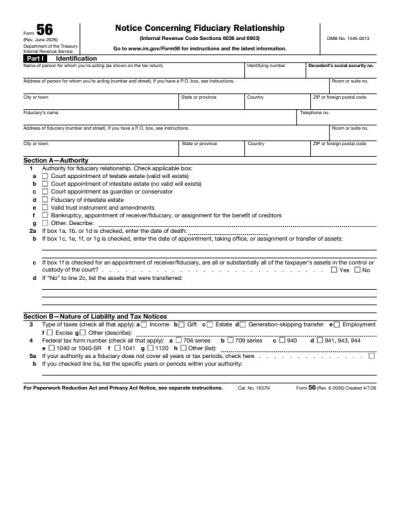
Page 1 contains Part I—Identification, where you identify both the person or entity for whom you're acting and the fiduciary, then complete Section A—Authority and Section B—Nature of Liability and Tax Notices. Those sections tell the IRS why you have authority, when the authority began, what tax types are involved, and which federal tax forms and years fall within your authority.
Page 2 contains Part II—Revocation or Termination of Notice, Part III—Court and Administrative Proceedings, and Part IV—Signature. Part II is used when a prior fiduciary notice must be revoked or ended, including total revocation, partial revocation, or substitution of a new fiduciary. Part III is completed only for certain court or agency proceedings, such as receiverships or other nonbankruptcy appointments, and Part IV is the signed declaration made under penalties of perjury.
Who needs to fill this out?
- Executors and court-appointed personal representatives of a decedent's estate should file Form 56 when they want the IRS to recognize the fiduciary relationship for the decedent, the estate, or both. The instructions specifically note that if you will file the decedent's final Form 1040 and also act for the estate, you may need separate Form 56 filings for the decedent and for the estate.
- Administrators of intestate estates, including a court-appointed administrator under line 1b or, in limited cases, the sole person charged with property of a decedent under line 1d, must file when they seek to act for the taxpayer before the IRS.
- Trustees named under a valid trust instrument, guardians, custodians, conservators, receivers, and similar fiduciaries should file once the fiduciary relationship is created and they need to deal with IRS matters for the person or entity they represent.
- Receivers and assignees for the benefit of creditors also use Form 56 to give notice of qualification under section 6036. For these filers, the instructions impose a special timing rule: the form must be filed on or within 10 days of the date of appointment.
- Fiduciaries for corporations, partnerships, trusts, and other terminating entities may file before the entity terminates so the fiduciary can continue representing the entity on tax matters after termination.
- Who does not use Form 56: an authorized representative acting only by permission of the taxpayer should use Form 2848, not Form 56. The instructions also say Form 56 cannot be used to change the taxpayer's last known address; address changes belong on Form 8822 or Form 8822-B.
- Who generally does not need to file: a person who is not seeking to act before the IRS in a fiduciary capacity, or a bankruptcy trustee, debtor-in-possession, or similar fiduciary in a bankruptcy proceeding who is not required to give notice of qualification under section 6036 because bankruptcy notice rules apply separately under title 11.
Where and how to submit
Form 56 is filed with the Internal Revenue Service Center where the person or entity for whom you're acting is required to file tax returns. The IRS instructions give Form 1040 as an example and direct filers to the underlying return instructions to find the correct mailing address. In other words, the right mailing address depends on the taxpayer being represented and the return type involved. The form is sent to the IRS, not to an employer, bank, probate court, or state tax agency.
There is one special address in the instructions. A fiduciary acting as a receiver in a receivership proceeding, similar fiduciary, or assignee for the benefit of creditors must file Form 56 with the insolvency function at Internal Revenue Service, Insolvency MS 5027 DAL, Dallas, TX 75242, and must do so on or within 10 days of appointment. The IRS MeF forms list also includes Form 56, so electronic filing may be available through supported authorized e-file software, but paper filing remains the default method described in the instructions. There is no employer copy or beneficiary copy; the notice goes to the IRS so future tax notices can be directed appropriately.
How to fill it out
- Step 1 — Part I, Identification: Enter the name, identifying number, address, and telephone number for the person for whom you're acting, then complete the same items for the fiduciary. Use the decedent's SSN or ITIN if you are acting for a decedent, and use an EIN for a non-individual entity when required by the instructions.
- Step 2 — Section A, line 1a through line 1g: Check the box that matches your authority. Use line 1a for a testate estate, line 1b for an intestate estate with court appointment, line 1c for guardian or conservator, line 1d for certain intestate estates without court appointment, line 1e for a trust, line 1f for bankruptcy, receiver, fiduciary, or assignment for the benefit of creditors, and line 1g for other authority. If you check line 1g, describe the authority in the space provided.
- Step 3 — Section A, line 2a through line 2d: Enter the date of death on line 2a only when lines 1a, 1b, or 1d apply. Enter the date of appointment, taking office, assignment, or transfer of assets on line 2b when lines 1c, 1e, 1f, or 1g apply. If you checked line 1f as a court-appointed receiver or fiduciary, answer line 2c to show whether all or substantially all assets are in the control or custody of the court, and if the answer is No, list transferred assets on line 2d.
- Step 4 — Section B, line 3 and line 4: Mark the tax types on line 3a through 3g, such as income, gift, estate, generation-skipping transfer, employment, excise, or other. Then check the specific federal tax form numbers on line 4a through 4h, including forms in the 706 series, 709 series, 940, 941/943/944, 1040 or 1040-SR, 1041, 1120, or another form you list on line 4h.
- Step 5 — Section B, line 5a and line 5b: If your authority does not cover every tax year or period, check line 5a and list the exact years or periods on line 5b. This is where you narrow the scope of the notice so the IRS knows exactly which years, quarters, or returns fall within your fiduciary authority.
- Step 6 — Part II, line 6 through line 8: Complete this part only if you are revoking or terminating an earlier notice. Use line 6a for total revocation or termination, identify the basis on line 6b, 6c, or 6d, use line 7a and 7b for a partial revocation, and use line 8 if a new fiduciary has been or will be substituted, listing the substitute fiduciary's name and address.
- Step 7 — Part III and Part IV: Complete Part III only if you were appointed a receiver, trustee, or fiduciary by a court or governmental unit in a proceeding other than bankruptcy. Enter the name of court, date proceeding initiated, address of court, docket number, and the date, time, and place of the proceeding. Then sign in Part IV as the fiduciary's signature and enter your title, such as executor, trustee, guardian, receiver, or personal representative.
Important deadlines & penalties
- General timing rule: The instructions say you should generally file Form 56 when you create or terminate a fiduciary relationship. There is no once-a-year filing date like April 15 unless that date also happens to be when the relationship begins or ends.
- Special 10-day deadline: A fiduciary appointed or authorized as a receiver, similar fiduciary, or assignee for the benefit of creditors must file Form 56 on or within 10 days of the date of appointment with the IRS insolvency function.
- No automatic extension listed in the instructions: The Form 56 instructions do not provide a separate extension form or automatic extension deadline for filing the notice itself. If you miss the proper timing, the IRS may treat the notice as not properly given until complete information is provided.
- Penalty and consequence rule on the notice itself: The instructions state that if you do not provide the requested information, the IRS may suspend processing and may not consider the filing proper notification until the information is supplied. They also state that providing false information may subject you to penalties.
- Related return penalties still matter: Because a fiduciary steps into the taxpayer's place, failing to file the underlying return on time can trigger ordinary IRS late-filing penalties. For individuals and most business returns, the IRS states the failure-to-file penalty is generally 5% of unpaid tax for each month or part of a month, up to 25%.
- Minimum late-filing penalty for Forms 1040 and 1120: If a return is more than 60 days late and its due date is after December 31, 2025, the minimum failure-to-file penalty is generally $525 or 100% of the unpaid tax, whichever is less.
- Late-payment penalty on the underlying tax: If the tax shown on the return is not paid when due, the IRS generally charges 0.5% of unpaid tax per month, up to 25%, and interest also accrues. An installment agreement may reduce that monthly rate to 0.25% while the agreement is in effect.
Common mistakes to avoid
- Using Form 56 instead of Form 2848: The IRS draws a sharp line between a fiduciary and an authorized representative. Filing Form 56 when you only have representation authority can lead to rejected or ineffective notice and delay IRS communications.
- Failing to file separate notices for a decedent and the estate: The instructions explain that an executor handling the decedent's final Form 1040 and the estate's tax matters may need one Form 56 for the decedent and another for the estate. Combining them on one notice can confuse the taxpayer identity and SSN/EIN records.
- Checking the wrong authority box on line 1: For example, marking line 1d for an intestate estate when there is already a court-appointed administrator contradicts the instructions. That can cause the IRS to question your authority and ask for proof.
- Entering the wrong identifying number in Part I: Filers often use the estate EIN where the form is asking for the decedent's SSN, or vice versa. A mismatch between the taxpayer name and identifying number can prevent proper routing of notices and transcripts.
- Skipping line 2c and line 2d for a receiver or court-appointed fiduciary: If you check line 1f as a receiver or fiduciary, the instructions specifically require the assets-in-custody answer on line 2c and a transferred-assets description on line 2d when the answer is No. Leaving those blank makes the filing incomplete.
- Leaving Section B too broad or too vague: Not checking the right tax type on line 3, the right form number on line 4, or the right limited years on line 5b can result in notices being sent for the wrong taxes or periods, or not sent for the periods you actually control.
- Using Form 56 to change address: The instructions explicitly say it cannot update the taxpayer's last known address. If the address on Form 56 is intended as an address change and no Form 8822 or 8822-B is filed, IRS records may stay unchanged and mail may continue going to the old address.
Expert tips
- Match taxpayer identity exactly: Enter the name and identifying number exactly as they appear on the taxpayer's return records. For decedents, use the SSN or ITIN from the final Form 1040; for entities, use the correct EIN.
- Attach proof when the instructions call for it: If you check line 1a or line 1b, attach current letters testamentary or a court certificate. The instructions also warn that you must be prepared to furnish evidence substantiating your authority.
- Narrow the scope on line 5b when appropriate: If your appointment only covers certain quarters, tax years, or one class of return, spell that out. This avoids the common problem of the IRS treating the notice as broader than your actual authority.
- Do not rely on Form 56 for address maintenance: If the represented person or entity has moved, file Form 8822 or Form 8822-B separately. Many practitioners miss this because Form 56 also asks for an address, but the instructions say it does not update the last known address.
- Use Part II only when ending or limiting an earlier notice: Do not complete revocation lines just because a new fiduciary exists. The new fiduciary still generally must file their own Form 56 even if the old fiduciary completes Part II.
- For receivers and assignees, calendar the 10-day rule immediately: The insolvency filing deadline is short and easy to miss. Send the notice promptly to Insolvency MS 5027 DAL, Dallas, TX 75242 and keep proof of mailing or electronic submission.
- Keep the supporting references handy: The most useful official materials are the Instructions for Form 56, About Form 56, the underlying return instructions for where-to-file addresses, and the IRS penalty pages for failure to file and failure to pay.
Related forms & next steps
- Form 2848 — Power of Attorney and Declaration of Representative; used for representation authority, not fiduciary status.
- Form 8822 — Change of Address for individuals when the taxpayer's last known address must be updated.
- Form 8822-B — Change of Address or Responsible Party—Business for entities and business taxpayers.
- Form 1041 — U.S. Income Tax Return for Estates and Trusts, commonly filed after a fiduciary relationship is established for an estate or trust.
- Form 706 — United States Estate (and Generation-Skipping Transfer) Tax Return; relevant when a decedent's estate has a federal estate tax filing obligation.
- Form 1040 — Individual income tax return that a fiduciary may need to file for a decedent or represented individual.
- Instructions for Form 56 — Official line-by-line instructions, definitions, timing rules, and special insolvency address.
Frequently asked questions
What is Form 56 used for?
Form 56 tells the IRS that a fiduciary relationship has been created or terminated, so the fiduciary can act in the taxpayer's place for federal tax matters.
Do I file Form 56 for both a decedent and the estate?
Often, yes. The instructions explain that if you will file the decedent's final Form 1040 and also act for the estate, you may need one Form 56 for the decedent and another for the estate.
Can Form 56 be used to change the taxpayer's address?
No. The instructions specifically say Form 56 cannot be used to update the taxpayer's last known address. Use Form 8822 or Form 8822-B for that purpose.
When does a receiver or assignee for the benefit of creditors have to file Form 56?
The instructions require those filers to submit Form 56 on or within 10 days of appointment and to file it with the IRS insolvency function in Dallas.
Does filing Form 56 by itself transfer power to me?
No. Form 56 notifies the IRS of authority that already exists under a will, trust instrument, court appointment, receivership order, or similar legal basis. It does not create authority on its own.
What if I only need to represent a taxpayer before the IRS?
Then you generally need Form 2848, not Form 56. Form 56 is for fiduciaries; Form 2848 is for authorized representatives acting as agents.
Can I create Form 56, Notice Concerning Fiduciary Relationship in bulk?
Yes. PDFengine supports bulk generation of Form 56, Notice Concerning Fiduciary Relationship via Excel or CSV upload — upload a spreadsheet with one row per entry and PDFengine generates all PDFs at once. You can also automate bulk creation programmatically via the PDFengine API.
Ready to fill it in?
Fill in this formOfficial sources
- About Form 56, Notice Concerning Fiduciary Relationship — IRS overview of the form's purpose under sections 6903 and 6036.
- Instructions for Form 56 — Official IRS instructions covering who must file, timing rules, line-by-line guidance, and the insolvency address.
- Form 56 PDF — Official IRS form showing the current revision, parts, lines, and signature declaration.
- Modernized e-File (MeF) forms — IRS page listing Form 56 among supported MeF fiduciary forms.
- Failure to file penalty — IRS penalty rules used when a fiduciary also misses the due date for an underlying return.
More forms in this category
-
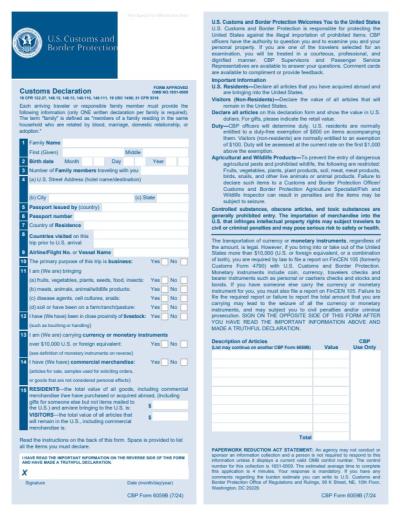 CBP Form 6059B — Customs DeclarationOfficial U.S. Customs and Border Protection arrival declaration form for travelers enterin...
-
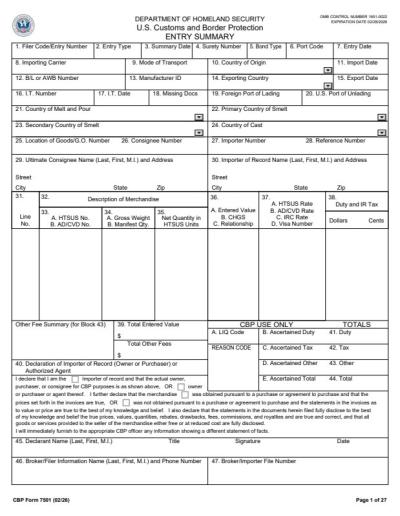 CBP Form 7501 — Entry SummaryOfficial U.S. Customs and Border Protection form used to summarize imported merchandise en...
-
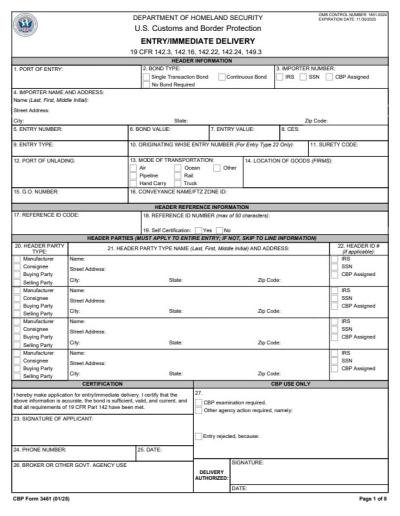 CBP Form 3461 — Entry/Immediate DeliveryOfficial U.S. Customs and Border Protection form for entry and immediate delivery of impor...
-
 CBP Form 3299 — Declaration for Free Entry of Unaccompanied ArticlesOfficial U.S. Customs and Border Protection form for claiming free entry of unaccompanied...