
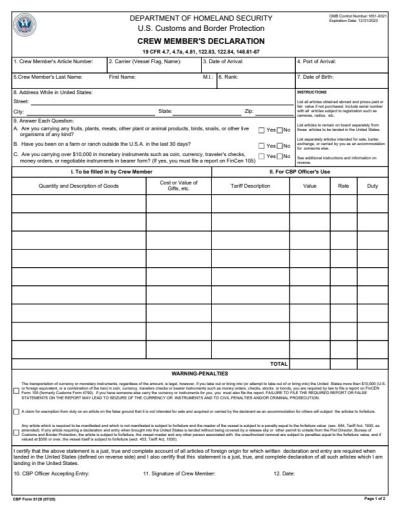
CBP Form 5129 — Crew Member's Declaration, filled in online.
Official CBP form used by crew members to declare articles acquired abroad and presented on arrival.
Type in the panel and watch each answer land on the page. Filling in and signing is free; downloading needs a free account, which includes 5 downloads a month.
Or fill it another way:
- Category
- Government
- Fillable fields
- 80
- Pages
- 2
- Paper size
- US Letter, 8.5 × 11 in
Five ways to fill this form.
-
Fill it in here
Type in the panel and watch it land on the form. Sign it, then download.
Free to fill and sign Start filling -
Many at once, from a spreadsheet
One row per person, one finished PDF for each.
Paid plan · you can walk through it Start with a spreadsheet -
Send it to someone to fill in
Email a link. They fill it in without an account and you get the answers back.
Paid plan · you can walk through it Send a request -
From your own software
Fill it over the API. One request returns the finished PDF.
Paid plan -
Let an AI assistant do it
Connect ChatGPT or Claude once, then describe what goes on the form.
With a free account
What is this form?
CBP Form 5129 is the Crew Member's Declaration used to report articles acquired abroad and presented on arrival in the United States. The form captures carrier details, arrival information, crew identity, address details, and itemized goods so customs officers can review what the crew member is declaring at the port of entry.
PDFengine keeps the official layout intact while mapping the real AcroForm fields from the government PDF. That makes this template useful for structured review, internal approvals, and repeatable filing workflows, especially when several people need to check the same data before the final version is sent. Instead of typing into a flat scan, you can work in the actual fillable form, save a readable copy, and keep the completed PDF in the same evidence folder as the related case, employment, benefits, or customs records.
That workflow matters because these forms rarely stand alone. A court application sits next to statements and incident logs, a customs filing sits next to invoices and transport records, and an HR leave document sits next to employer notices and provider certifications. Using the original government PDF from the start reduces version confusion, makes later comparison easier, and helps everyone involved review the same structure the agency or employer expects to receive.
Because this is a travel-facing customs declaration, speed and legibility matter. Crew members often complete it close to arrival, sometimes after a long voyage or shift, and officers need to understand quickly who is declaring the goods, where the arrival took place, and how the item values were described. A digital draft helps avoid avoidable handwriting mistakes in names, dates, or descriptions, and it makes it easier for an operator or purser to review the declaration before it is handed over at the port. That extra review is useful when receipts are incomplete or when several personal items need to be summarized clearly in limited space, because the final declaration still needs to be understandable at first glance. In practice, a cleaner draft can also help the crew member answer follow-up questions faster if an officer wants clarification at inspection. That matters when arrival processing is busy and the declaration must be read quickly. It also reduces the chance that values or item descriptions have to be rewritten in a rush at the port, which is especially helpful during tight turnaround arrivals.
Who needs to fill this out?
- Crew members arriving in the United States who must declare goods acquired abroad
- Ship and airline personnel completing customs paperwork at port arrival
- Operators or agents preparing declaration packets for crew before inspection
- Compliance staff who want a readable draft before the declaration is handed to CBP
Where and how to submit
Give the completed 5129 to CBP at arrival as part of the crew declaration process. Keep a copy with travel records, crew manifests, receipts, or onboard purchase information in case an officer asks about declared articles or values after entry.
Before relying on the finished file, compare it against the latest official instructions because filing channels, supporting evidence rules, and acceptable document versions can change. A saved PDF is most useful when it sits next to the emails, notices, invoices, ID copies, statements, or internal notes that explain why each answer was entered the way it was.
If another person will review the document before submission, send the PDF together with the key backup documents instead of forwarding the form in isolation. That makes it easier to spot date mismatches, missing references, unchecked boxes, and inconsistent names before the official copy reaches the court, agency, employer, broker, or customs officer.
How to fill it out
- Step 1 — Open the identifying section: Start with fields such as Carrier and DateofArrive so the file is tied to the right case, voyage, employer, claimant, or importer before anything else is added.
- Step 2 — Confirm the role and status details: Use the next core fields, including Port, to state the correct status, leave reason, order type, declaration basis, or identity category expected on the official form.
- Step 3 — Add the main operational information: Complete the practical details around CrewMemberName so the agency or employer can understand what is being requested, declared, certified, or registered.
- Step 4 — Enter dates, references, or linked parties: Use fields such as QuanitityandDesc to tie the form back to the right dates, relationships, supporting references, or transaction details found in the rest of the file.
- Step 5 — Finish the submission-specific details: Complete Cost and any related fields so the final PDF reflects the exact filing path, declaration route, or administrative follow-up expected for this document.
- Step 6 — Review against source records: Before signing or sending, compare the finished PDF against source records, notices, IDs, invoices, schedules, or correspondence so names, dates, amounts, and checkboxes stay consistent across the packet.
Frequently asked questions
What is this form mainly used for?
CBP Form 5129 is the Crew Member's Declaration used to report articles acquired abroad and presented on arrival in the United States. The form captures carrier details, arrival information, crew identity, address details, and itemized goods so customs officers can review what the crew member is declaring at the port of entry.
Who usually completes it?
Usually the person, business, employer, adviser, or agent directly responsible for the filing or for preparing the official record.
Do I submit it to the agency or give it to someone else?
Give the completed 5129 to CBP at arrival as part of the crew declaration process. Keep a copy with travel records, crew manifests, receipts, or onboard purchase information in case an officer asks about declared articles or values after entry.
What documents should I keep with it?
Keep the final PDF with the source records that support the answers on the form, such as IDs, invoices, court papers, benefit notices, medical notes, or customs records.
Should I reuse an older version of the form?
Only if the official instructions still allow that version. When in doubt, compare your saved draft against the latest government PDF before filing.
Can I create CBP Form 5129 — Crew Member's Declaration in bulk?
Yes. PDFengine supports bulk generation of CBP Form 5129 — Crew Member's Declaration via Excel or CSV upload — upload a spreadsheet with one row per form and PDFengine generates all PDFs at once. You can also automate bulk creation programmatically via the PDFengine API.
Ready to fill it in?
Fill in this formMore forms in this category
-
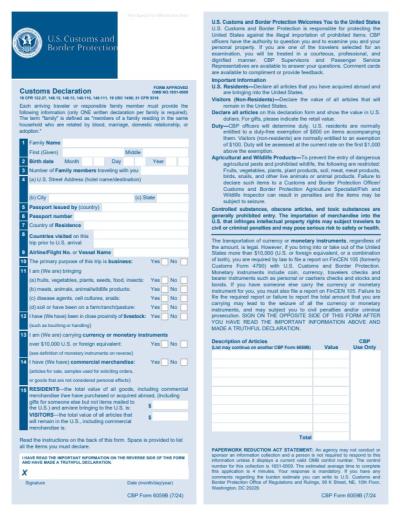 CBP Form 6059B — Customs DeclarationOfficial U.S. Customs and Border Protection arrival declaration form for travelers enterin...
-
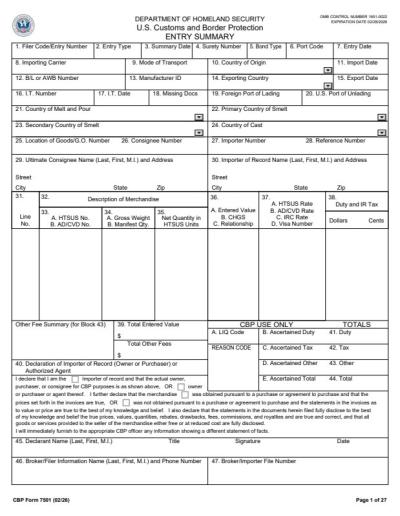 CBP Form 7501 — Entry SummaryOfficial U.S. Customs and Border Protection form used to summarize imported merchandise en...
-
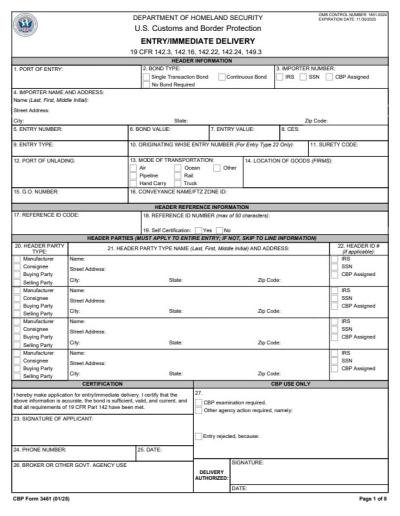 CBP Form 3461 — Entry/Immediate DeliveryOfficial U.S. Customs and Border Protection form for entry and immediate delivery of impor...
-
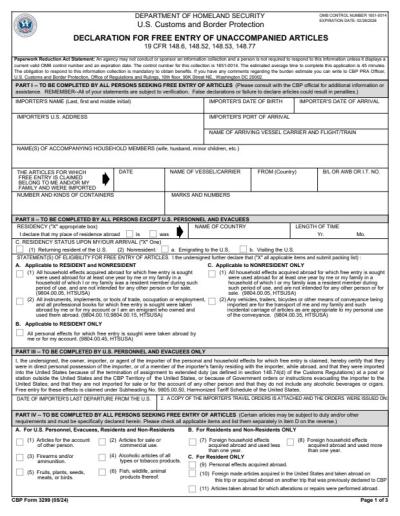 CBP Form 3299 — Declaration for Free Entry of Unaccompanied ArticlesOfficial U.S. Customs and Border Protection form for claiming free entry of unaccompanied...