
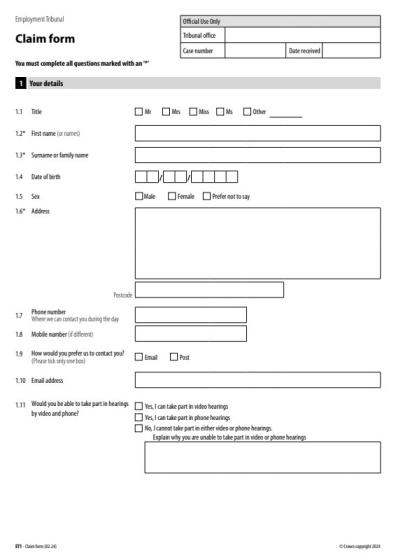
Form ET1 — Employment Tribunal Claim Form, filled in online.
Official HMCTS form used to make a claim to an employment tribunal.
Type in the panel and watch each answer land on the page. Filling in and signing is free; downloading needs a free account, which includes 5 downloads a month.
Or fill it another way:
- Category
- Legal
- Fillable fields
- 227
- Pages
- 16
- Paper size
- 581 × 822 pt
Five ways to fill this form.
-
Fill it in here
Type in the panel and watch it land on the form. Sign it, then download.
Free to fill and sign Start filling -
Many at once, from a spreadsheet
One row per person, one finished PDF for each.
Paid plan · you can walk through it Start with a spreadsheet -
Send it to someone to fill in
Email a link. They fill it in without an account and you get the answers back.
Paid plan · you can walk through it Send a request -
From your own software
Fill it over the API. One request returns the finished PDF.
Paid plan -
Let an AI assistant do it
Connect ChatGPT or Claude once, then describe what goes on the form.
With a free account
What is this form?
Form ET1 is the employment tribunal claim form used when someone wants to bring a claim against an employer, prospective employer, or sometimes a trade union. The form records the claimant's details, respondent details, employment status, ACAS early conciliation information, claim type, key dates, compensation sought, and the written narrative that explains what happened.
On PDFengine, the original government layout stays intact while the AcroForm fields are mapped into a structured template. That matters for long or sensitive filings because you can review the same official layout that will actually be printed, shared, or filed later. Instead of typing into a flat scan, you keep a reusable PDF that can be checked carefully before signatures, witness blocks, attachments, or agency submission steps happen.
This is especially useful for forms like Form ET1 — Employment Tribunal Claim Form because they rarely stand alone. They usually sit next to medical evidence, employer records, court papers, identity documents, recruitment files, or care notes. A saved draft reduces version confusion, makes review easier for another person, and helps you keep the final PDF consistent with the supporting documents that explain why each answer was entered.
Who needs to fill this out?
- Employees or workers making a claim to an employment tribunal
- Solicitors, union representatives, or advisers drafting an ET1 before filing
- Claimants who need to organise dates, ACAS details, and the factual basis of the claim
- Anyone wanting a reviewable copy of the official tribunal claim form
Where and how to submit
Submit ET1 using the official employment tribunal filing route and keep the completed PDF with ACAS paperwork, employment contracts, grievance records, payroll evidence, and the chronology of events. Tribunal claims often depend on clear dates and a coherent narrative, so a saved draft is useful before the final filing is made.
Before relying on the final version, compare it against the latest official guidance because filing addresses, online alternatives, evidence rules, and accepted versions can change. The safest workflow is to save the completed PDF together with the documents that support every material answer, so a later reviewer does not have to reconstruct the file from scratch.
In practice, the value of using the official PDF online is not only speed but control. You can pause, compare answers with source documents, ask another person to review the same draft, and keep a copy of exactly what was submitted or intended to be submitted. That is useful when a case is delayed, when a supervisor, lawyer, doctor, adviser, or family member needs to check one section, or when the form has to be recreated later from the original answers. Working in a structured template also reduces small transcription errors that become expensive later, especially on forms with many dates, names, checkboxes, or supporting references.
How to fill it out
- Step 1 — Start with the case and identity fields: Open the form by checking core fields such as Tribunal office and Case number. Make sure the correct person, agency, employer, court, or benefit claimant is attached to the draft before you continue.
- Step 2 — Add the main contact or status details: Complete the next important fields, including Date received, so the official PDF reflects the right contact details, relationship, leave status, claim status, or filing context.
- Step 3 — Record the central facts of the form: Use fields such as 1 Title Mr and 1 Title Mrs to capture the key facts this document is really about. Match those entries to source records rather than rewriting them from memory.
- Step 4 — Finish the operational or evidence-specific fields: Work through 1 Title Miss and the related fields around it so dates, references, explanations, medical or legal details, and any linked parties line up with the rest of the file.
- Step 5 — Review signatures, declarations, and cross-checks: Before the PDF is treated as final, check any declaration, signature, witness, medical, or submission fields against the evidence packet and confirm that names, dates, and checkboxes are internally consistent.
- Step 6 — Save a filing-ready copy: Keep a clean saved PDF before submission so another person can review it, supporting documents can be attached, and later questions can be answered from the exact same version of the form.
Frequently asked questions
What is ET1 used for?
ET1 is used to start an employment tribunal claim.
Why are ACAS details important?
Many claims require ACAS early conciliation information, so the details should match the official record.
Do key dates matter?
Yes. Employment tribunal claims often turn on dates such as dismissal, discrimination incidents, or the end of employment.
Should I explain the facts clearly in the form?
Yes. A coherent statement of the claim helps the tribunal and the respondent understand the case.
Is it worth keeping a copy before filing?
Yes. A saved PDF makes it easier to review the narrative and supporting facts before submission.
Can I create Form ET1 — Employment Tribunal Claim Form in bulk?
Yes. PDFengine supports bulk generation of Form ET1 — Employment Tribunal Claim Form via Excel or CSV upload — upload a spreadsheet with one row per form and PDFengine generates all PDFs at once. You can also automate bulk creation programmatically via the PDFengine API.
Ready to fill it in?
Fill in this formMore forms in this category
-
 VA Form 21-22a — Appointment of Individual as Claimant's RepresentativeOfficial VA form used to appoint an individual representative such as an attorney, agent,...
-
 CH-120 Response to Request for Civil Harassment Restraining OrdersCH-120 Response to Request for Civil Harassment Restraining Orders is the official fillabl...
-
 CP10.5 Prejudgment Claim of Right to PossessionCP10.5 Prejudgment Claim of Right to Possession is the official fillable form from Judicia...
-
 FL-341(C) Children's Holiday Schedule AttachmentFL-341(C) Children's Holiday Schedule Attachment is the official fillable form from Judici...