
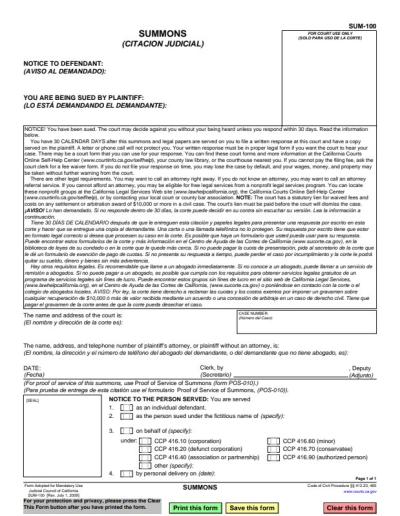
Sum 100 Summons, filled in online.
Sum 100 Summons — official fillable PDF form
Type in the panel and watch each answer land on the page. Filling in and signing is free; downloading needs a free account, which includes 5 downloads a month.
Or fill it another way:
- Category
- Legal
- Fillable fields
- 16
- Pages
- 1
- Paper size
- US Letter, 8.5 × 11 in
Five ways to fill this form.
-
Fill it in here
Type in the panel and watch it land on the form. Sign it, then download.
Free to fill and sign Start filling -
Many at once, from a spreadsheet
One row per person, one finished PDF for each.
Paid plan · you can walk through it Start with a spreadsheet -
Send it to someone to fill in
Email a link. They fill it in without an account and you get the answers back.
Paid plan · you can walk through it Send a request -
From your own software
Fill it over the API. One request returns the finished PDF.
Paid plan -
Let an AI assistant do it
Connect ChatGPT or Claude once, then describe what goes on the form.
With a free account
What is this form?
California Judicial Council form SUM-100 is a civil summons that gives a defendant formal notice of a lawsuit and explains the deadline and basic method for responding. It identifies the plaintiff, defendant, court, case number, and attorney or self-represented plaintiff, and it includes the clerk’s issuance information plus the capacity in which a person or entity is served. The summons normally accompanies the complaint and other required case documents. This fillable version helps you prepare a legible working copy, but it does not replace the current instructions, eligibility rules, required evidence, or review by the receiving authority. Use the edition requested for the relevant transaction or reporting period and compare the completed PDF with the official source before submission.
Information should come from source records rather than memory or estimates. Names, identifiers, dates, amounts, addresses, and selections must agree with the supporting documents for the case. A technically complete PDF can still be rejected when an answer is inaccurate, a required attachment is missing, or a signature belongs to the wrong person. Save the original records and document any calculation used to produce an amount.
Who needs to fill this out?
- Plaintiffs starting a California unlimited or limited civil case that uses SUM-100.
- Attorneys and self-represented litigants preparing a summons for clerk issuance.
- Registered process servers, sheriffs, or other legally authorized people serving the issued papers.
- Defendants reviewing the notice and arranging a timely response to the complaint.
Before starting, confirm that California SUM-100 Summons is the form requested by the issuing or receiving organization. Assign one person to reconcile the entries when several people provide information. Do not enter placeholder data simply to make a field look complete. If a question does not apply, follow the printed instructions for leaving it blank or marking it not applicable, because a blank field and a zero can have different meanings.
Where and how to submit
Present the completed summons through the filing method used by the California Superior Court handling the case and obtain a clerk-issued copy. Serve the issued summons, complaint, and every other required document through a legally authorized person and method. The server completes the appropriate proof of service, which is then filed with the court; the plaintiff must not personally serve papers when California law prohibits it. Use only a submission channel accepted by the receiving organization, and verify the address, portal, email, or office against current official instructions. Keep a complete copy together with attachments and proof of delivery or electronic confirmation. If the recipient returns the form for correction, amend the inaccurate entry transparently and resubmit the complete package; do not discard the version that shows what was originally delivered.
Review the generated PDF at normal size and at high zoom. Confirm that long values are not clipped, checkboxes show the intended choice, dates use the requested format, and every signature and attachment is present. Protect the file because it may contain personal, financial, medical, or transaction information. Share it only with people and systems authorized to handle the submission.
How to fill it out
- Step 1 — NOTICE TO DEFENDANT: Enter every defendant’s legal name consistently with the complaint. Include an entity’s exact registered name and do not replace it with a trade name unless the pleadings support that designation.
- Step 2 — YOU ARE BEING SUED BY PLAINTIFF: List every plaintiff exactly as named in the filed complaint. Reconcile spelling, party order, and any representative capacity.
- Step 3 — The name and address of the court is: Enter the Superior Court branch and street address where the case is filed, using the court’s current filing information.
- Step 4 — Case Number: Use the number assigned by the clerk. Do not invent a number on a summons prepared before the court has opened the case.
- Step 5 — Plaintiff’s attorney or plaintiff without an attorney: Provide the responsible attorney’s or self-represented plaintiff’s name, State Bar number when applicable, address, and telephone details.
- Step 6 — Date and clerk issuance: Leave clerk-only issuance fields for the court unless local procedure expressly directs otherwise. A summons generally must be issued before service.
- Step 7 — Service-capacity fields: When documenting service, identify the person served, any fictitious name, and the entity or representative capacity, selecting the applicable corporation or other statutory basis without conflicting choices.
Frequently asked questions
Is SUM-100 itself the complaint?
No. It is the summons notifying the defendant; the complaint states the claims and ordinarily must be served with it.
How long does a defendant have to respond?
The summons commonly states 30 calendar days after service, but parties should read the issued papers and obtain legal advice because exceptions and other deadlines can apply.
Can the plaintiff serve the summons?
A party generally may not serve the summons and complaint personally; service must be made by an adult who is not a party and is legally permitted to serve process.
What if a business is being sued?
Use the exact entity name and arrange service on a person and in a capacity authorized by California law. Entity service rules can be technical.
Can I use an electronic signature?
Use an electronic signature only when the recipient and the applicable instructions accept it. A typed name is not automatically equivalent to a valid signature, and some filings require an original, witnessed, notarized, or professional signature.
What should I check before submitting?
Reconcile identifiers, dates, amounts, selected options, attachments, and signatures against the source records. Then inspect the final PDF for clipped text, blank required fields, duplicate selections, and pages in the wrong order.
Should I keep a copy of the completed form?
Yes. Keep the exact submitted version, supporting records, and delivery confirmation for the retention period that applies. Store the files securely because the form may contain sensitive information.
Can I create California SUM-100 Summons in bulk?
Yes. PDFengine supports bulk generation of California SUM-100 Summons via Excel or CSV upload — upload a spreadsheet with one row per form and PDFengine generates all PDFs at once. You can also automate bulk creation programmatically via the PDFengine API. Each generated form must still be individually reviewed and, where required, signed.
Ready to fill it in?
Fill in this formMore forms in this category
-
 VA Form 21-22a — Appointment of Individual as Claimant's RepresentativeOfficial VA form used to appoint an individual representative such as an attorney, agent,...
-
 CH-120 Response to Request for Civil Harassment Restraining OrdersCH-120 Response to Request for Civil Harassment Restraining Orders is the official fillabl...
-
 CP10.5 Prejudgment Claim of Right to PossessionCP10.5 Prejudgment Claim of Right to Possession is the official fillable form from Judicia...
-
 FL-341(C) Children's Holiday Schedule AttachmentFL-341(C) Children's Holiday Schedule Attachment is the official fillable form from Judici...