
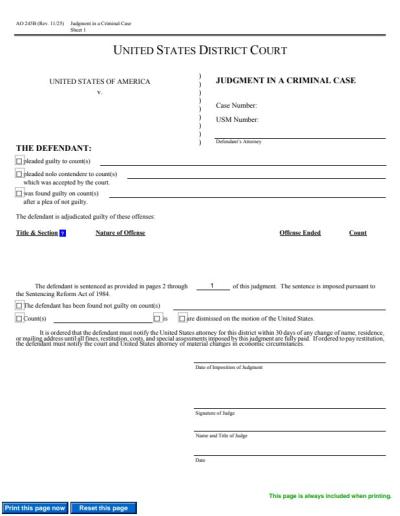
AO 245B, filled in online.
Judgment in a Criminal Case
Type in the panel and watch each answer land on the page. Filling in and signing is free; downloading needs a free account, which includes 5 downloads a month.
Or fill it another way:
- Category
- Legal
- Fillable fields
- 779
- Pages
- 25
- Paper size
- US Letter, 8.5 × 11 in
Five ways to fill this form.
-
Fill it in here
Type in the panel and watch it land on the form. Sign it, then download.
Free to fill and sign Start filling -
Many at once, from a spreadsheet
One row per person, one finished PDF for each.
Paid plan · you can walk through it Start with a spreadsheet -
Send it to someone to fill in
Email a link. They fill it in without an account and you get the answers back.
Paid plan · you can walk through it Send a request -
From your own software
Fill it over the API. One request returns the finished PDF.
Paid plan -
Let an AI assistant do it
Connect ChatGPT or Claude once, then describe what goes on the form.
With a free account
What is this form?
AO 245B is the federal judiciary judgment form used to record the final judgment in a criminal case. It captures the defendant identity, counts of conviction, imprisonment, supervised release, monetary penalties, special conditions, recommendations, and payment instructions in the exact structure needed for court records and post-sentencing administration. On PDFengine, this template is presented as a fillable PDF that keeps the official government layout while making the document easier to complete, review, and store digitally.
That matters because AO 245B is rarely a standalone note. It usually sits inside a larger court, immigration, or veterans-benefits workflow where names, dates, classification choices, provider details, monetary figures, and signatures must line up with supporting evidence. Using the mapped AcroForm fields reduces retyping, makes internal review easier, and helps produce a cleaner final PDF for filing or recordkeeping.
In practice, many people do not complete this kind of form in one sitting. They gather identifiers first, then confirm facts against notices, agency letters, medical records, court papers, or employer documents. A structured fillable PDF makes that workflow easier because the same draft can be reviewed, corrected, saved, and reused without changing the official layout that the receiving agency expects.
That is also useful when the person completing the form is not the only reviewer. A lawyer, paralegal, HR manager, veteran service officer, family member, or translator may all need to check the same draft before it is submitted. Keeping the official format intact reduces confusion and makes it easier to compare each answer with the rest of the supporting file.
Who needs to fill this out?
- Federal court staff preparing the formal judgment after sentencing
- Defense or prosecution teams reviewing the wording of a proposed criminal judgment
- Law offices that need a clean working copy before filing or comparing minute entries
- People auditing sentencing terms, payment schedules, and count-by-count dispositions
- International users, advisers, or back-office teams who need a clean English-language copy of the official AO 245B before filing
Where and how to submit
The completed AO 245B is entered on the criminal docket by the court after sentencing and becomes part of the official case record. Store the final PDF with the sentencing transcript, statement of reasons, restitution schedules, and any amended judgment documents because later supervision, appeals, and collections work often depend on the exact language in the judgment.
Even when the form is prepared outside the United States, it remains a U.S. federal document. Keep the English names, official identifiers, and dates exactly as they appear in the source records, and preserve the finished PDF together with the rest of the filing package so later reviews, follow-up requests, or amendments can trace the original submission cleanly.
It is also smart to keep a working copy before filing and a final copy after filing. That makes it easier to answer follow-up questions, compare agency notices against the original submission, and prove later which version of the form was actually sent.
How to fill it out
- Step 1 — Confirm the filing context: Start with 1 and confirm you are working on the correct case, claim, petition, or benefits request before entering data.
- Step 2 — Complete identifying details: Fill fields such as Location with the exact names, numbers, and identifiers shown in the underlying records.
- Step 3 — Add the main party or benefit details: Use entries like Name and Num to capture the core facts of AO 245B. Match the wording to source documents instead of paraphrasing.
- Step 4 — Review selection fields and classifications: Check boxes or structured fields such as Atty carefully so the selected filing basis, case status, or benefit category is consistent with the packet.
- Step 5 — Finish narrative or supporting entries: If the form includes a text or explanation field such as Guilty, use it to clarify dates, providers, counts, conditions, or other facts that support the filing.
- Step 6 — Validate before submission: Compare the final PDF with supporting letters, evidence, notices, identity records, and payment details so the official form matches the rest of the file before it is sent.
Frequently asked questions
Who usually prepares AO 245B?
It is typically prepared by court staff based on the judge's sentencing rulings and the final record in the criminal case.
Why is the monetary-penalty section important?
Because fines, assessments, forfeiture, and restitution terms drive later collection and compliance obligations.
Can the judgment be amended later?
Yes. Courts sometimes issue amended judgments when sentencing terms, credits, or clerical details need correction.
Does AO 245B include supervised release terms?
Yes. The form records both standard and special conditions tied to the sentence.
Should counsel compare the judgment with the oral sentence?
Yes. Any mismatch between the oral pronouncement and the written judgment should be spotted quickly.
Should I keep a copy before filing?
Yes. A saved pre-filing copy and a final filed copy make later review, corrections, and follow-up questions much easier.
Can I create AO 245B in bulk?
Yes. PDFengine supports bulk generation of AO 245B via Excel or CSV upload — upload a spreadsheet with one row per form and PDFengine generates all PDFs at once. You can also automate bulk creation programmatically via the PDFengine API.
Ready to fill it in?
Fill in this formMore forms in this category
-
 VA Form 21-22a — Appointment of Individual as Claimant's RepresentativeOfficial VA form used to appoint an individual representative such as an attorney, agent,...
-
 CH-120 Response to Request for Civil Harassment Restraining OrdersCH-120 Response to Request for Civil Harassment Restraining Orders is the official fillabl...
-
 CP10.5 Prejudgment Claim of Right to PossessionCP10.5 Prejudgment Claim of Right to Possession is the official fillable form from Judicia...
-
 FL-341(C) Children's Holiday Schedule AttachmentFL-341(C) Children's Holiday Schedule Attachment is the official fillable form from Judici...