
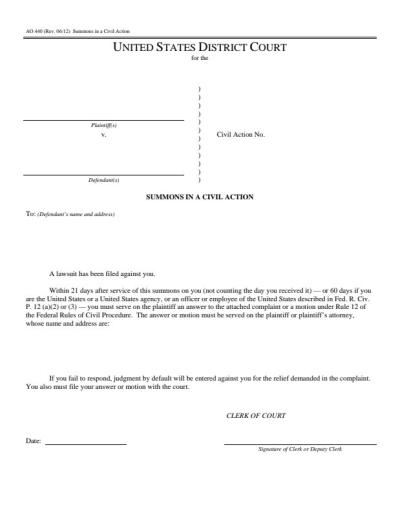
AO 440 — Summons in a Civil Action, filled in online.
Official U.S. Courts summons form issued in a federal civil case.
Type in the panel and watch each answer land on the page. Filling in and signing is free; downloading needs a free account, which includes 5 downloads a month.
Or fill it another way:
- Category
- Legal
- Fillable fields
- 36
- Pages
- 2
- Paper size
- US Letter, 8.5 × 11 in
Five ways to fill this form.
-
Fill it in here
Type in the panel and watch it land on the form. Sign it, then download.
Free to fill and sign Start filling -
Many at once, from a spreadsheet
One row per person, one finished PDF for each.
Paid plan · you can walk through it Start with a spreadsheet -
Send it to someone to fill in
Email a link. They fill it in without an account and you get the answers back.
Paid plan · you can walk through it Send a request -
From your own software
Fill it over the API. One request returns the finished PDF.
Paid plan -
Let an AI assistant do it
Connect ChatGPT or Claude once, then describe what goes on the form.
With a free account
What is this form?
AO 440 is the official federal summons form used in a civil action. It tells the defendant that a lawsuit has been filed, identifies the court and parties, states the time to respond, and forms part of the service package that puts the defendant on formal notice of the case. Although short, the form is procedural and should line up exactly with the filed complaint, case caption, and clerk-issued details. A fillable PDF is useful because even small mistakes in names, addresses, or party labels can slow service or force the summons to be reissued.
On PDFengine, the official layout stays intact while the AcroForm fields are mapped into a structured fillable template. That is useful for forms like AO 440 because the people reviewing them usually care about the original wording, checkbox structure, and court or agency layout. Instead of typing into a flat scan, you can save a draft, review it with another person, and return to the same version later without recreating the document from scratch.
Accuracy matters more than filler on legal and court-linked forms. Users should copy names, dates, account references, court numbers, estate details, or financial figures from the source records that support the filing. A clean PDF workflow reduces transcription mistakes and makes it easier to compare the completed form with the complaint, petition, will, schedules, or correspondence that sits beside it.
That matters especially when the same form is reviewed by more than one person. A lawyer, trustee, executor, court clerk, or family member may all look at the same draft at different moments, so having one consistent fillable PDF helps prevent conflicting versions and avoids small errors becoming procedural delays later.
Who needs to fill this out?
- Lawyers preparing service documents in a federal civil case
- Self-represented litigants who need the standard federal summons format
- Filing teams checking that the summons matches the complaint caption and case details
- Anyone assembling the official service packet for a defendant
Where and how to submit
AO 440 is used in the opening service stage of a federal civil action and is typically filed or presented with the complaint so the clerk can issue it. Before using the final PDF for service, make sure the caption, defendant name, plaintiff name, court name, and service address match the court file and local requirements.
Keep the issued summons with the complaint, service proofs, and docket receipts. Service disputes often turn on exact names and dates, so it helps to retain the version that was reviewed or issued by the clerk.
In practice, the value of completing AO 440 online is control. You can pause, compare the answers with evidence, let another person review the draft, and keep a copy of exactly what was intended for filing or service. That becomes useful when the court, agency, trustee, solicitor, executor, or opposing party later asks what was entered and why.
How to fill it out
- Step 1 — Confirm the case and parties: Start with Info and make sure the PDF belongs to the right case, estate, debtor, family dispute, or applicant before you continue.
- Step 2 — Enter the main identity details: Complete fields such as Plaintiff exactly as they appear in the supporting records so names, court references, and addresses stay consistent.
- Step 3 — Add the central factual details: Use Civil action number and Defendant to capture the main facts, amounts, dates, or classifications the form is designed to report.
- Step 4 — Review the status or selection fields: Check entries like Defendant address carefully so boxes, categories, and procedural choices match the underlying situation.
- Step 5 — Finish any narrative or supporting detail: If the form includes an explanation field such as Plaintiff address, use it to add the specific context a reviewer would need rather than leaving the official PDF ambiguous.
- Step 6 — Cross-check before filing: Compare the finished PDF with the complaint, petition, schedules, will, tax records, or supporting papers and confirm that names, dates, totals, and attachments are internally consistent.
Frequently asked questions
What does AO 440 do?
It notifies the defendant that a federal civil action has been filed and that a response is required.
Can I serve an incorrect summons anyway?
That is risky. Errors in party names or case details can cause service problems.
Does the summons need to match the complaint exactly?
Yes. The caption and parties should be consistent with the filed case.
Who usually issues the summons?
The clerk typically issues it after the case is opened or reviewed.
Should I save the issued version?
Yes. The issued summons is part of the formal service record.
Can I create AO 440 — Summons in a Civil Action in bulk?
Yes. PDFengine supports bulk generation of AO 440 — Summons in a Civil Action via Excel or CSV upload — upload a spreadsheet with one row per form and PDFengine generates all PDFs at once. You can also automate bulk creation programmatically via the PDFengine API.
Ready to fill it in?
Fill in this formMore forms in this category
-
 VA Form 21-22a — Appointment of Individual as Claimant's RepresentativeOfficial VA form used to appoint an individual representative such as an attorney, agent,...
-
 CH-120 Response to Request for Civil Harassment Restraining OrdersCH-120 Response to Request for Civil Harassment Restraining Orders is the official fillabl...
-
 CP10.5 Prejudgment Claim of Right to PossessionCP10.5 Prejudgment Claim of Right to Possession is the official fillable form from Judicia...
-
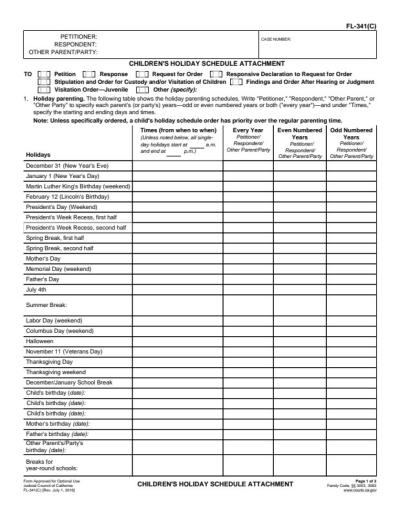 FL-341(C) Children's Holiday Schedule AttachmentFL-341(C) Children's Holiday Schedule Attachment is the official fillable form from Judici...