
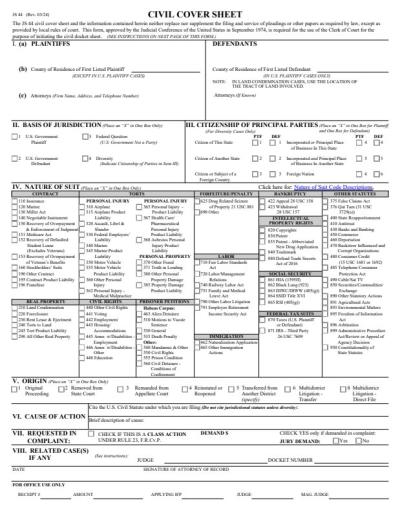
JS 44 — Civil Cover Sheet, filled in online.
Official U.S. Courts civil cover sheet used to classify a newly filed federal civil case.
Type in the panel and watch each answer land on the page. Filling in and signing is free; downloading needs a free account, which includes 5 downloads a month.
Or fill it another way:
- Category
- Legal
- Fillable fields
- 36
- Pages
- 2
- Paper size
- US Letter, 8.5 × 11 in
Five ways to fill this form.
-
Fill it in here
Type in the panel and watch it land on the form. Sign it, then download.
Free to fill and sign Start filling -
Many at once, from a spreadsheet
One row per person, one finished PDF for each.
Paid plan · you can walk through it Start with a spreadsheet -
Send it to someone to fill in
Email a link. They fill it in without an account and you get the answers back.
Paid plan · you can walk through it Send a request -
From your own software
Fill it over the API. One request returns the finished PDF.
Paid plan -
Let an AI assistant do it
Connect ChatGPT or Claude once, then describe what goes on the form.
With a free account
What is this form?
JS 44 is the official civil cover sheet used in U.S. federal district court filings. It is not the complaint itself; instead, it classifies the case by party type, jurisdiction, nature of suit, cause of action, requested relief, and related procedural information so the clerk’s office can route and docket the case correctly. That classification role means the answers should mirror the complaint and any filing instructions for the district where the case is being opened. A fillable PDF helps because lawyers and self-represented litigants can compare the cover sheet directly with the complaint caption and jurisdiction allegations before submitting the opening papers.
On PDFengine, the official layout stays intact while the AcroForm fields are mapped into a structured fillable template. That is useful for forms like JS 44 because the people reviewing them usually care about the original wording, checkbox structure, and court or agency layout. Instead of typing into a flat scan, you can save a draft, review it with another person, and return to the same version later without recreating the document from scratch.
Accuracy matters more than filler on legal and court-linked forms. Users should copy names, dates, account references, court numbers, estate details, or financial figures from the source records that support the filing. A clean PDF workflow reduces transcription mistakes and makes it easier to compare the completed form with the complaint, petition, will, schedules, or correspondence that sits beside it.
That matters especially when the same form is reviewed by more than one person. A lawyer, trustee, executor, court clerk, or family member may all look at the same draft at different moments, so having one consistent fillable PDF helps prevent conflicting versions and avoids small errors becoming procedural delays later.
Who needs to fill this out?
- Lawyers filing a new civil case in U.S. federal district court
- Self-represented litigants who need the standard federal civil cover sheet
- Court filing teams checking jurisdiction, party categories, and nature-of-suit codes
- Anyone preparing the opening package for a federal civil action
Where and how to submit
JS 44 is generally filed with the opening civil complaint and related initiation documents in federal district court. Before filing, users should confirm that the caption, jurisdiction basis, cause-of-action text, and requested case classification match the complaint and the local court’s filing rules.
Keep the completed PDF with the complaint, summons drafts, filing receipt, and service papers. If the clerk’s office later questions the case classification or party information, the saved cover sheet provides the exact version that accompanied the opening filing.
In practice, the value of completing JS 44 online is control. You can pause, compare the answers with evidence, let another person review the draft, and keep a copy of exactly what was intended for filing or service. That becomes useful when the court, agency, trustee, solicitor, executor, or opposing party later asks what was entered and why.
How to fill it out
- Step 1 — Confirm the case and parties: Start with PlCty[0] and make sure the PDF belongs to the right case, estate, debtor, family dispute, or applicant before you continue.
- Step 2 — Enter the main identity details: Complete fields such as DefCty[0] exactly as they appear in the supporting records so names, court references, and addresses stay consistent.
- Step 3 — Add the central factual details: Use Plaintiffs[0] and AttorneysPL[0] to capture the main facts, amounts, dates, or classifications the form is designed to report.
- Step 4 — Review the status or selection fields: Check entries like Defendants[0] carefully so boxes, categories, and procedural choices match the underlying situation.
- Step 5 — Finish any narrative or supporting detail: If the form includes an explanation field such as AttorneysDef[0], use it to add the specific context a reviewer would need rather than leaving the official PDF ambiguous.
- Step 6 — Cross-check before filing: Compare the finished PDF with the complaint, petition, schedules, will, tax records, or supporting papers and confirm that names, dates, totals, and attachments are internally consistent.
Frequently asked questions
What is JS 44 used for?
It is used to classify and open a civil case in federal district court.
Is JS 44 the same as the complaint?
No. It is a cover sheet that accompanies the complaint.
Why do nature-of-suit and jurisdiction boxes matter?
Because they help the court route, code, and manage the case correctly.
Should the cover sheet match the complaint caption?
Yes. The parties and case theory should be consistent across the opening documents.
Do local court rules still matter if the form is federal?
Yes. District-specific filing rules can add requirements around the opening package.
Can I create JS 44 — Civil Cover Sheet in bulk?
Yes. PDFengine supports bulk generation of JS 44 — Civil Cover Sheet via Excel or CSV upload — upload a spreadsheet with one row per form and PDFengine generates all PDFs at once. You can also automate bulk creation programmatically via the PDFengine API.
Ready to fill it in?
Fill in this formMore forms in this category
-
 VA Form 21-22a — Appointment of Individual as Claimant's RepresentativeOfficial VA form used to appoint an individual representative such as an attorney, agent,...
-
 CH-120 Response to Request for Civil Harassment Restraining OrdersCH-120 Response to Request for Civil Harassment Restraining Orders is the official fillabl...
-
 CP10.5 Prejudgment Claim of Right to PossessionCP10.5 Prejudgment Claim of Right to Possession is the official fillable form from Judicia...
-
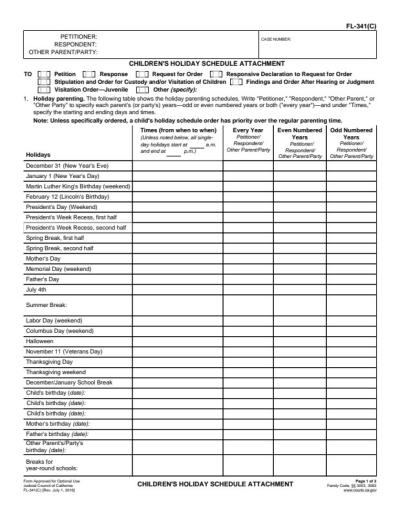 FL-341(C) Children's Holiday Schedule AttachmentFL-341(C) Children's Holiday Schedule Attachment is the official fillable form from Judici...