
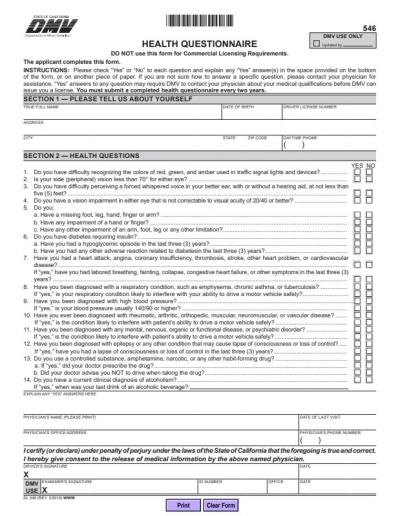
Dl 546 Health Questionnaire California Dmv, filled in online.
Dl 546 Health Questionnaire California Dmv — official fillable PDF form
Type in the panel and watch each answer land on the page. Filling in and signing is free; downloading needs a free account, which includes 5 downloads a month.
Or fill it another way:
- Category
- Healthcare
- Fillable fields
- 69
- Pages
- 1
- Paper size
- US Letter, 8.5 × 11 in
Five ways to fill this form.
-
Fill it in here
Type in the panel and watch it land on the form. Sign it, then download.
Free to fill and sign Start filling -
Many at once, from a spreadsheet
One row per person, one finished PDF for each.
Paid plan · you can walk through it Start with a spreadsheet -
Send it to someone to fill in
Email a link. They fill it in without an account and you get the answers back.
Paid plan · you can walk through it Send a request -
From your own software
Fill it over the API. One request returns the finished PDF.
Paid plan -
Let an AI assistant do it
Connect ChatGPT or Claude once, then describe what goes on the form.
With a free account
What is this form?
Dl 546 Health Questionnaire California Dmv is an official form used to provide California DMV with health information relevant to driving ability, licensing review, and medical follow-up. In practical use, the form works as a structured record: it keeps names, dates, identifiers, checkboxes, and narrative answers in one place so the receiving agency or organization can review the facts without having to rebuild the story from emails or handwritten notes. That matters when the form becomes part of a tax file, licensing review, compliance packet, social-services case, HR record, or another official workflow tied to deadlines and supporting documents.
This template follows the official layout issued by the California Department of Motor Vehicles (DMV). Because PDFengine preserves the original field order and labels, you can type directly into the same boxes reviewers expect to see. Common fields such as Name, Driver License Number, Date of Birth and Condition, Diagnosis are easier to check when they are entered cleanly instead of squeezed into a scanned copy. That reduces rework, makes signatures and dates easier to confirm, and gives you a cleaner PDF to save, share internally, or attach to a case or transaction record.
The form is still an official document, so the content should match the underlying facts and any supporting records. Use the fillable version to prepare a precise submission, not to improvise answers. If a field refers to an account number, case identifier, permit, license detail, payroll fact, medical note, delivery fact, or household detail, it should match the source records that sit behind the form. A polished PDF is helpful, but accuracy is what makes the finished document usable in the real workflow.
Who needs to fill this out?
- Drivers asked by California DMV to answer medical or health-related questions. They benefit from a typed, reviewable version that keeps the official structure intact and makes supporting documents easier to match.
- People preparing information about conditions that may affect safe driving. They benefit from a typed, reviewable version that keeps the official structure intact and makes supporting documents easier to match.
- Family members or advocates helping organize records before a DMV response. They benefit from a typed, reviewable version that keeps the official structure intact and makes supporting documents easier to match.
- Administrative staff ensuring that dates, providers, and disclosures are readable. They benefit from a typed, reviewable version that keeps the official structure intact and makes supporting documents easier to match.
Where and how to submit
Return the completed questionnaire through the DMV driver-safety or licensing workflow that requested it and keep a copy with any medical correspondence, appointment notices, or clinician information. Health questionnaires work best when the answers are complete, dated, and consistent with the medical facts already known to the driver or provider.
Before sending it, compare the completed PDF with the records that support it: notices, invoices, payroll data, delivery papers, license information, provider notes, or case documentation. If the workflow later asks for corrections, having a saved draft and a clean final copy makes those updates much faster.
How to fill it out
- Step 1 — Driver identification: Use Name, Driver License Number, Date of Birth to connect the questionnaire to the correct DMV driver record. Review the values against the source records before moving on, because this part often determines whether the form is tied to the correct file, person, shipment, account, case, or medical record. Clean entries here also make later signatures, timelines, and follow-up questions much easier to handle.
- Step 2 — Condition details: Use Condition, Diagnosis, Date to describe the health issue or diagnosis that led to the questionnaire. Review the values against the source records before moving on, because this part often determines whether the form is tied to the correct file, person, shipment, account, case, or medical record. Clean entries here also make later signatures, timelines, and follow-up questions much easier to handle.
- Step 3 — Treatment and provider: Use Physician, Medication, Treatment to show what care or treatment is currently in place. Review the values against the source records before moving on, because this part often determines whether the form is tied to the correct file, person, shipment, account, case, or medical record. Clean entries here also make later signatures, timelines, and follow-up questions much easier to handle.
- Step 4 — Driving impact: Use Loss of Consciousness, Episodes, Restrictions to explain whether the condition affects safe operation of a vehicle. Review the values against the source records before moving on, because this part often determines whether the form is tied to the correct file, person, shipment, account, case, or medical record. Clean entries here also make later signatures, timelines, and follow-up questions much easier to handle.
- Step 5 — Certification: Use Signature, Date to finalize the questionnaire with a dated confirmation. Review the values against the source records before moving on, because this part often determines whether the form is tied to the correct file, person, shipment, account, case, or medical record. Clean entries here also make later signatures, timelines, and follow-up questions much easier to handle.
Frequently asked questions
Why does DMV ask for a health questionnaire?
DMV may need health information when a condition, incident, or report raises questions about driving ability or licensing safety review.
Should I answer from memory only?
Use current records if possible. Dates, diagnoses, provider names, and medication details are more reliable when checked against actual documents.
Do medical details really matter?
Yes. Missing or inconsistent health information can create delays, requests for clarification, or an incomplete picture of the driving-safety issue.
Can someone help me prepare the form?
Yes. A family member, advocate, or clinician can help organize the information, but the final answers should still be reviewed carefully by the person responsible.
Should I keep a copy and related records?
Yes. Keep the completed questionnaire and any supporting medical correspondence in case DMV requests follow-up or updated information later.
Can I create DL 546 Health Questionnaire in bulk?
Yes. PDFengine supports bulk generation of DL 546 Health Questionnaire via Excel or CSV upload — upload a spreadsheet with one row per form and PDFengine generates all PDFs at once. You can also automate bulk creation programmatically via the PDFengine API.
Ready to fill it in?
Fill in this formMore forms in this category
-
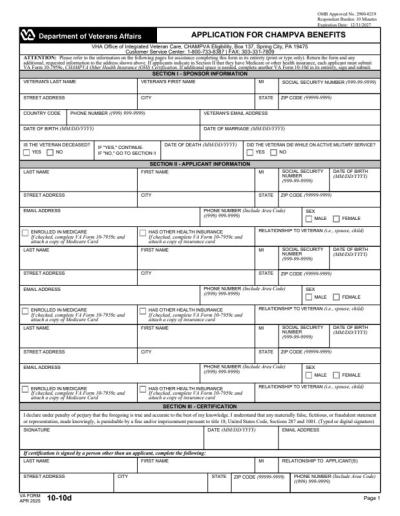 VA Form 10-10D — Application for CHAMPVA BenefitsOfficial VA form used to apply for CHAMPVA health benefits.
-
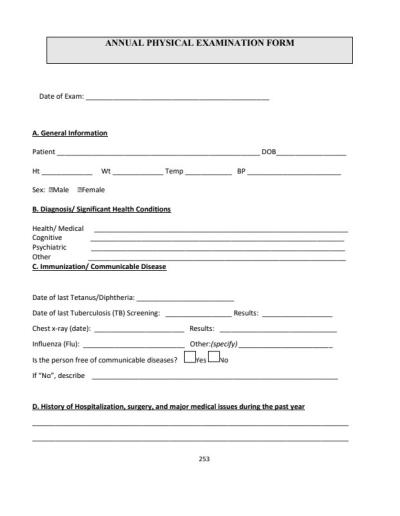 Annual Physical Exam Verification FormAnnual Physical Exam Verification Form — official fillable PDF form
-
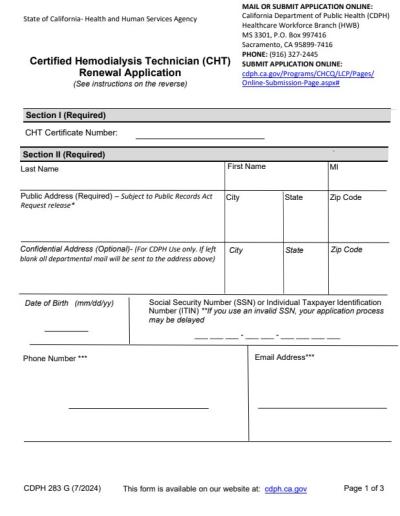 Certified hemodialysis technician cht renewal applicationCertified hemodialysis technician cht renewal application — official fillable PDF form
-
 Covid 19 Test Results Form TemplateCovid 19 Test Results Form Template — official fillable PDF form