
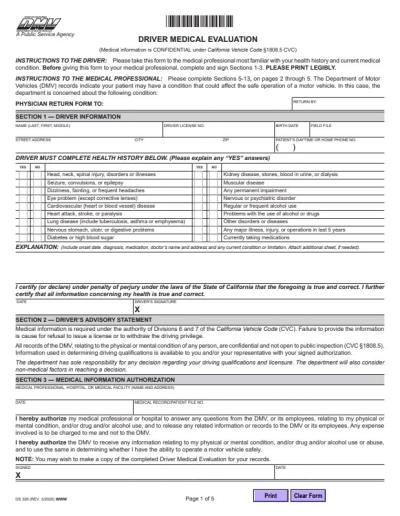
Ds 326 Driver Medical Evaluation, filled in online.
Ds 326 Driver Medical Evaluation — official fillable PDF form
Type in the panel and watch each answer land on the page. Filling in and signing is free; downloading needs a free account, which includes 5 downloads a month.
Or fill it another way:
- Category
- Healthcare
- Fillable fields
- 329
- Pages
- 5
- Paper size
- US Letter, 8.5 × 11 in
Five ways to fill this form.
-
Fill it in here
Type in the panel and watch it land on the form. Sign it, then download.
Free to fill and sign Start filling -
Many at once, from a spreadsheet
One row per person, one finished PDF for each.
Paid plan · you can walk through it Start with a spreadsheet -
Send it to someone to fill in
Email a link. They fill it in without an account and you get the answers back.
Paid plan · you can walk through it Send a request -
From your own software
Fill it over the API. One request returns the finished PDF.
Paid plan -
Let an AI assistant do it
Connect ChatGPT or Claude once, then describe what goes on the form.
With a free account
What is this form?
Ds 326 Driver Medical Evaluation is an official form used to capture a clinician-supported medical evaluation for a driver when California DMV needs more detailed health review. In practical use, the form works as a structured record: it keeps names, dates, identifiers, checkboxes, and narrative answers in one place so the receiving agency or organization can review the facts without having to rebuild the story from emails or handwritten notes. That matters when the form becomes part of a tax file, licensing review, compliance packet, social-services case, HR record, or another official workflow tied to deadlines and supporting documents.
This template follows the official layout issued by the California Department of Motor Vehicles (DMV). Because PDFengine preserves the original field order and labels, you can type directly into the same boxes reviewers expect to see. Common fields such as Driver Name, Driver License Number, Date of Birth and Diagnosis, Date of Diagnosis are easier to check when they are entered cleanly instead of squeezed into a scanned copy. That reduces rework, makes signatures and dates easier to confirm, and gives you a cleaner PDF to save, share internally, or attach to a case or transaction record.
The form is still an official document, so the content should match the underlying facts and any supporting records. Use the fillable version to prepare a precise submission, not to improvise answers. If a field refers to an account number, case identifier, permit, license detail, payroll fact, medical note, delivery fact, or household detail, it should match the source records that sit behind the form. A polished PDF is helpful, but accuracy is what makes the finished document usable in the real workflow.
Who needs to fill this out?
- Drivers asked to obtain a medical evaluation for DMV review. They benefit from a typed, reviewable version that keeps the official structure intact and makes supporting documents easier to match.
- Physicians or clinics completing the medical portion of the form. They benefit from a typed, reviewable version that keeps the official structure intact and makes supporting documents easier to match.
- Family members helping gather diagnosis, treatment, and episode history. They benefit from a typed, reviewable version that keeps the official structure intact and makes supporting documents easier to match.
- Advocates or admin staff making sure patient and provider details line up. They benefit from a typed, reviewable version that keeps the official structure intact and makes supporting documents easier to match.
Where and how to submit
Return the completed evaluation through the DMV process that requested it and keep a copy together with provider notes, appointment dates, and any related licensing correspondence. DS 326 usually matters because it combines driver identification with detailed clinical information, so it should be completed from the medical record and not from rough recollection.
Before sending it, compare the completed PDF with the records that support it: notices, invoices, payroll data, delivery papers, license information, provider notes, or case documentation. If the workflow later asks for corrections, having a saved draft and a clean final copy makes those updates much faster.
How to fill it out
- Step 1 — Driver details: Use Driver Name, Driver License Number, Date of Birth to identify the person whose driving fitness is being evaluated. Review the values against the source records before moving on, because this part often determines whether the form is tied to the correct file, person, shipment, account, case, or medical record. Clean entries here also make later signatures, timelines, and follow-up questions much easier to handle.
- Step 2 — Medical diagnosis: Use Diagnosis, Date of Diagnosis, Condition to state the relevant medical condition clearly and tie it to the evaluation. Review the values against the source records before moving on, because this part often determines whether the form is tied to the correct file, person, shipment, account, case, or medical record. Clean entries here also make later signatures, timelines, and follow-up questions much easier to handle.
- Step 3 — Treatment history: Use Medication, Treatment, Physician to show what care the driver receives and who is supervising it. Review the values against the source records before moving on, because this part often determines whether the form is tied to the correct file, person, shipment, account, case, or medical record. Clean entries here also make later signatures, timelines, and follow-up questions much easier to handle.
- Step 4 — Episodes and impairment: Use Loss of Consciousness, Seizures, Restrictions to explain whether the condition has episodes or impairments that affect driving safety. Review the values against the source records before moving on, because this part often determines whether the form is tied to the correct file, person, shipment, account, case, or medical record. Clean entries here also make later signatures, timelines, and follow-up questions much easier to handle.
- Step 5 — Medical certification: Use Signature, Date, License Number to complete the evaluation with the provider's dated professional confirmation. Review the values against the source records before moving on, because this part often determines whether the form is tied to the correct file, person, shipment, account, case, or medical record. Clean entries here also make later signatures, timelines, and follow-up questions much easier to handle.
Frequently asked questions
How is DS 326 different from a simple health questionnaire?
DS 326 is generally used for a more detailed medical evaluation, often with clinician input and condition-specific information that goes beyond a basic driver self-report.
Who usually completes the medical sections?
Those parts are normally completed by a physician, clinic, or other qualified medical provider who can document the diagnosis, treatment, and any safety concerns.
Why are dates and episode history important?
DMV review often depends on timing, frequency, stability, and treatment history. Missing date information can make the evaluation less useful.
Can I attach supporting medical records?
If the DMV instructions or provider process allow it, supporting records can help explain the same facts shown on the form. Keep them consistent with the evaluation.
Should both driver and provider keep copies?
Yes. A retained copy helps the driver, the provider, and any advocate refer back to the exact information that was submitted.
Can I create DS 326 Driver Medical Evaluation in bulk?
Yes. PDFengine supports bulk generation of DS 326 Driver Medical Evaluation via Excel or CSV upload — upload a spreadsheet with one row per form and PDFengine generates all PDFs at once. You can also automate bulk creation programmatically via the PDFengine API.
Ready to fill it in?
Fill in this formMore forms in this category
-
 VA Form 10-10D — Application for CHAMPVA BenefitsOfficial VA form used to apply for CHAMPVA health benefits.
-
 Annual Physical Exam Verification FormAnnual Physical Exam Verification Form — official fillable PDF form
-
 Certified hemodialysis technician cht renewal applicationCertified hemodialysis technician cht renewal application — official fillable PDF form
-
 Covid 19 Test Results Form TemplateCovid 19 Test Results Form Template — official fillable PDF form