
Form 1040-NR, filled in online.
U.S. Nonresident Alien Income Tax Return
Type in the panel and watch each answer land on the page. Filling in and signing is free; downloading needs a free account, which includes 5 downloads a month.
Or fill it another way:
- Category
- Tax
- Fillable fields
- 167
- Pages
- 2
- Paper size
- US Letter, 8.5 × 11 in
Five ways to fill this form.
-
Fill it in here
Type in the panel and watch it land on the form. Sign it, then download.
Free to fill and sign Start filling -
Many at once, from a spreadsheet
One row per person, one finished PDF for each.
Paid plan · you can walk through it Start with a spreadsheet -
Send it to someone to fill in
Email a link. They fill it in without an account and you get the answers back.
Paid plan · you can walk through it Send a request -
From your own software
Fill it over the API. One request returns the finished PDF.
Paid plan -
Let an AI assistant do it
Connect ChatGPT or Claude once, then describe what goes on the form.
With a free account
Key facts
| Form number | Form 1040-NR |
|---|---|
| Official name | U.S. Nonresident Alien Income Tax Return |
| Issuing agency | Internal Revenue Service |
| Current revision date | Tax year 2025 |
| Number of pages | 2-page base return |
| Filing frequency | Annual |
| Related instructions document | Instructions for Form 1040-NR (2025) |
What is this form?
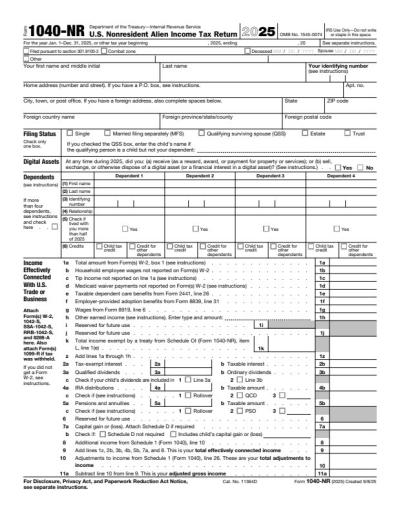
Form 1040-NR is the federal income tax return for nonresident aliens and, in some cases, nonresident alien estates and trusts. Its official IRS title is Form 1040-NR, U.S. Nonresident Alien Income Tax Return. The current form in this template is the 2025 revision. It is used to report U.S.-source income, calculate tax, claim withholding and credits, and request a refund or pay any balance due.
The form is organized into identifiable sections. Page 1 covers your name, identifying number, filing status, digital asset question, dependents, and the Income Effectively Connected With U.S. Trade or Business lines 1a through 11a. Page 2 covers Tax and Credits on lines 11b through 24, Payments and Refundable Credits on lines 25 through 33, refund and balance-due lines 34 through 38, and the signature area. Most filers must also attach Schedule OI (Form 1040-NR), and some must attach Schedule NEC, Schedule A (Form 1040-NR), or other IRS schedules.
Who needs to fill this out?
- File if you were a nonresident alien engaged in a U.S. trade or business during 2025, even if you had no income from that business, no U.S.-source income, or income exempt by treaty.
- File if you were not engaged in a U.S. trade or business but received U.S.-source income reportable on Schedule NEC, lines 1 through 12, and the full tax was not withheld.
- File if you owe special taxes, including alternative minimum tax, household employment taxes, additional tax on IRAs or other tax-favored accounts, or uncollected Social Security and Medicare tax carried through Schedule 2.
- File if you had HSA, Archer MSA, or Medicare Advantage MSA distributions that must be reported through Schedule 2.
- File if you had at least $400 of net self-employment earnings and are a resident of a country that has a U.S. totalization agreement.
- File if advance premium tax credit payments were made for you or a dependent through the Marketplace.
- File if you are the personal representative, estate, or trust for a taxpayer or entity with a Form 1040-NR filing duty.
- You may not need to file if you were an F, J, M, or Q visa student, teacher, or trainee with no income subject to section 871; if you qualified for Article 21(2) of the U.S.-India treaty and 2025 gross income was not more than $15,750 if single or $31,500 if a qualifying surviving spouse; or if your only U.S.-source partnership income was fully handled on Schedule NEC with correct withholding.
Where and how to submit
Form 1040-NR is submitted to the IRS, not to an employer, school, or withholding agent. The IRS accepts electronic filing for Form 1040-NR through supported software and authorized e-file providers. If you e-file, you usually do not mail a paper copy unless the IRS later requests documents.
For 2025 filings mailed by an individual, use Department of the Treasury, Internal Revenue Service, Austin, TX 73301-0215, USA if no payment is enclosed, or Internal Revenue Service, P.O. Box 1303, Charlotte, NC 28201-1303, USA if a payment is enclosed. Estates and trusts without payment use Internal Revenue Service, Kansas City, MO 64999, USA; with payment they use the Charlotte P.O. Box. Calendar-year 2025 returns are generally due April 15, 2026 or June 15, 2026, depending on whether wages subject to U.S. withholding were received.
How to fill it out
- Step 1 — Identification and filing status: Enter your name, identifying number, street address, foreign country name, and foreign postal code at the top of page 1. Check one filing status box only: Single, Married filing separately, Qualifying surviving spouse, Estate, or Trust. Answer the digital asset question.
- Step 2 — Dependents: In the dependents table, enter each dependent's first name, last name, identifying number, relationship, whether the dependent lived with you more than half of 2025, and whether the dependent qualifies for the child tax credit or credit for other dependents.
- Step 3 — Income effectively connected with a U.S. trade or business: Complete lines 1a through 11a. Use Form W-2 box 1 for line 1a, taxable interest on line 2b, taxable dividends on line 3b, IRA distributions on lines 4a and 4b, pensions and annuities on lines 5a and 5b, capital gain or loss on line 7a, Schedule 1 income on line 8, total income on line 9, adjustments from Schedule 1 line 26 on line 10, and adjusted gross income on line 11a. Treaty-exempt income must agree with Schedule OI item L.
- Step 4 — Tax and credits: On page 2, carry line 11a to line 11b. Enter itemized deductions from Schedule A (Form 1040-NR) on line 12, qualified business income deduction on line 13a if applicable, estate or trust exemption on line 13b, and Schedule 1-A deductions on line 13c. Complete tax on line 16, additional taxes on line 17, credits on lines 19 and 20, tax from Schedule NEC line 15 on line 23a, and total tax on line 24.
- Step 5 — Payments, refund, or amount due: Enter withholding on lines 25a through 25g, including Form W-2 on line 25a, Form 1099 on line 25b, Form 8805 on line 25e, Form 8288-A on line 25f, and Form 1042-S on line 25g. Enter 2025 estimated tax payments on line 26 and any Form 1040-C credit on line 29. Total payments on line 33, compute overpayment on line 34 or balance due on line 37, and complete refund lines 35a through 35e if you want a refund.
- Step 6 — Designee, signature, and attachments: Complete the Third Party Designee section only if you want the IRS to discuss the return with someone else. Sign and date the form, enter your occupation, and attach required schedules and withholding forms, including Schedule OI, and when applicable Schedule NEC, Schedule A (Form 1040-NR), Forms W-2, 1042-S, 8288-A, 8805, and Form 8833.
Important deadlines & penalties
- April 15, 2026: Due date for calendar-year 2025 Form 1040-NR if you were an employee and received wages subject to U.S. income tax withholding.
- June 15, 2026: Due date if you did not receive wages as an employee subject to U.S. withholding.
- Estates and trusts: If the nonresident alien estate or trust has a U.S. office, the return is due by the 15th day of the 4th month after year end; without a U.S. office, it is due by the 15th day of the 6th month after year end.
- Automatic extension: Form 4868 can give most Form 1040-NR filers an automatic 6-month extension to file. The extension moves the filing deadline, but not the payment deadline, so estimated tax should still be paid by the original due date.
- Late filing penalty: The IRS failure-to-file penalty is generally 5% of the unpaid tax for each month or part of a month the return is late, up to 25%. If the return is more than 60 days late, the minimum penalty for Forms 1040 due during 2025 is generally $510 or 100% of the unpaid tax, whichever is less; for returns due after December 31, 2025, the listed minimum is $525.
- Late payment penalty: The IRS failure-to-pay penalty is generally 0.5% of unpaid tax per month, up to 25%. If both late-filing and late-payment penalties apply in the same month, the failure-to-file penalty is reduced by the failure-to-pay amount for that month.
- Special timing rules: When the due date falls on a Saturday, Sunday, or legal holiday, the deadline shifts to the next business day. Taxpayers serving in or supporting the U.S. Armed Forces in a designated combat zone may qualify for more time.
Common mistakes to avoid
- Choosing an ineligible filing status at the top of page 1. Form 1040-NR filers generally cannot use Married filing jointly or Head of household. Using a resident-only status can cause the IRS to reject the return or recompute tax and credits.
- Leaving out Schedule OI or failing to complete item L for treaty claims. The IRS instructions say Schedule OI is required with Form 1040-NR. Missing treaty details can lead to denial of treaty benefits, refund delays, or IRS correspondence asking for support.
- Claiming the wrong deduction on line 12. Many filers incorrectly enter the standard deduction even though line 12 generally requires itemized deductions from Schedule A (Form 1040-NR). Outside limited exceptions, such as certain residents of India, that can overstate the refund and trigger adjustments.
- Reporting withholding on the wrong payment line. Form 1042-S belongs on line 25g, Form 8288-A on line 25f, Form 8805 on line 25e, W-2 withholding on line 25a, and 1099 withholding on line 25b. Misplacing withholding often causes the IRS to disallow credits until documents are matched manually.
- Using gross amounts instead of taxable amounts on lines 2b, 3b, 4b, or 5b. For example, line 3a shows qualified dividends, but line 3b is the taxable dividend line that flows into income. Entering the wrong figure can overstate or understate adjusted gross income and tax.
- Forgetting to carry Schedule NEC tax to line 23a. U.S.-source income not effectively connected with a U.S. trade or business is taxed separately. If line 23a is blank when Schedule NEC applies, total tax on line 24 will be understated and the IRS may bill additional tax, penalties, and interest.
- Missing signature, date, or identifying number in the Sign Here section. An unsigned paper return is not validly filed, which can expose the taxpayer to late-filing penalties even if the form was mailed on time.
Expert tips
- Match line 1a to Form W-2, box 1, not box 3 or box 5. Social Security and Medicare wage boxes are often higher than taxable wages and should not be used for line 1a.
- Reconcile treaty benefits before filling line 1k and Schedule OI item L. If you are excluding income under a treaty, make sure the treaty article, country of residence, prior-year claim history, and exempt amount all agree across Schedule OI and any Form 8833 attachment.
- Use line 25g aggressively but accurately. Nonresident filers often miss withholding reported on Form 1042-S, especially scholarship, fellowship, royalty, dividend, or independent personal service income. Omitting line 25g can turn a refund into an amount due.
- Check whether line 29 applies before ignoring it. If you paid departure tax with Form 1040-C, that payment belongs on line 29 and directly reduces the balance due.
- If you want a foreign refund mailing address, use line 35e. Do not assume the IRS will infer a foreign mailing address from page 1 if you want the check sent elsewhere outside the United States.
- Review dependents before claiming line 19 credits. Child tax credit and credit for other dependents are restricted for many nonresident filers; the IRS instructions specifically limit full eligibility mainly to residents of Canada and Mexico and, in narrower cases, residents of India and South Korea.
- Use the IRS instructions and Pub. 519 together. The line-by-line instructions tell you where to enter numbers, while Publication 519 explains residency, treaty, and nonresident filing rules that determine whether those numbers belong on Form 1040-NR at all.
Related forms & next steps
- Schedule OI (Form 1040-NR) — required other-information schedule, including treaty disclosure questions.
- Schedule NEC (Form 1040-NR) — computes tax on income not effectively connected with a U.S. trade or business.
- Schedule A (Form 1040-NR) — itemized deductions for nonresident alien filers.
- Form 8833 — treaty-based return position disclosure when required.
- Form 4868 — automatic extension of time to file Form 1040-NR.
- Form 1040-C — U.S. departing alien income tax return; amounts paid may flow to line 29.
- Publication 519 — core IRS guide on U.S. tax rules for aliens.
Frequently asked questions
Who has to file Form 1040-NR?
You generally must file Form 1040-NR if you were a nonresident alien engaged in a U.S. trade or business during the tax year, if you had certain U.S.-source income not fully covered by withholding, or if you owe special taxes reported through Schedule 2. Estates, trusts, and personal representatives may also have to file it.
Is Form 1040-NR the same as Form 1040?
No. Form 1040-NR is specifically for nonresident aliens and follows different rules for filing status, deductions, treaty benefits, and taxation of U.S.-source income. It also requires Schedule OI and may require Schedule NEC or other nonresident-specific schedules.
When is Form 1040-NR due?
For calendar-year 2025 returns, the due date is April 15, 2026 if you received wages subject to U.S. withholding, and June 15, 2026 if you did not receive such wages. Filing an extension with Form 4868 gives more time to file, but not more time to pay tax.
Do I need to attach Form 1042-S to Form 1040-NR?
Yes, if Form 1042-S reports withholding or income relevant to your return, you should attach it and claim the withholding on line 25g. Missing Forms 1042-S are a common reason refunds are delayed or reduced.
Can I claim treaty benefits on Form 1040-NR?
Yes, if an applicable U.S. income tax treaty allows the benefit and you meet the treaty requirements. You must disclose the claim on Schedule OI, especially item L, and may also need to attach Form 8833.
Can I e-file Form 1040-NR?
Yes. The IRS allows Form 1040-NR to be filed electronically through compatible software and authorized providers. E-filing usually reduces math and attachment errors and may produce faster acknowledgments and refunds.
Can I create Form 1040-NR, U.S. Nonresident Alien Income Tax Return in bulk?
Yes. PDFengine supports bulk generation of Form 1040-NR, U.S. Nonresident Alien Income Tax Return via Excel or CSV upload — upload a spreadsheet with one row per entry and PDFengine generates all PDFs at once. You can also automate bulk creation programmatically via the PDFengine API.
Ready to fill it in?
Fill in this formOfficial sources
- About Form 1040-NR — IRS overview of the return and linked schedules.
- Instructions for Form 1040-NR (2025) — official filing instructions, due dates, schedules, and line guidance.
- Where to file Form 1040-NR — official IRS mailing addresses for international filings.
- IRS failure-to-file penalty — official penalty percentages and minimum late-filing penalty amounts.
- IRS failure-to-pay penalty — official monthly late-payment penalty rules and reduced-rate payment plan guidance.



