
Form 1040-X, filled in online.
Form 1040-X — official IRS fillable PDF form
Type in the panel and watch each answer land on the page. Filling in and signing is free; downloading needs a free account, which includes 5 downloads a month.
Or fill it another way:
- Category
- Tax
- Fillable fields
- 166
- Pages
- 2
- Paper size
- US Letter, 8.5 × 11 in
Five ways to fill this form.
-
Fill it in here
Type in the panel and watch it land on the form. Sign it, then download.
Free to fill and sign Start filling -
Many at once, from a spreadsheet
One row per person, one finished PDF for each.
Paid plan · you can walk through it Start with a spreadsheet -
Send it to someone to fill in
Email a link. They fill it in without an account and you get the answers back.
Paid plan · you can walk through it Send a request -
From your own software
Fill it over the API. One request returns the finished PDF.
Paid plan -
Let an AI assistant do it
Connect ChatGPT or Claude once, then describe what goes on the form.
With a free account
Key facts
| Item | Details |
|---|---|
| Form number | Form 1040-X |
| Official name | Amended U.S. Individual Income Tax Return |
| Issuing agency | Internal Revenue Service (Department of the Treasury) |
| Current revision date | Rev. February 2024 for the form in this template |
| Number of pages | 2 pages |
| Filing frequency | As needed, one separate Form 1040-X for each tax year amended |
| Related instructions document | Instructions for Form 1040-X (continuous-use instructions; Rev. September 2024 for the prior-year 2024 instructions) |
What is this form?
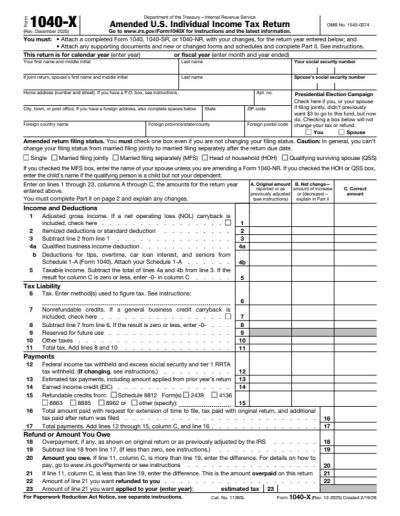
Form 1040-X, Amended U.S. Individual Income Tax Return, is the IRS form used to correct a previously filed federal individual income tax return. Taxpayers use Form 1040-X to amend an original Form 1040, Form 1040-SR, or Form 1040-NR; older returns originally filed on Form 1040-A or 1040-EZ are also corrected through this form. It is used to change amounts the IRS already processed, make certain late elections, or claim a refund, carryback, credit, or deduction that was missed on the original filing.
The form in this template is the Rev. February 2024 version, while the IRS updates the instructions separately as a continuous-use publication. Page 1 reports the numerical changes in columns A (original amount), B (net change), and C (correct amount) for lines 1 through 23. Page 2 contains Part I—Dependents and Part II—Explanation of Changes, where the filer explains each correction and attaches supporting schedules.
Who needs to fill this out?
- Individuals who already filed Form 1040, 1040-SR, or 1040-NR and later discover a change to filing status, income, deductions, credits, dependents, withholding, estimated tax, or tax liability should file Form 1040-X.
- Taxpayers claiming a refund because they missed deductions, refundable credits, a qualified business income deduction, or a loss or credit carryback generally use Form 1040-X if the claim is still timely.
- Taxpayers changing amounts previously adjusted by the IRS may use Form 1040-X to show the corrected figures and explain why the IRS-adjusted amount is still wrong.
- Nonresident or dual-status individuals may also use Form 1040-X to amend Form 1040-NR or to correct a filing that should have been made on Form 1040 instead of Form 1040-NR. There is no income threshold for Form 1040-X; the trigger is a material change to an already filed individual return.
- Do not file Form 1040-X if the IRS already corrected math or clerical errors, if the IRS only asks you to send a missing schedule, if you want a refund of penalties or interest already paid (use Form 843), or if you are filing only an injured spouse claim (use Form 8379).
Where and how to submit
Form 1040-X is filed with the Internal Revenue Service, not with an employer or state agency. The IRS allows electronic filing through participating software for the current year and generally the two prior tax periods; older amended returns and some special situations must be mailed on paper. For calendar year 2025 paper filings, the IRS lists these addresses: many eastern and midwestern states mail to Department of the Treasury, Internal Revenue Service, Kansas City, MO 64999-0052; Alabama, Arkansas, Florida, Georgia, Louisiana, Mississippi, Oklahoma, and Texas mail to Department of the Treasury, Internal Revenue Service, Austin, TX 73301-0052; and many western states mail to Department of the Treasury, Internal Revenue Service, Ogden, UT 84201-0052.
Taxpayers with a foreign address, APO or FPO address, certain territorial filings, Form 2555, Form 4563, or dual-status issues generally mail to Department of the Treasury, Internal Revenue Service, Austin, TX 73301-0215. To claim a refund, the general deadline is within 3 years after the original return was filed or 2 years after the tax was paid, whichever is later. If you owe additional tax, file and pay by the original due date—usually April 15 for calendar-year filers—to reduce penalties and interest.
How to fill it out
- Step 1 — Header, tax year, and filing status: Enter the calendar or fiscal year being amended, then complete your name, SSN, current address, and spouse information if applicable. Check the amended filing status box for Single, MFJ, MFS, HOH, or QSS. If you check MFS, enter your spouse's name in the spouse-name field.
- Step 2 — Income and deductions (lines 1 through 5): Use column A for the amount originally reported or later adjusted, column B for the increase or decrease, and column C for the corrected figure. Complete line 1 for adjusted gross income, line 2 for itemized deductions or standard deduction, line 3 for the difference, line 4a for the qualified business income deduction, line 4b for Schedule 1-A deductions, and line 5 for taxable income.
- Step 3 — Tax liability (lines 6 through 11): On line 6, enter the corrected tax and the method used if required. Then complete line 7 for nonrefundable credits, line 8 for tax after credits, line 10 for other taxes, and line 11 for total tax.
- Step 4 — Payments, refund, or amount due (lines 12 through 23): Correct withholding on line 12, estimated tax on line 13, EIC on line 14, refundable credits on line 15, and extension or later payments on line 16. Then compute lines 17 through 23 to determine total payments, prior overpayment, amount you owe, refund requested, or the amount applied to next year's estimated tax.
- Step 5 — Part I, Dependents (page 2, lines 24 through 29): If your amendment changes who you claim, update the dependent counts and complete the dependent table with each dependent's name, SSN, relationship, residency checkboxes, and the child tax credit or credit for other dependents checkboxes. Pay particular attention to line 25 and line 27.
- Step 6 — Part II, explanation and attachments: In Part II—Explanation of Changes, explain every changed line and why it changed. Attach every new or changed form or schedule that supports the amendment, such as Schedule A, Schedule 8812, Form 8962, or a corrected Form W-2.
- Step 7 — Sign and file: Sign and date the return in the Sign Here section; for a joint amendment, the spouse must also sign. Complete the Paid Preparer Use Only section if applicable, then submit the form electronically or mail it to the proper IRS address with the required attachments.
Important deadlines & penalties
- Refund claims: In general, file Form 1040-X within 3 years after the date you filed the original return or within 2 years after the date you paid the tax, whichever is later. If you filed early, the IRS usually treats the return as filed on the regular due date, typically April 15.
- If you owe more tax: File the amendment and pay by the original due date for that year—generally April 15 for calendar-year filers. An extension of time to file is not an extension of time to pay.
- Failure-to-file penalty: The IRS generally charges 5% of the tax due per month or part of a month the return is late, up to 25%.
- Failure-to-pay penalty: The IRS generally charges 0.5% of unpaid tax per month or part of a month, up to 25%. If you are on an approved installment agreement and filed on time, the monthly rate can drop to 0.25%.
- Minimum late-filing penalty: If an individual Form 1040 series return is more than 60 days late, the minimum penalty for returns due in calendar year 2025 is generally $510 or 100% of the unpaid tax, whichever is less.
- Special deadline extensions: Longer amendment periods can apply for disasters, combat zones, bad debts or worthless securities, and certain foreign tax credit claims.
Common mistakes to avoid
- Putting corrected numbers directly into column C without reconciling columns A and B on lines 1 through 23. That often causes IRS delays because the form no longer shows how the amendment was calculated.
- Using the wrong figure in line 1, column A for adjusted gross income. Column A must show the original amount or the amount previously adjusted by the IRS, not the amount you now believe is correct.
- Failing to attach the form or schedule that supports a changed line, such as Schedule A for line 2, Schedule 8812 for line 15, or Form 8962 for refundable credit changes. Missing attachments are a common reason amended returns stall.
- Leaving Part II too vague. Writing only "corrected income" or "missed deduction" without identifying the affected lines can trigger an IRS request for more information.
- Misreporting payments or credits on line 12, line 13, or line 15 without matching Forms W-2, 1099, or prior-year carryovers. That can reduce the refund claimed on lines 21 through 23.
- Forgetting to update Part I dependents after changing credits or filing status. If line 25, line 27, or the credit checkboxes do not support the claimed credit, the IRS may disallow it.
- Mailing an unsigned paper amendment or omitting a spouse's signature on a joint amendment. The IRS will not process an unsigned Form 1040-X.
Expert tips
- Start with a copy of the original return. The IRS instructions specifically suggest making the corrections there first, then transferring the final figures into columns A, B, and C.
- Use IRS-adjusted amounts in column A if the IRS already changed the return. This is one of the easiest technical rules to miss.
- Explain changes by line number in Part II. A short note such as "Line 2 increased by $3,450 because taxpayer is now itemizing on attached Schedule A" is much stronger than a vague narrative.
- Review line 15 carefully. Refundable credits often require a matching checkbox or attached form, such as Schedule 8812, Form 2439, Form 4136, Form 8863, or Form 8962.
- If you expect a refund on a 2021-or-later amendment, consider e-filing. Eligible electronically filed amended returns can request direct deposit, while paper-filed Form 1040-X refunds are generally paid by check.
Related forms & next steps
- Form 1040 — Original U.S. individual income tax return that Form 1040-X corrects. IRS form page
- Form 1040-SR — Original individual return for seniors that can also be amended with Form 1040-X. IRS form page
- Form 1040-NR — U.S. Nonresident Alien Income Tax Return; certain nonresident amendments flow through Form 1040-X. IRS form page
- Schedule A (Form 1040) — Itemized deductions schedule often attached when line 2 changes. IRS schedule page
- Form 1045 — Application for Tentative Refund that may be available instead of Form 1040-X for certain carrybacks. IRS form page
- Form 843 — Claim for Refund and Request for Abatement, used instead of Form 1040-X for refund requests involving penalties or interest already paid. IRS form page
- Form 8379 — Injured Spouse Allocation, used when a joint refund was offset against the other spouse's debt. IRS form page
- Instructions for Form 1040-X — Official IRS instructions covering filing limits, special rules, and attachments. IRS instructions
Frequently asked questions
What is Form 1040-X used for?
Form 1040-X is used to amend a previously filed federal individual income tax return. Taxpayers use it to correct filing status, income, deductions, credits, dependents, payments, or tax liability on an earlier Form 1040, 1040-SR, or 1040-NR.
Can I file Form 1040-X electronically?
Yes, in many cases. The IRS allows electronic filing of amended returns through participating software for the current tax year and generally the two prior tax periods. Older years and some special situations still require paper filing.
How long do I have to amend my return with Form 1040-X?
To claim a refund, the general rule is three years from the date the original return was filed or two years from the date the tax was paid, whichever is later. Special longer periods can apply for disaster relief, combat zones, bad debts, worthless securities, and certain foreign tax credit claims.
Do I need to attach corrected schedules to Form 1040-X?
Yes. You should attach every form or schedule affected by the change. Under current IRS guidance, paper-filed Form 1040-X submissions must also include a completed updated Form 1040, 1040-SR, or 1040-NR showing the corrected entries.
How long does the IRS take to process Form 1040-X?
The IRS says you should generally allow about 8 to 12 weeks, although some amended returns can take up to 16 weeks or longer. You can usually check the status through the IRS Where's My Amended Return? tool about three weeks after filing.
Will the IRS send my amended return refund by direct deposit?
If you electronically file an eligible amended return for tax year 2021 or later, you can generally request direct deposit. If you mail a paper Form 1040-X, the IRS generally issues any refund by paper check.
Can I create Form 1040-X, Amended U.S. Individual Income Tax Return in bulk?
Yes. PDFengine supports bulk generation of Form 1040-X, Amended U.S. Individual Income Tax Return via Excel or CSV upload — upload a spreadsheet with one row per entry and PDFengine generates all PDFs at once. You can also automate bulk creation programmatically via the PDFengine API.
Ready to fill it in?
Fill in this formOfficial sources
- About Form 1040-X, Amended U.S. Individual Income Tax Return — IRS overview of the form's purpose and e-file availability.
- Instructions for Form 1040-X — Official IRS instructions covering line entries, filing limits, attachments, and penalties.
- File an amended return — IRS guidance on when to amend, how to file, refunds, and balances due.
- Where to file addresses for Form 1040-X — Official IRS mailing addresses for paper-filed amended returns.
- Failure to file penalty — IRS penalty page with current monthly and minimum late-filing penalty rules for individual returns.



