
IRS Form 172 Net Operating Losses (NOLs), filled in online.
IRS Form 172 Net Operating Losses (NOLs) — official fillable PDF form
Type in the panel and watch each answer land on the page. Filling in and signing is free; downloading needs a free account, which includes 5 downloads a month.
Or fill it another way:
- Category
- Tax
- Fillable fields
- 109
- Pages
- 3
- Paper size
- US Letter, 8.5 × 11 in
Five ways to fill this form.
-
Fill it in here
Type in the panel and watch it land on the form. Sign it, then download.
Free to fill and sign Start filling -
Many at once, from a spreadsheet
One row per person, one finished PDF for each.
Paid plan · you can walk through it Start with a spreadsheet -
Send it to someone to fill in
Email a link. They fill it in without an account and you get the answers back.
Paid plan · you can walk through it Send a request -
From your own software
Fill it over the API. One request returns the finished PDF.
Paid plan -
Let an AI assistant do it
Connect ChatGPT or Claude once, then describe what goes on the form.
With a free account
What is this form?
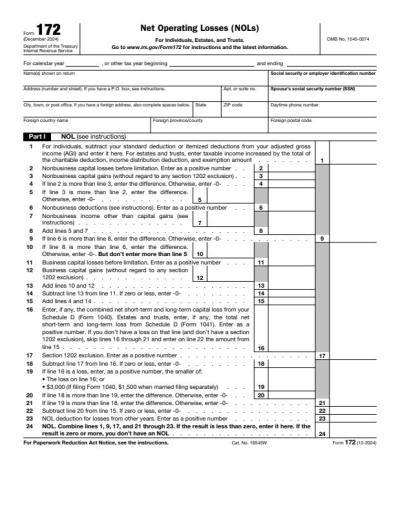
IRS Form 172 Net Operating Losses (NOLs) is an official form issued by the Internal Revenue Service (IRS) to compute a net operating loss and document the nonbusiness and business adjustments that determine the loss available under federal tax rules. The form starts from income or loss reported on the taxpayer’s return, then applies statutory adjustments for capital gains and losses, nonbusiness deductions, pass-through items, and other limitations. The final amount supports a carryforward or another NOL-related filing; it does not by itself claim a refund.
\nUse the official instructions for the relevant filing year alongside this fillable version. PDFengine helps you enter data into the original PDF and download a completed copy, but it does not decide eligibility, calculate facts that are not supplied, or submit the form for you. Before signing, compare every identifier, date, amount, checkbox, and attachment against source records. A technically complete PDF can still be rejected when information is inconsistent, a required schedule is missing, or an outdated revision is used.
Who needs to fill this out?
This template is most relevant to people and organizations in the following situations:
\n- Individuals whose deductions and business losses may exceed income for a tax year. Review the official eligibility and filing rules before relying on this form.
- Estates and trusts calculating a federal net operating loss. Review the official eligibility and filing rules before relying on this form.
- Tax professionals preparing an NOL carryforward schedule. Review the official eligibility and filing rules before relying on this form.
- Taxpayers supporting an amended return or tentative refund application with an NOL computation. Review the official eligibility and filing rules before relying on this form.
If your facts fall outside these examples, consult the issuing agency’s current instructions or a qualified adviser. Do not enter placeholder identifiers or estimates merely to make every field appear complete; leave fields blank only when the instructions permit it and use the required notation when a line calls for zero, none, or not applicable.
Where and how to submit
Attach the completed computation to the federal filing for which the IRS instructions require it, such as an amended return or other NOL claim, and retain it with the source schedules. The filing location and deadline follow the related return, not Form 172 alone. Verify the tax year’s NOL rules because carryback and carryforward treatment has changed repeatedly. PDFengine does not transmit this form to the issuing agency. Download the final PDF, check that all entries remain visible, and use only the agency’s accepted filing channel. Protect the file in storage and transit because tax, identity, financial, or personnel information may be sensitive. Record the submission date, delivery or confirmation number, amount paid when applicable, and the exact version sent so you can answer a later notice or prepare a correction.
How to fill it out
Gather identification records, the related return or transaction documents, and the current agency instructions before starting. Then complete the PDF in this order:
\n- \n
- Step 1 — For calendar year: Enter the applicable date or period in the format printed on the form and confirm that it matches the tax year, transaction, or supporting record. This label comes directly from the official PDF, so match it to the same line in the agency instructions.
- Step 2 — Name(s) shown on return: Enter the complete legal name used in the related agency record or source document; use a trade name only when the label or instructions specifically request it. This label comes directly from the official PDF, so match it to the same line in the agency instructions.
- Step 3 — Social security or employer identification number: Copy this identifier exactly from the official record, preserving every digit and any required leading zero; then compare it a second time before continuing. This label comes directly from the official PDF, so match it to the same line in the agency instructions.
- Step 4 — Line 1: For individuals, subtract your standard deduction or itemized deductions from your adjusted gross income (AGI) and enter it here. For estates and trusts, enter taxable income increased by the total of the charitable deduction, income distribution deduction, and exemption amount: Enter the requested address component exactly as used for official correspondence, including unit, state, postal code, and foreign-address details when applicable. This label comes directly from the official PDF, so match it to the same line in the agency instructions.
- Step 5 — Line 2: Nonbusiness capital losses before limitation. Enter as a positive number: Transfer the correct monetary or calculated amount from the named return, schedule, payroll record, or transaction document; apply the official line instruction and recheck the arithmetic. This label comes directly from the official PDF, so match it to the same line in the agency instructions.
- Step 6 — Line 6: Nonbusiness deductions: Transfer the correct monetary or calculated amount from the named return, schedule, payroll record, or transaction document; apply the official line instruction and recheck the arithmetic. This label comes directly from the official PDF, so match it to the same line in the agency instructions.
After completing these steps, inspect the entire PDF page by page. Calculated totals should reconcile to source schedules, checkbox answers should not conflict, and names and identifiers should remain consistent across all pages. Sign and date only after that review, and add any schedules, statements, payment, or evidence required by the official instructions.
Frequently asked questions
Does Form 172 create an automatic refund?
\nNo. It computes the NOL; you must use the appropriate return or refund procedure to apply that loss. Always verify the current instructions when dates, thresholds, addresses, or agency procedures could have changed.
\nCan capital losses be included without adjustment?
\nNo. Business and nonbusiness capital gains and losses are handled through specific lines and limitations on the form. Always verify the current instructions when dates, thresholds, addresses, or agency procedures could have changed.
\nShould I enter negative amounts?
\nFollow each line instruction carefully. Several lines explicitly require a positive number or zero even when the source item is a loss. Always verify the current instructions when dates, thresholds, addresses, or agency procedures could have changed.
\nWhich tax year’s instructions should I use?
\nUse the instructions and law applicable to the loss year and the year in which the NOL is used. Always verify the current instructions when dates, thresholds, addresses, or agency procedures could have changed.
\nDo estates and trusts calculate line 1 like individuals?
\nNo. Estates and trusts begin with taxable income modified by the charitable deduction, income distribution deduction, and exemption amount as directed. Always verify the current instructions when dates, thresholds, addresses, or agency procedures could have changed.
\nCan I create IRS Form 172 Net Operating Losses (NOLs) in bulk?
\nYes. PDFengine supports bulk generation of IRS Form 172 Net Operating Losses (NOLs) via Excel or CSV upload: use one row per form and map each spreadsheet column to the corresponding PDF field. PDFengine then generates the completed PDFs together. You can also automate bulk creation programmatically through the PDFengine API. Bulk generation speeds up data entry but does not replace record-by-record validation, signatures, attachments, or submission through the issuing agency’s approved channel.
Ready to fill it in?
Fill in this form


