
Form 4562, filled in online.
Form 4562 — official IRS fillable PDF form
Type in the panel and watch each answer land on the page. Filling in and signing is free; downloading needs a free account, which includes 5 downloads a month.
Or fill it another way:
- Category
- Tax
- Fillable fields
- 275
- Pages
- 3
- Paper size
- US Letter, 8.5 × 11 in
Five ways to fill this form.
-
Fill it in here
Type in the panel and watch it land on the form. Sign it, then download.
Free to fill and sign Start filling -
Many at once, from a spreadsheet
One row per person, one finished PDF for each.
Paid plan · you can walk through it Start with a spreadsheet -
Send it to someone to fill in
Email a link. They fill it in without an account and you get the answers back.
Paid plan · you can walk through it Send a request -
From your own software
Fill it over the API. One request returns the finished PDF.
Paid plan -
Let an AI assistant do it
Connect ChatGPT or Claude once, then describe what goes on the form.
With a free account
Key facts
| Form number | Form 4562 |
|---|---|
| Official name | Depreciation and Amortization (Including Information on Listed Property) |
| Issuing agency | Internal Revenue Service, Department of the Treasury |
| Current revision date | 2025 revision |
| Number of pages | 3 pages |
| Filing frequency | Filed as needed with an annual federal income tax return |
| Attachment sequence | Sequence No. 179 |
| Related instructions document | 2025 Instructions for Form 4562 |
What is this form?
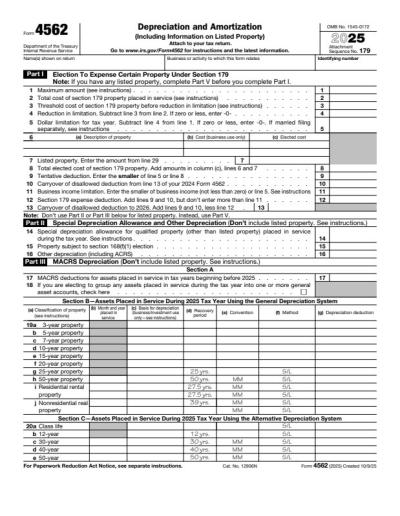
Form 4562 is the federal tax form used to claim depreciation and amortization deductions for business or income-producing property. Its official name is Form 4562, Depreciation and Amortization (Including Information on Listed Property). Taxpayers use Form 4562 to elect a deduction under section 179, claim special depreciation allowance, report MACRS depreciation, and disclose business or investment use of listed property such as passenger automobiles, trucks, SUVs, aircraft, and other property that may have personal-use potential. The current IRS form is the 2025 revision, and it must be attached to the taxpayer's federal income tax return.
Form 4562 is divided by topic. Part I covers the section 179 election on lines 1 through 13. Part II reports special depreciation allowance and other depreciation on lines 14 through 16. Part III reports MACRS depreciation, including the 2025 form's new line 19h and line 20e for 50-year property. Part IV summarizes the deduction totals and includes lines 23a and 23b for section 263A capitalized costs. Part V covers listed property and vehicle-use substantiation, while Part VI reports amortization on lines 42 through 44.
In practical terms, Form 4562 is where a business converts asset cost into deductible tax expense. It does not stand alone. The form says Attach to your tax return, so it travels with the underlying return such as Form 1040 with Schedule C, Form 1065, Form 1120, or Form 1120-S. The 2025 version also adds line 24c for taxpayers who own, lease, or charter an aircraft, which is easy to miss if someone is reusing an older checklist.
Who needs to fill this out?
- Taxpayers claiming depreciation for property placed in service during the 2025 tax year must file Form 4562.
- Taxpayers claiming a section 179 expense deduction, including a carryover from a prior year, must file it.
- Anyone claiming depreciation on a vehicle or other listed property must file it, even if the property was placed in service in an earlier year.
- Anyone claiming a deduction for any vehicle on a form other than Schedule C (Form 1040) must file it.
- Corporations claiming depreciation on a corporate income tax return other than Form 1120-S must file it.
- Taxpayers claiming amortization of costs that begins during the 2025 tax year must file Part VI.
- You generally do not need Form 4562 if you are not claiming current-year depreciation, section 179, listed-property depreciation, or new amortization for the year.
- Employees deducting job-related vehicle expenses do not use Form 4562 for that purpose; the IRS directs them to Form 2106. An estate or trust cannot make the section 179 election in Part I, although it may still need Form 4562 for other depreciation or amortization items.
Where and how to submit
Form 4562 is submitted with the federal income tax return for the taxpayer and activity involved. It is not usually sent to a separate IRS address by itself. If the return is paper filed, the correct mailing address is the one listed in the instructions for the underlying return, such as Form 1040, Form 1065, Form 1120, or Form 1120-S. The form itself states Attach to your tax return.
Electronic filing is allowed when the underlying tax return is e-filed and Form 4562 is included in that filing. The deadline is the same as the deadline for the return it supports. For many calendar-year individual filers that means April 15. For many calendar-year partnerships and S corporations that means March 15. If a taxpayer makes or revokes a section 179 election on an amended return, the IRS instructions say that amended return must be filed within the time prescribed by law for the applicable tax year.
How to fill it out
- Step 1 — Header information: Enter the Name(s) shown on return, Identifying number, and the Business or activity to which this form relates at the top of page 1. If multiple businesses or activities each require Form 4562, prepare a separate form for each one.
- Step 2 — Part I, Election To Expense Certain Property Under Section 179: Complete lines 1 through 5 to calculate the section 179 limitation. On line 6, columns (a) through (c), enter each item's Description of property, Cost (business use only), and Elected cost. Enter listed-property section 179 cost from line 29 on line 7, then finish lines 8 through 13 to compute the allowed deduction and any carryover.
- Step 3 — Parts II and III, non-listed property depreciation: Use line 14 for Special depreciation allowance, line 15 for Property subject to section 168(f)(1) election, and line 16 for Other depreciation. In Part III, enter pre-2025 MACRS deductions on line 17. For 2025 assets, complete lines 19a through 19j in Section B or lines 20a through 20e in Section C using the form's fields for Classification of property, Month and year placed in service, Basis for depreciation, Recovery period, Convention, Method, and Depreciation deduction.
- Step 4 — Part IV, Summary: Enter listed-property depreciation from line 28 on line 21. Then complete line 22 by adding the section 179 deduction, depreciation amounts, and listed-property amount. If Part III assets include section 263A costs, report interest costs capitalized under section 263A(f) on line 23a and other capitalized costs on line 23b.
- Step 5 — Part V, Listed Property: Answer line 24a on whether you have evidence supporting business or investment use and line 24b on whether that evidence is written. If applicable, complete line 24c for aircraft ownership, lease, or charter status. In Section A, enter each asset's Type of property, Date placed in service, Business/investment use percentage, Cost or other basis, Basis for depreciation, Recovery period, Method/Convention, Depreciation deduction, and Elected section 179 cost.
- Step 6 — Part V, vehicle-use details and Part VI amortization: If Section B applies, complete lines 30 through 33 for mileage totals and lines 34 through 36 for vehicle-availability questions. In Section C, answer lines 37 through 41 if employees use vehicles. Then complete Part VI by listing amortizable items on line 42, columns (a) through (f), entering prior amortization on line 43, and totaling column (f) on line 44.
Important deadlines & penalties
- General due date: Form 4562 is due on the same date as the federal return it is attached to.
- Calendar-year individuals: The usual due date is April 15.
- Calendar-year partnerships and S corporations: The usual due date is March 15.
- Calendar-year C corporations: The usual due date is April 15.
- Extension for individuals: Form 4868 generally extends the filing deadline to October 15, but it does not extend time to pay tax.
- Extension for many business returns: Form 7004 generally provides an automatic 6-month extension to file certain business returns, but not an extension to pay tax.
- Late-filing penalty: Because Form 4562 is part of the tax return filing package, the IRS general failure-to-file penalty is 5% of the tax due for each month or part of a month the return is late, up to 25%.
- Late-payment penalty: The IRS general failure-to-pay penalty is usually 0.5% of unpaid tax per month, up to 25%, plus interest.
- Accuracy-related penalty: If depreciation, section 179, or listed-property deductions are overstated, the IRS may impose an accuracy-related penalty of 20% of the underpayment.
- Special circumstances: Federally declared disaster relief can extend the filing deadline for the underlying return, which also extends the due date for Form 4562.
Common mistakes to avoid
- Completing Part I before Part V when listed property exists: The form specifically says that if you have listed property, you must complete Part V before Part I. Ignoring that instruction can make line 7 and line 29 inconsistent and distort the section 179 deduction.
- Putting listed property in Part II or Part III: Vehicles and other listed assets belong in Part V, not on lines 14 through 20. Misclassifying them can cause the IRS to question the deduction.
- Answering Yes on lines 24a or 24b without records: Taxpayers often claim they have evidence or written evidence of business use but lack mileage logs or contemporaneous documentation. That can lead to disallowance of the listed-property deduction.
- Mileage totals that do not add up on lines 30 through 33: Total business/investment miles, Total commuting miles, and Total other personal miles should reconcile to Total miles driven during the year. A mismatch weakens substantiation.
- Not reducing basis after a section 179 election: The instructions warn that section 179 expense reduces the amount used for later depreciation and special depreciation allowance. Missing that adjustment can overstate deductions on lines 14, 19, 20, 25, or 42.
- Ignoring the 2025 split between lines 23a and 23b: Current-year assets with section 263A costs now require separate reporting for interest costs capitalized under section 263A(f) and other capitalized costs. Leaving those lines blank or combining the amounts can trigger IRS follow-up.
- Using one form for multiple activities: The IRS says to file a separate Form 4562 for each business or activity that requires one. Combining unrelated activities makes the basis and deduction support harder to verify.
Expert tips
- Start with Part V when vehicles are involved: That note at the top of Part I matters. Completing listed-property calculations first helps the section 179 amount on line 29 flow correctly to line 7.
- Keep written mileage logs: For lines 24a, 24b, and 30 through 36, contemporaneous written records are much stronger than reconstructed estimates. Publication 463 is the key IRS reference.
- Watch the standard mileage rule: If you use the standard mileage rate or deduct lease expense, the note above Part V Section A limits which fields you complete. That exception is easy to overlook.
- Check the 50% business-use threshold carefully: Property used more than 50% in qualified business use goes on line 26. Property used 50% or less goes on line 27 and may lose more favorable treatment.
- Use Publication 946 before assigning recovery periods: If you are unsure whether an item is 5-year, 7-year, 15-year, residential rental, or nonresidential real property, confirm the class life before completing Part III.
- Update old templates for the 2025 changes: The form now includes lines 19h, 20e, 23a, 23b, and 24c. Reusing an older workpaper without those fields is a predictable source of errors.
- Do not forget line 43: Preparers often enter only new amortization on line 42 and miss Amortization of costs that began before your 2025 tax year on line 43, which understates the deduction.
Related forms & next steps
- Form 2106 — Employee Business Expenses; used by employees for job-related vehicle expenses instead of Form 4562.
- Form 7205 — Energy Efficient Commercial Buildings Deduction; the Form 4562 instructions say not to use Form 4562 for section 179D deductions.
- Form 4797 — Sales of Business Property; often used when property depreciated on Form 4562 is sold or disposed of.
- Form 6251 — Alternative Minimum Tax; depreciation may create AMT adjustments for individuals.
- Publication 946 — How To Depreciate Property; the main IRS guide for section 179, MACRS, recovery periods, and depreciation methods.
- Publication 463 — Travel, Gift, and Car Expenses; important for listed-property substantiation and vehicle-use records.
Frequently asked questions
What is Form 4562 used for?
Form 4562 is used to claim depreciation and amortization deductions, elect section 179 expensing, claim special depreciation allowance, and report business use of listed property such as vehicles and certain aircraft. It is attached to the federal income tax return rather than filed by itself in most cases.
Do I need to file Form 4562 every year?
No. You file it only when a filing trigger applies, such as current-year depreciation, section 179, listed-property depreciation, a vehicle deduction on a form other than Schedule C, or amortization beginning during the year.
Can I use the standard mileage rate and still file Form 4562?
Yes. The form states that for a vehicle using the standard mileage rate or deducting lease expense, you complete only lines 24a and 24b, columns (a) through (c) of Part V Section A, all of Section B, and Section C if applicable.
What happens if business use of a vehicle falls to 50% or less?
That changes how listed property is reported. Property used more than 50% in qualified business use is shown on line 26, while property used 50% or less is shown on line 27. It can also affect section 179 treatment and depreciation method.
Can Form 4562 be filed with an amended return?
Yes. The 2025 instructions say a section 179 election, or a revocation of that election, can be made on an amended return filed within the time prescribed by law for the applicable tax year.
What records should I keep for listed property?
Keep mileage logs, purchase records, placed-in-service dates, and records showing business, commuting, and personal use. The answers on lines 24a, 24b, and 30 through 36 should match those records. Publication 463 provides the IRS substantiation rules.
Can I create Form 4562 in bulk?
Yes. PDFengine supports bulk generation of Form 4562 via Excel or CSV upload — upload a spreadsheet with one row per entry and PDFengine generates all PDFs at once. You can also automate bulk creation programmatically via the PDFengine API.
Ready to fill it in?
Fill in this formOfficial sources
- IRS About Form 4562 — official overview of the form's purpose and filing use.
- 2025 Instructions for Form 4562 — official line-by-line instructions, filing requirements, and special rules.
- 2025 Form 4562 PDF — official IRS form showing the exact fields, lines, and sections.
- Publication 946, How To Depreciate Property — official IRS guide to depreciation methods, section 179, and MACRS classifications.
- IRS Failure to File Penalty — official IRS penalty page for late-filed returns that can affect filings that include Form 4562.



