
Form 4868, filled in online.
Application for Automatic Extension of Time to File
Type in the panel and watch each answer land on the page. Filling in and signing is free; downloading needs a free account, which includes 5 downloads a month.
Or fill it another way:
- Category
- Tax
- Fillable fields
- 17
- Pages
- 4
- Paper size
- US Letter, 8.5 × 11 in
Five ways to fill this form.
-
Fill it in here
Type in the panel and watch it land on the form. Sign it, then download.
Free to fill and sign Start filling -
Many at once, from a spreadsheet
One row per person, one finished PDF for each.
Paid plan · you can walk through it Start with a spreadsheet -
Send it to someone to fill in
Email a link. They fill it in without an account and you get the answers back.
Paid plan · you can walk through it Send a request -
From your own software
Fill it over the API. One request returns the finished PDF.
Paid plan -
Let an AI assistant do it
Connect ChatGPT or Claude once, then describe what goes on the form.
With a free account
Key facts
| Form number | Form 4868 |
|---|---|
| Official name | Application for Automatic Extension of Time To File U.S. Individual Income Tax Return |
| Issuing agency | Internal Revenue Service (Department of the Treasury) |
| Current revision date | 2025 edition of the IRS form; IRS page last reviewed March 30, 2026 |
| Number of pages | 4 pages |
| Filing frequency | As needed, generally once per tax year when an individual needs an extension |
| Primary return types covered | Forms 1040, 1040-SR, 1040-NR, and 1040-SS |
| Related instructions document | Instructions printed within the official Form 4868 PDF and cross-references to Form 1040 instructions, Pub. 54, and Pub. 519 |
What is this form?
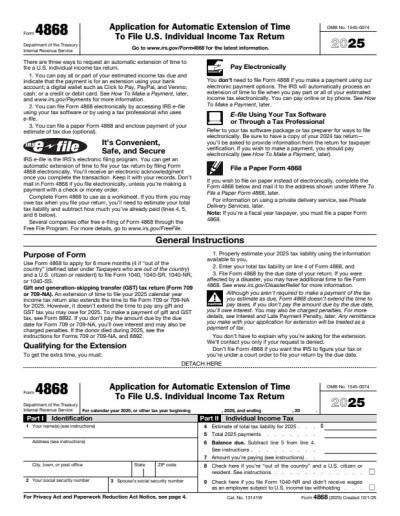
Form 4868, officially titled Application for Automatic Extension of Time To File U.S. Individual Income Tax Return, is the IRS extension form individuals use to request more time to file a federal income tax return. For the current IRS version, Form 4868 applies to returns for tax year 2025 and gives most eligible filers an automatic 6-month filing extension for Form 1040, Form 1040-SR, Form 1040-NR, or Form 1040-SS. It extends the time to file the return, not the time to pay tax due.
The form itself is short, but each line matters. Part I covers identification: line 1 asks for your name and address, line 2 for your social security number, and line 3 for your spouse's social security number if applicable. Part II is where the extension request is validated financially. Line 4 asks for your estimate of total tax liability for 2025, line 5 for total 2025 payments, line 6 for the balance due, and line 7 for the amount you're paying with the extension request.
The IRS current PDF is labeled Form 4868 (2025) and spans 4 pages, including instructions, payment guidance, penalty rules, and the state-based paper filing addresses on page 4. Two special checkboxes also drive eligibility in less common cases: line 8 is for taxpayers who are out of the country on the return due date, and line 9 is for certain Form 1040-NR filers who did not receive wages subject to U.S. withholding.
Who needs to fill this out?
- U.S. citizens and residents who need extra time to file Form 1040 or Form 1040-SR for tax year 2025 should file Form 4868 by the regular due date, generally April 15, 2026.
- Nonresident filers who will file Form 1040-NR and cannot file by the return's due date should use Form 4868. If they did not receive wages as an employee subject to U.S. income tax withholding and the return is due June 15, 2026, they should also check line 9.
- Form 1040-SS filers may use Form 4868 to request the automatic extension to file.
- Taxpayers abroad who are already allowed the automatic 2-month postponement because they are out of the country on the regular due date may file Form 4868 by June 15, 2026 and check line 8 if they need the additional 4 months.
- Fiscal-year individual taxpayers can use Form 4868, but the IRS instructions say they must file a paper Form 4868 rather than relying on the standard electronic workflow for calendar-year filers.
- Estate or trust filers using Form 1040-NR may use the form and enter an EIN on line 2, marking it as estate or trust in the left margin as instructed.
- Who does not need to file: taxpayers who make an electronic payment and indicate that the payment is for an extension do not need to separately submit Form 4868; taxpayers who can file their return on time do not need it; business entities filing returns such as Forms 1120 or 1065 do not use this form; and people asking the IRS to calculate their tax or filing under a court order to file by the due date should not file Form 4868.
Where and how to submit
Form 4868 goes to the IRS, not to an employer, client, or state tax agency. The fastest filing methods are IRS e-file, tax software, or making an electronic extension payment through IRS Direct Pay, EFTPS, credit or debit card, digital wallet, or an IRS online account. For most calendar-year taxpayers using the 2025 form, the filing deadline is April 15, 2026. Taxpayers who are out of the country or certain Form 1040-NR filers may have a June 15 deadline for the extension request, and most approved extensions run to October 15, 2026.
If filing on paper, the exact IRS address depends on where you live and whether you are sending payment. With payment: AL, FL, GA, LA, MS, NC, SC, TN, and TX use P.O. Box 1302, Charlotte, NC 28201-1302; AZ, AR, NM, OK, and many other states use P.O. Box 931300, Louisville, KY 40293-1300; foreign-country, APO/FPO, Puerto Rico, Form 2555, dual-status, Guam, Virgin Islands, 1040-NR, and 1040-SS special categories generally use P.O. Box 1303, Charlotte, NC 28201-1303 USA. Without payment, the IRS centers listed in the instructions are Austin, TX 73301-0045, Kansas City, MO 64999-0045, Ogden, UT 84201-0045, Austin, TX 73301-0215 USA, and Kansas City, MO 64999-0045 USA, depending on residence category. If you use a private delivery service, use the IRS street-address list rather than a P.O. box.
How to fill it out
- Step 1 — Identification: Complete line 1 with your name(s) and mailing address exactly as you want IRS correspondence sent. Enter your SSN on line 2. If filing jointly, enter the spouse's SSN on line 3. If you plan to file a joint return, list both spouses' names in the same order they will appear on the return.
- Step 2 — Estimate total tax liability: On line 4, Estimate of total tax liability for 2025, enter the total tax you expect to report on your final return. The instructions tie this to Form 1040, 1040-SR, or 1040-NR, line 24, or Form 1040-SS, Part I, line 7. If the amount is zero, enter -0-. The estimate must be reasonable or the extension can be invalidated.
- Step 3 — Enter prior payments: On line 5, Total 2025 payments, enter the total payments you expect to report on the return. For Form 1040, 1040-SR, or 1040-NR, this corresponds to line 33, excluding Schedule 3, line 10. For Form 1040-SS, use Part I, line 12, excluding Part I, line 9. Do not include the payment you are making with Form 4868 on line 5.
- Step 4 — Calculate what is still due: On line 6, Balance due, subtract line 5 from line 4. If line 5 exceeds line 4, enter -0-. Then complete line 7, Amount you're paying. You can still get the filing extension even if you cannot pay the full balance, but paying as much as possible reduces interest and late-payment exposure.
- Step 5 — Mark any special filing status: Check line 8 only if you are out of the country on the due date and are a U.S. citizen or resident. Check line 9 only if you are filing Form 1040-NR, did not receive wages subject to U.S. income tax withholding, and your return is due June 15. Do not check both boxes casually; each box signals a specific rule set.
- Step 6 — Submit using the correct channel: File electronically through IRS e-file or a tax professional, or mail the paper form to the address that matches your state, residency category, and whether you are enclosing payment. If you pay electronically and designate the payment as an extension payment, the IRS says you generally do not need to file Form 4868 separately. Keep any electronic acknowledgment or payment confirmation number with your records.
Important deadlines & penalties
- Standard due date: For a 2025 calendar-year return, file Form 4868 by April 15, 2026.
- Out-of-country taxpayers: If you qualify as out of the country on the return due date, you generally have until June 15, 2026 to file the return and pay without requesting an extension. If you still need more time to file, submit Form 4868 by June 15 and check line 8 to extend the filing deadline to about October 15, 2026.
- Form 1040-NR filers without wages subject to U.S. withholding: If the return is due June 15, 2026, file Form 4868 by that date and check line 9.
- Maximum extension period: For most calendar-year filers, the extension runs no later than October 15, 2026. Fiscal-year filers use the due date of the fiscal-year return instead of the April calendar-year deadline.
- Late payment penalty: Usually 0.5% of unpaid tax for each month or part of a month after the payment due date, up to a maximum of 25%. If you filed on time and have an approved payment plan, IRS guidance says the rate can drop to 0.25% per month during the agreement.
- Late filing penalty: Usually 5% of the tax due for each month or part of a month the return is late, up to 25%. If the return is more than 60 days late, the minimum penalty for Forms 1040 and 1120 with a return due date after December 31, 2025 is $525 or 100% of the unpaid tax, whichever is less.
- Interest: Interest accrues on tax not paid by the original due date even when the extension is valid. Form 4868 protects against late filing penalties when properly filed, but it does not stop interest and usually does not stop late payment penalties.
- Special deadline changes: IRS disaster relief, combat-zone relief, and certain overseas rules can move the normal deadline. The IRS directs affected taxpayers to check disaster and combat-zone guidance for the adjusted due dates.
Common mistakes to avoid
- Entering an unrealistic amount on line 4: The IRS instructions say the extension can be null and void if the Estimate of total tax liability for 2025 is not reasonable. A lowball estimate can cost the taxpayer the protection of the extension.
- Including the extension payment on line 5: Line 5, Total 2025 payments should reflect prior payments expected on the return, not the remittance sent with Form 4868. Inflating line 5 understates line 6, Balance due.
- Thinking Form 4868 extends time to pay: Many filers treat line 7, Amount you're paying, as optional and ignore payment entirely. The extension still applies to filing, but unpaid tax can trigger interest and the 0.5% per month late-payment penalty.
- Checking line 8 without qualifying as out of the country: Line 8 applies only to specific taxpayers whose main place of work is outside the United States and Puerto Rico, or who are on military or naval duty outside those locations. Misusing the box can create correspondence and timing issues.
- Missing line 9 for eligible 1040-NR filers: If a nonresident filer did not receive wages subject to U.S. withholding and the return is due June 15, failing to check line 9 can cause confusion about which due-date rule applies.
- Using a paper mailing address that does not match the taxpayer's residence and payment status: Page 4 of the form splits filing addresses by geography and by whether payment is enclosed. Sending the form to the wrong IRS center risks processing delays or a late-filed extension.
- Assuming a new address on line 1 updates IRS records: The instructions say showing a new address on Form 4868 does not update your IRS record. Taxpayers who moved should file Form 8822, or later notices may go to the wrong address.
Expert tips
- Build line 4 from the actual return draft: The cleanest approach is to prepare most of Form 1040 or 1040-NR first, then copy the expected line 24 total tax amount into line 4 of Form 4868.
- Double-check what belongs on line 5: For 1040-series returns, the instructions point to line 33 but specifically exclude Schedule 3, line 10. That exclusion is easy to miss and matters if you are also tracking prior extension payments.
- Pay something even if you cannot pay in full: A partial amount on line 7 reduces the tax base on which interest and late-payment penalties accrue. For many taxpayers, that is more important than perfect precision on the remittance.
- Use electronic payment to simplify compliance: If you pay electronically and designate the payment as an extension payment, the IRS says you generally do not need to submit a separate paper Form 4868. Save the confirmation number shown in the payment section of the form.
- Out-of-country filers should compare Form 4868 and Form 2350: If you need extra time because you expect to meet the bona fide residence or physical presence test later, the IRS instructions direct you to Form 2350 rather than relying only on line 8 of Form 4868.
- Fix identity issues before filing: If a name changed after marriage or divorce, update records with the Social Security Administration first. Mismatches between line 1 and line 2 or 3 can slow processing.
- Use the IRS publications that match your status: Pub. 54 is useful for U.S. citizens and residents abroad, while Pub. 519 helps nonresident filers using Form 1040-NR. These publications answer edge-case timing questions that the one-page form itself does not.
Related forms & next steps
- Form 1040 — the standard U.S. individual income tax return that Form 4868 extends.
- Form 1040-SR — the return for seniors; Form 4868 also extends its filing deadline.
- Form 1040-NR — the nonresident alien income tax return referenced by line 9 of Form 4868.
- Form 1040-SS — used by certain self-employed individuals in U.S. territories; Form 4868 can extend its filing deadline.
- Form 2350 — a separate extension form for taxpayers abroad who need more time to qualify for the foreign earned income exclusion tests.
- Form 8822 — used to officially notify the IRS of an address change; Form 4868 does not update IRS address records by itself.
- Form W-7 — application for an Individual Taxpayer Identification Number when a filer is not eligible for an SSN.
- Instructions for Form 1040 — the instruction booklet that explains where extension payments are later claimed on the tax return.
Frequently asked questions
Does Form 4868 give me more time to pay my taxes?
No. Form 4868 gives more time to file your return, not more time to pay the tax. Interest starts after the original due date, and a late-payment penalty usually applies if tax remains unpaid.
What forms does Form 4868 extend?
For the 2025 version, the IRS says Form 4868 can extend the filing time for Form 1040, Form 1040-SR, Form 1040-NR, and Form 1040-SS. It also coordinates with gift-tax filing timing in some cases, but it does not extend the time to pay gift or GST tax.
Do I need to mail Form 4868 if I pay online?
Usually no. If you make an electronic payment and indicate that the payment is for an extension, the IRS says the extension is generally processed automatically and a separate Form 4868 is not required.
What happens if I estimate line 4 incorrectly?
A small estimation error is not automatically fatal, but the IRS instructions require a proper and reasonable estimate of total 2025 tax liability. If the IRS determines the estimate on line 4 was not reasonable, the extension can be treated as invalid.
Can taxpayers living abroad use Form 4868?
Yes. Taxpayers who are out of the country on the return due date already get an automatic 2-month postponement to file and pay, generally until June 15, 2026, for a 2025 calendar-year return. If they need more time to file, they can submit Form 4868 by that date and check line 8 for the additional 4 months.
Where do I report a payment made with Form 4868 on my final return?
The IRS instructions say payments made with Form 4868 are generally claimed on Schedule 3, line 10 for Form 1040, 1040-SR, or 1040-NR, or on Part I, line 9 of Form 1040-SS, subject to the return instructions.
Can I create Form 4868 in bulk?
Yes. PDFengine supports bulk generation of Form 4868 via Excel or CSV upload — upload a spreadsheet with one row per entry and PDFengine generates all PDFs at once. You can also automate bulk creation programmatically via the PDFengine API.
Ready to fill it in?
Fill in this formOfficial sources
- IRS: About Form 4868 — official overview of who uses the form and links to the current PDF.
- IRS Form 4868 PDF — the official 2025 form and instructions, including line-by-line guidance and mailing addresses.
- IRS Failure to File Penalty — official penalty percentages and minimum late-filing penalty amounts.
- IRS Failure to Pay Penalty — official explanation of the 0.5% monthly late-payment penalty and reduced rates for approved payment plans.
- IRS Newsroom: Act now to file, pay, or request an extension — official filing-season guidance on electronic extension and payment options.



