
Form 5329, filled in online.
Form 5329 — official IRS fillable PDF form
Type in the panel and watch each answer land on the page. Filling in and signing is free; downloading needs a free account, which includes 5 downloads a month.
Or fill it another way:
- Category
- Tax
- Fillable fields
- 75
- Pages
- 3
- Paper size
- US Letter, 8.5 × 11 in
Five ways to fill this form.
-
Fill it in here
Type in the panel and watch it land on the form. Sign it, then download.
Free to fill and sign Start filling -
Many at once, from a spreadsheet
One row per person, one finished PDF for each.
Paid plan · you can walk through it Start with a spreadsheet -
Send it to someone to fill in
Email a link. They fill it in without an account and you get the answers back.
Paid plan · you can walk through it Send a request -
From your own software
Fill it over the API. One request returns the finished PDF.
Paid plan -
Let an AI assistant do it
Connect ChatGPT or Claude once, then describe what goes on the form.
With a free account
Key facts
| Form number | Form 5329 |
|---|---|
| Official name | Additional Taxes on Qualified Plans (Including IRAs) and Other Tax-Favored Accounts |
| Issuing agency | Internal Revenue Service |
| Current revision date | 2025 revision; form footer shows Created 6/12/25 |
| Number of pages | 3 pages |
| Filing frequency | Filed as needed with the annual federal return |
| Main companion returns | Form 1040, 1040-SR, 1040-NR, or 1041 |
| Related instructions document | Instructions for Form 5329 (2025) |
What is this form?
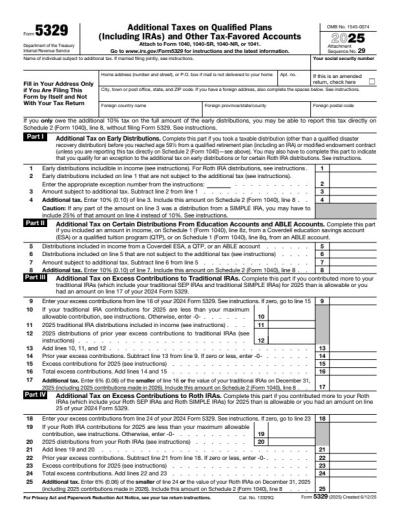
Form 5329, officially titled Additional Taxes on Qualified Plans (Including IRAs) and Other Tax-Favored Accounts, is the IRS form used to report excise taxes that apply when retirement or other tax-favored accounts are handled in a way the tax code penalizes. The 2025 version covers early distributions, certain taxable distributions from education and ABLE accounts, excess contributions, and missed required minimum distributions. The official IRS PDF is a 3-page form, and the 2025 form footer states it was created on 6/12/25.
The form is divided into nine substantive parts. Part I deals with the additional tax on early distributions and the exception numbers entered on line 2. Part II covers certain distributions from Coverdell ESAs, qualified tuition programs, and ABLE accounts. Parts III through VIII address excess contributions to traditional IRAs, Roth IRAs, Coverdell ESAs, Archer MSAs, HSAs, and ABLE accounts, usually at a 6% rate. Part IX covers excess accumulations, meaning missed required minimum distributions from qualified plans and IRAs.
Form 5329 is also used to correct and explain issues that other IRS forms do not fully resolve. Taxpayers use it to calculate tax due on lines such as line 4, line 8, line 17, line 25, line 33, line 41, line 49, line 51, and line 55, but also to claim exceptions not fully reflected on Form 1099-R, carry forward prior-year excess amounts, and request waiver treatment when a missed required minimum distribution was due to reasonable error.
Who needs to fill this out?
- Individuals who took an early distribution before age 59½ from an IRA, 401(k), 403(b), pension, annuity, or modified endowment contract and either owe the additional tax or need to claim an exception in Part I.
- Roth IRA taxpayers whose 2025 Form 8606, line 25c is more than zero, or whose Roth IRA distribution includes a qualified first-time homebuyer amount or a recapture amount from a prior conversion or rollover.
- Taxpayers with taxable Coverdell ESA, qualified tuition program, or ABLE account distributions that were included in income and may trigger Part II.
- Anyone with excess 2025 contributions or a prior-year excess carryover for traditional IRAs, Roth IRAs, Coverdell ESAs, Archer MSAs, HSAs, or ABLE accounts. Relevant 2025 thresholds in the IRS instructions include a general IRA limit of $7,000, or $8,000 if age 50 or older; Roth IRA phaseout starting at $236,000 for married filing jointly, $150,000 for single or head of household, and $0 for married filing separately if spouses lived together; a Coverdell ESA annual limit of $2,000; and an ABLE annual limit of $19,000 plus the additional amount allowed for certain employed beneficiaries.
- Individuals, trusts, and estates that missed a required minimum distribution from a qualified retirement plan, an eligible section 457 plan, or an IRA and must complete Part IX.
- Who generally does not need to file: a taxpayer who owes only the 10% additional tax on the full amount of early distributions and has box 7 of every Form 1099-R correctly coded may often report the tax directly on Schedule 2 (Form 1040), line 8 without filing Form 5329. Living owners of Roth IRAs also do not have lifetime required minimum distributions.
Where and how to submit
Form 5329 is usually filed with a federal income tax return. Individuals attach it to Form 1040, Form 1040-SR, or Form 1040-NR. Trusts and estates attach it to Form 1041. When filed as part of the return package, it may generally be submitted electronically through IRS-authorized software or an approved e-file provider. The tax from Form 5329 usually flows to Schedule 2 (Form 1040), line 8, or for fiduciary returns, Form 1041, Schedule G, line 8.
If you do not otherwise need to file an income tax return, the IRS allows you to file Form 5329 by itself at the same time and place you would file Form 1040, 1040-SR, or 1040-NR. The IRS does not print a single national mailing address on Form 5329 itself; the correct paper-filing address is the address shown in the current Form 1040 series instructions for the filer's state or foreign address. A standalone Form 5329 cannot be e-filed. If you file it by itself, complete the address section on page 1 and the signature section on page 3.
How to fill it out
- Step 1 — Heading and filer information: Enter the name of the individual subject to the additional tax and the Social Security number at the top of page 1. Complete the address fields only if you are filing Form 5329 by itself and not with Form 1040, 1040-SR, 1040-NR, or 1041. If you are amending a previously filed 2025 Form 5329, check the amended return box.
- Step 2 — Part I, Additional Tax on Early Distributions: On line 1, enter early distributions includible in income. On line 2, enter the amount not subject to the additional tax and write the applicable exception number in the exception box; if more than one exception applies, use 99. Subtract line 2 from line 1 on line 3. On line 4, enter 10% of line 3 unless the SIMPLE IRA caution applies and part of line 3 must be taxed at 25%.
- Step 3 — Part II, Certain Distributions From Education Accounts and ABLE Accounts: Enter on line 5 the taxable distributions from a Coverdell ESA, qualified tuition program, or ABLE account that were included in income. Enter on line 6 the portion excluded from the additional tax. Subtract on line 7, then compute line 8 as 10% of line 7.
- Step 4 — Parts III through V, Excess contributions to IRAs and Coverdell ESAs: In Part III, start with prior-year traditional IRA excess on line 9, adjust for current-year room and qualifying distributions through line 16, and compute the 6% tax on line 17. In Part IV, use lines 18 through 24 for Roth IRAs and compute the tax on line 25. In Part V, use lines 26 through 32 for Coverdell ESAs and compute the tax on line 33.
- Step 5 — Parts VI through VIII, Archer MSA, HSA, and ABLE excess contributions: In Part VI, Archer MSA distributions on line 36 come from Form 8853, line 8, and the 6% tax is computed on line 41. In Part VII, HSA distributions on line 44 come from Form 8889, line 16, and the 6% tax is computed on line 49. In Part VIII, enter the 2025 ABLE excess contribution on line 50 and compute the 6% tax on line 51.
- Step 6 — Part IX, Excess Accumulation in Qualified Retirement Plans: Enter the minimum required distribution for 2025 on lines 52a and 52b, the amount actually distributed on lines 53a and 53b, and calculate the tax on lines 54a and 54b. Add them on line 55. If you are requesting a waiver for reasonable cause, attach the required statement. If filing the form by itself, sign and date page 3; if attaching it to a return, transfer the tax to Schedule 2 (Form 1040), line 8 or Form 1041, Schedule G, line 8.
Important deadlines & penalties
- Annual filing deadline: file Form 5329 with the 2025 federal return by the due date of that return. For most calendar-year individual filers, that date is April 15, 2026.
- Extension deadline: if you obtain an extension for the underlying return, the filing deadline generally moves to October 15, 2026.
- Standalone Form 5329 deadline: if you do not otherwise file Form 1040, 1040-SR, or 1040-NR, file Form 5329 by itself by the same date that return would have been due.
- Coverdell ESA correction deadline: to avoid treating certain 2025 excess Coverdell contributions as contributed, the withdrawal generally must be made before June 1, 2026.
- IRA, HSA, and Archer MSA correction timing: many excess-contribution corrections must be completed by the due date of the return, including extensions. If the original return was timely filed, some corrections may still be made within 6 months after the original due date through an amended return marked Filed pursuant to section 301.9100-2.
- RMD timing: the first required minimum distribution is generally due by April 1 of the year after the year the account owner reaches age 73, and later annual RMDs are generally due by December 31.
- Tax rates on the form: Part I generally applies a 10% tax to early distributions, but some SIMPLE IRA distributions are taxed at 25%. Parts III through VIII generally apply a 6% tax on excess contributions. Part IX generally applies a 25% tax to missed RMDs, reduced to 10% if timely corrected within two years under IRS guidance.
- Late filing and payment penalties: if the return is filed late, the general IRS failure-to-file penalty is usually 5% of unpaid tax per month up to 25%. If the return is over 60 days late and due after 12/31/2025, the minimum Form 1040 failure-to-file penalty is $525 or 100% of the unpaid tax, if less. Failure to pay is generally 0.5% per month up to 25%, plus interest.
Common mistakes to avoid
- Reporting an exception without filing Form 5329: taxpayers sometimes put the tax directly on Schedule 2 even though they need to explain an exception on line 2. That can overstate tax or create a mismatch with Form 1099-R.
- Using the wrong exception number on line 2: if the exception code does not match the facts, the IRS may deny the exception and assess the 10% tax on line 4.
- Ignoring the SIMPLE IRA caution in Part I: if part of line 3 came from a SIMPLE IRA distribution within the first 2 years of participation, using 10% instead of 25% understates line 4.
- Forgetting prior-year carryover lines: taxpayers often skip line 9, line 18, line 26, line 34, or line 42 even though a prior Form 5329 showed an excess. That can understate the current-year 6% tax.
- Entering the wrong distribution amount in the excess-contribution sections: for example, using total IRA withdrawals instead of the amount that actually reduces prior-year excess on line 11, line 20, or similar lines. That can understate tax on line 17 or line 25.
- Ignoring the December 31 value limitation: the 6% tax on line 17, line 25, line 33, line 41, line 49, and line 51 is based on the smaller of the excess amount or the relevant year-end account value.
- Failing to attach a reasonable-cause explanation for a missed RMD: if Part IX is completed but no explanation statement is attached, the IRS may assess the penalty instead of considering waiver relief.
Expert tips
- Reconcile Form 1099-R before starting Part I: compare box 1, box 2a, and box 7 with lines 1 through 4. Many Form 5329 errors start with a 1099-R coding issue.
- Use Form 8606 first for Roth IRA issues: the IRS instructions direct taxpayers to Form 8606, line 25c for certain Part I entries and Form 8606, line 19 for Part IV, line 20.
- Check the contribution limit before calling anything excess: the general 2025 IRA limit is $7,000 or $8,000 if age 50 or older, but Roth IRA eligibility can phase out based on modified AGI. Pub. 590-A is the key IRS reference.
- Do not assume all withdrawals fix an excess automatically: in the IRA sections, the instructions distinguish between ordinary distributions and distributions that actually reduce prior-year excess.
- Use the companion forms: Form 8853 supports Part VI, Form 8889 supports Part VII, and Pub. 970 is useful for Coverdell ESA and qualified tuition program issues in Part II and Part V.
- For missed RMDs, correct the shortfall quickly: keep proof of the corrective distribution and attach a short, specific reasonable-cause statement if you want waiver consideration in Part IX.
Related forms & next steps
- Form 1040 — individual income tax return to which Form 5329 is usually attached.
- Form 1040-SR — alternative individual return for seniors that can also include Form 5329.
- Form 1041 — fiduciary income tax return used when a trust or estate reports Part IX tax.
- Form 8606 — used for nondeductible IRAs and Roth IRA distribution calculations that feed Part I and Part IV.
- Form 8853 — Archer MSAs and long-term care insurance contracts; supports Part VI entries.
- Form 8889 — Health Savings Accounts; supports Part VII entries.
- Instructions for Form 5329 — official line-by-line instructions, exception numbers, and correction rules.
Frequently asked questions
What is Form 5329 used for?
Form 5329 reports additional taxes on early distributions, excess contributions, certain taxable education and ABLE account distributions, and missed required minimum distributions.
Do I need Form 5329 if my Form 1099-R already shows an early distribution?
Not always. If box 7 is correctly coded and you simply owe the full 10% additional tax, you may be able to report the tax directly on Schedule 2 (Form 1040), line 8. You generally need Form 5329 if you are claiming an exception or if the coding does not fully resolve the tax treatment.
What is the penalty for excess IRA contributions on Form 5329?
For traditional IRAs and Roth IRAs, the form generally applies a 6% excise tax for each year the excess remains in the account. For 2025, those taxes are calculated in Part III and Part IV.
Can Form 5329 be filed by itself?
Yes. If you do not otherwise have to file Form 1040, 1040-SR, or 1040-NR, the IRS allows Form 5329 to be filed by itself. A standalone Form 5329 must be paper-filed and cannot be e-filed.
How do I fix a missed RMD on Form 5329?
Complete Part IX, take the missed distribution as soon as possible, and attach a reasonable-cause explanation if you are requesting waiver. IRS guidance states that the tax may be reduced to 10% if timely corrected within two years, and it may be waived for reasonable cause.
Can I create Form 5329 in bulk?
Yes. PDFengine supports bulk generation of Form 5329 via Excel or CSV upload — upload a spreadsheet with one row per entry and PDFengine generates all PDFs at once. You can also automate bulk creation programmatically via the PDFengine API.
Ready to fill it in?
Fill in this formOfficial sources
- IRS About Form 5329 — overview of the form and what it covers.
- Instructions for Form 5329 (2025) — official filing rules, exception numbers, and line-by-line instructions.
- Form 5329 (2025) PDF — official form with the exact parts, lines, and carryforward references.
- IRS Required Minimum Distribution FAQs — official RMD deadlines, correction rules, and penalty overview.
- IRS Penalties — official summary of late-filing, late-payment, and related penalty rules.



