
Form 709, filled in online.
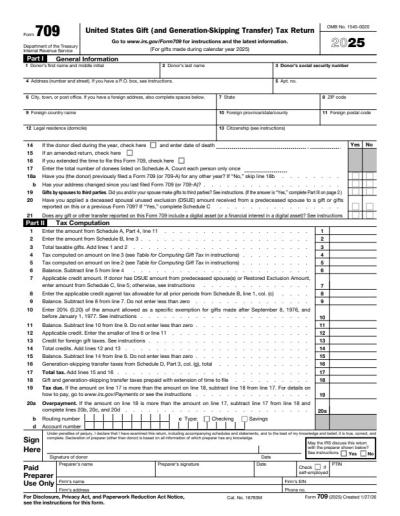
United States Gift (and Generation-Skipping Transfer) Tax Return
Type in the panel and watch each answer land on the page. Filling in and signing is free; downloading needs a free account, which includes 5 downloads a month.
Or fill it another way:
- Category
- Tax
- Fillable fields
- 1849
- Pages
- 10
- Paper size
- US Letter, 8.5 × 11 in
Five ways to fill this form.
-
Fill it in here
Type in the panel and watch it land on the form. Sign it, then download.
Free to fill and sign Start filling -
Many at once, from a spreadsheet
One row per person, one finished PDF for each.
Paid plan · you can walk through it Start with a spreadsheet -
Send it to someone to fill in
Email a link. They fill it in without an account and you get the answers back.
Paid plan · you can walk through it Send a request -
From your own software
Fill it over the API. One request returns the finished PDF.
Paid plan -
Let an AI assistant do it
Connect ChatGPT or Claude once, then describe what goes on the form.
With a free account
Key facts
| Item | Details |
|---|---|
| Form number | Form 709 |
| Official name | United States Gift (and Generation-Skipping Transfer) Tax Return |
| Issuing agency | Internal Revenue Service, Department of the Treasury |
| Current revision date | 2025 revision; official PDF footer shows Created 1/27/26 |
| Number of pages | 10 pages |
| Filing frequency | Annual, one return per calendar year of reportable gifts |
| Related instructions document | Instructions for Form 709 (2025) |
| Main companion schedules | Schedules A, B, C, and D |
What is this form?
Form 709, officially titled United States Gift (and Generation-Skipping Transfer) Tax Return, is the IRS return used to report lifetime transfers that are subject to the federal gift tax and certain lifetime generation-skipping transfer (GST) taxes. The form is not limited to tax actually due. It is also used to disclose reportable gifts, elect gift splitting, report direct skips, and allocate GST exemption during life. For the current official version, the IRS form is the 2025 Form 709 for gifts made during calendar year 2025; the official PDF footer shows Form 709 (2025) Created 1/27/26.
The return is organized into several working parts. Part I collects donor information and key yes-or-no items such as prior Form 709 filings, DSUE usage, and whether any reported transfer includes a digital asset. Part II computes tax, credits, prepayments, tax due, or overpayment. Part III handles spousal consent for gift splitting. Schedule A reports current-year gifts, Schedule B brings in prior taxable gifts, Schedule C tracks DSUE and restored exclusion, and Schedule D handles GST exemption and GST tax.
Who needs to fill this out?
- U.S. citizens or residents generally must file Form 709 if they gave more than $19,000 to any one donee during 2025, other than qualifying unlimited transfers such as many gifts to a U.S.-citizen spouse.
- Anyone who made a gift of a future interest must generally file even if the value was $19,000 or less, because the annual exclusion does not apply to future interests.
- Spouses electing to split gifts must file, regardless of gift amount. Each spouse files a separate Form 709; there is no joint gift tax return.
- Spouses transferring community property, joint tenancy property, or tenancy-by-the-entirety property may each need to file because each spouse is treated as making part of the gift.
- Donors making direct skips or certain transfers in trust that implicate GST tax or GST exemption allocation must report those transfers on Form 709.
- Executors must file the donor's Form 709 if the donor died before filing a required return.
- You generally do not need to file if all gifts for the year were present-interest gifts of $19,000 or less per donee, you made no reportable spouse gifts, and no GST-reportable transfers were made. You also generally do not file solely for direct payments of qualifying tuition or medical expenses to the provider, transfers to political organizations, or certain transfers to exempt organizations.
- Nonresident not a citizen filers who were NRNCs for the entire year generally use Form 709-NA, not Form 709, for U.S.-situs real or tangible property gifts.
Where and how to submit
Paper-filed original Form 709 returns are mailed to the IRS at Department of the Treasury, Internal Revenue Service Center, Kansas City, MO 64999. If you use a designated private delivery service, the IRS instructions list Internal Revenue Service, 333 W. Pershing Road, Kansas City, MO 64108. Amended or supplemental Form 709 filings are sent to Internal Revenue Service Center, Attn: E&G, Stop 824G, 7940 Kentucky Drive, Florence, KY 41042-2915. Form 709 goes to the IRS—not to an employer, broker, bank, or the donee.
Electronic filing is available through the IRS Modernized e-File (MeF) system for Form 709, Form 709-NA, and Form 8892. A taxpayer can authorize a reporting agent or other authorized e-file provider, and Form 8453-EG is used to authenticate certain electronic filings and electronic funds withdrawal authorizations. The normal deadline for a 2025 gift tax return is April 15, 2026, subject to weekend/holiday carryover rules and valid extensions. If you are filing because of gift splitting, each spouse still files a separate return, although the IRS instructs spouses to mail both returns in the same envelope when both are paper filed.
How to fill it out
- Step 1 — Part I, General Information: Complete lines 1 through 13 with the donor's name, Social Security number, address, legal residence, and citizenship. Then answer the checkbox items on lines 14 through 21: date of death if applicable on line 14, amended return on line 15, extension on line 16, total number of donees on line 17, prior Form 709 filings on line 18, DSUE usage on line 19, gifts by spouses to third parties on line 20, and the digital asset question on line 21.
- Step 2 — Part III, Spouse's Consent on Gifts to Third Parties: If line 20 is "Yes," complete Part III on page 2. Enter the consenting spouse's name on line 2 and SSN on line 3, answer whether you were married the entire year on lines 4 and 5, answer whether your spouse will file a return on line 6, and complete line 7 for the required Notice of Consent. If you are not splitting gifts, skip Part III.
- Step 3 — Schedule A, Parts 1 through 3: Report each gift in chronological order. Use Part 1 for gifts subject only to gift tax, Part 2 for direct skips, and Part 3 for indirect skips and other transfers in trust. For each item, complete columns for the donee's name and address, relationship, description of gift, donor's adjusted basis, date of gift, value at date of gift, and net transfer. If gift splitting applies, enter one-half of the gift in the split-gift column. Check the applicable boxes for charitable gifts, deductible spouse gifts, section 2652(a)(3), or section 2632 elections.
- Step 4 — Schedule A, Part 4, Taxable Gift Reconciliation: Add the Part 1 through Part 3 totals into line 1, enter annual exclusions on line 2, and compute the included amount on line 3. Then complete the deduction lines: marital deduction lines 4 through 6, charitable deduction line 7, total deductions line 8, balance line 9, any GST tax payable with the form on line 10, and taxable gifts on line 11. Carry line 11 to Part II, line 1.
- Step 5 — Schedule B and Schedule C, if applicable: If you answered "Yes" to prior Form 709 filings on Part I, line 18a, complete Schedule B and carry Schedule B line 3 to Part II line 2. If you have a DSUE amount from a predeceased spouse or a restored exclusion amount, complete Schedule C and carry Schedule C line 5 to Part II line 7.
- Step 6 — Schedule D, GST Tax Computation: If any gifts are listed on Schedule A, Part 2 or Part 3, complete Schedule D. Report generation-skipping transfers in Part 1, reconcile available and claimed GST exemption in Part 2, lines 1 through 8, and compute GST tax in Part 3. Carry the total GST tax to Schedule A, Part 4, line 10 and Part II, line 16.
- Step 7 — Part II, Tax Computation and signature: Use Part II, lines 1 through 20 to compute total taxable gifts, tentative tax, applicable credit, prior-period credit, foreign gift tax credit if any, GST tax, tax due, or overpayment. If you overpaid, complete lines 20b through 20d for direct deposit. Then sign and date the return in the signature block; if a paid preparer completed it, the preparer section must also be completed.
Important deadlines & penalties
- Standard due date: Form 709 is due April 15 of the year after the gift was made. For gifts made in 2025, the due date is April 15, 2026, unless that date falls on a weekend or legal holiday.
- Donor died during the year: The executor must file the donor's 2025 Form 709 by the earlier of the due date, including extensions, for the donor's estate tax return or April 15, 2026 (or the donor's extended gift tax deadline).
- Automatic extension: Extending your 2025 federal income tax return with Form 4868 or Form 2350 also extends Form 709 if you are extending the income tax return. If you are not extending an income tax return, use Form 8892 for an automatic 6-month extension of time to file Form 709.
- No automatic extension to pay: An extension of time to file does not extend the time to pay gift or GST tax. Unpaid tax can trigger late-payment charges and interest from the original due date.
- Late-filing penalty: The IRS instructions cite section 6651, which generally imposes a 5% penalty per month or part of a month for late filing, up to 25%, unless you show reasonable cause.
- Late-payment penalty: Section 6651 also generally imposes a 0.5% penalty per month for late payment, up to 25%, plus interest.
- Valuation penalties: The instructions warn of valuation-understatement penalties when reported value is 65% or less of actual value, and gross valuation understatement issues when reported value is 40% or less of actual value.
Common mistakes to avoid
- Omitting gifts under the annual exclusion that are future interests: Many filers assume any gift under $19,000 is ignored. It is not if the gift is a future interest. Leaving it off Schedule A can understate taxable gifts and keep the statute of limitations open.
- Checking "Yes" to gift splitting on Part I, line 20 but not completing Part III: Gift splitting requires spousal consent details on Part III, lines 1 through 7. Missing consent can cause the IRS to deny split-gift treatment and reallocate the entire gift to one donor.
- Ignoring prior filings on Part I, line 18 and Schedule B: Form 709 tax is cumulative. If prior taxable gifts are not brought forward through Schedule B, line 3, the applicable credit and tax computation on Part II, lines 3 through 12 can be materially wrong.
- Failing to answer the digital asset question on line 21: Leaving this item blank can delay processing or trigger follow-up questions.
- Using unsupported values on Schedule A: Filers often enter a value in Schedule A without attaching support for a claimed valuation discount or complex asset valuation. If Schedule A item A is "Yes," the instructions require an explanation, and weak support can lead to penalties or an examination.
- Misreporting split gifts in Schedule A columns: When gifts are split, the donor must use the split-gift column and show only the proper net transfer. Using the full amount in the wrong column distorts Schedule A totals and Part II tax.
- Skipping Schedule D for trust transfers or direct skips: Gifts listed in Schedule A, Part 2 or Part 3 often require Schedule D. If GST exemption is not allocated correctly, future distributions or terminations can face unexpected GST tax.
Expert tips
- Build the return in the IRS order: Complete Schedule A first, then Schedule B, Schedule C, and Schedule D as needed, and only then finish Part II. That mirrors the IRS instructions and reduces carryover errors.
- Count donees carefully on Part I, line 17: Count each person only once, even if that donee received multiple gifts.
- Use chronological order in Schedule A Parts 2 and 3: The form expressly requires direct skips and indirect skips to be listed in chronological order. That helps the IRS follow GST allocations and ETIP items.
- Attach the right statements: Common missing attachments include a valuation discount explanation, a section 529 five-year election statement, a Notice of Consent for gift splitting, and a Notice of Allocation or election-out statement for GST exemption issues.
- Be deliberate with spouse-gift elections: On Schedule A, Part 4 and the column checkboxes, the marital deduction and QTIP treatment can have estate and future gift tax consequences. If you check the deductible spouse gift box and claim the deduction, you may be making a QTIP election.
- Think about adequate disclosure, not just tax due: Even if no gift tax is payable, a properly completed Form 709 with enough detail can start the statute of limitations on gift valuation issues. Sparse descriptions can leave old gifts open longer.
Related forms & next steps
- Form 709-NA — Gift and GST tax return for a nonresident not a citizen of the United States.
- Form 8892 — Automatic extension of time to file Form 709 and/or voucher to pay gift or GST tax.
- Form 8453-EG — E-file declaration used to authenticate electronic Forms 709 and 709-NA.
- Form 4868 — Individual income tax extension that can also extend Form 709 when applicable.
- Form 2350 — Extension request for certain taxpayers abroad; can also extend Form 709 when it extends the income tax return.
- Instructions for Form 709 — Official line-by-line instructions, filing rules, and tax tables for the current revision.
Frequently asked questions
Who has to file Form 709?
Generally, a U.S. citizen or resident files Form 709 if they gave more than $19,000 to any one donee in 2025, made a gift of a future interest, elected to split gifts with a spouse, or made a reportable GST transfer.
Do I file Form 709 if no gift tax is due?
Often, yes. Form 709 is a reporting return as well as a tax-computation return. Many taxpayers file only to disclose gifts, use annual exclusions, elect gift splitting, or allocate GST exemption even when the final tax due is zero.
Can spouses file one joint Form 709?
No. The IRS instructions say spouses may not file a joint gift tax return. If gifts are split, each spouse files a separate Form 709, and Part III is used for the spouse's consent.
Do gifts of cryptocurrency or NFTs go on Form 709?
Yes, if the transfer is otherwise reportable. The current form specifically asks on Part I, line 21 whether any gift or other transfer reported on the return includes a digital asset or financial interest in a digital asset.
What if I already filed Form 709 and found an error?
File another Form 709 as an amended return, check the amended return box on Part I, line 15, explain what changed, and attach a copy of the original return. The IRS instructions give a separate Florence, Kentucky address for amended or supplemental filings.
Can I create Form 709 in bulk?
Yes. PDFengine supports bulk generation of Form 709 via Excel or CSV upload — upload a spreadsheet with one row per entry and PDFengine generates all PDFs at once. You can also automate bulk creation programmatically via the PDFengine API.
Ready to fill it in?
Fill in this formOfficial sources
- About Form 709 — IRS overview of the form's purpose and scope.
- Form 709 (2025) PDF — Official 10-page return with Parts I through III and Schedules A through D.
- Instructions for Form 709 (2025) — Official filing rules, addresses, extension methods, and schedule instructions.
- Modernized e-File (MeF) for gift taxes — IRS electronic filing options for Forms 709, 709-NA, and 8892.
- Failure to file penalty — IRS explanation of section 6651 late-filing penalty rules and rates.



