
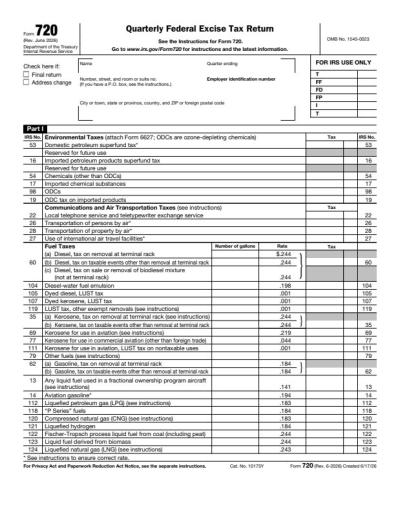
Form 720, filled in online.
Form 720 — official IRS fillable PDF form
Type in the panel and watch each answer land on the page. Filling in and signing is free; downloading needs a free account, which includes 5 downloads a month.
Or fill it another way:
- Category
- Tax
- Fillable fields
- 715
- Pages
- 8
- Paper size
- US Letter, 8.5 × 11 in
Five ways to fill this form.
-
Fill it in here
Type in the panel and watch it land on the form. Sign it, then download.
Free to fill and sign Start filling -
Many at once, from a spreadsheet
One row per person, one finished PDF for each.
Paid plan · you can walk through it Start with a spreadsheet -
Send it to someone to fill in
Email a link. They fill it in without an account and you get the answers back.
Paid plan · you can walk through it Send a request -
From your own software
Fill it over the API. One request returns the finished PDF.
Paid plan -
Let an AI assistant do it
Connect ChatGPT or Claude once, then describe what goes on the form.
With a free account
What is this form?
Form 720 is the quarterly IRS excise tax return used to report federal excise taxes on specific products, services, and activities. It combines multiple tax categories in a single filing, so the return is often used by businesses that need to report deposits, liabilities, and claims tied to very specific tax codes. On PDFengine, the template is presented as a fillable PDF so the user can complete the official layout online and download a clean finished file. The field schema behind this template maps the real AcroForm fields, which makes it practical for structured data entry, repeatable office workflows, and later review.
Because this is an official IRS form, accuracy matters more than marketing language. Users should treat it as a filing-ready worksheet: enter names, identification numbers, dates, amounts, and checkboxes exactly as they appear in source records. A reliable PDF workflow is especially useful when multiple people need to review the same filing package or when a taxpayer, executor, employer, or adviser needs to keep a precise copy for audit or recordkeeping purposes.
Who needs to fill this out?
- Businesses that owe federal excise tax on specific goods, services, or activities
- Fuel, communications, transportation, environmental, or manufacturers' tax filers working with quarterly excise reporting
- Finance teams reconciling excise liabilities, deposits, and credits for the quarter
- Accountants preparing an IRS excise return with multiple tax categories and schedules
- Anyone who wants to complete the official Form 720 layout without editing the original government PDF by hand
Where and how to submit
Form 720 is filed with the IRS each quarter, usually by the last day of the month following quarter end. Depending on the taxes involved, the filer may also need to attach schedules or claims and separately reconcile excise tax deposits. Keep the completed PDF with your quarterly tax workpapers, sales data, and deposit confirmations so the reported lines can be traced later during an IRS review or internal audit.
For Dutch and German users dealing with U.S. tax paperwork, the main practical point is that Form 720 remains a U.S. federal tax document even when you prepare it from abroad. That means you should follow IRS filing instructions, preserve English names exactly as issued in source documents, and keep a copy of the final PDF together with any schedules, statements, payroll reports, probate records, or correspondence linked to the filing.
Before entering data, assemble the source records that control the filing: the current IRS instructions, the related federal return, statements from payers or custodians, prior-year carryforwards, and any schedules that feed the calculation. Mark which figures are copied, which are calculated, and which require a judgment or election. This simple preparation step prevents a number from being entered twice or carried to the wrong line and gives a reviewer a clear audit trail.
Review the completed form in two passes. In the first pass, check identity data, tax year, addresses, identification numbers, status boxes, and signatures. In the second, recalculate totals and compare every material amount with the source schedule. A mathematically correct total can still be wrong when it belongs to another person, activity, period, or return. Resolve differences before creating the final PDF rather than explaining them after filing.
How to fill it out
- Step 1 — Review the filing context: Start with Quarter ending and confirm you are working on the right tax year, transaction, or reporting event before entering numbers.
- Step 2 — Enter identifying details: Complete fields such as Employer identification number and any related taxpayer, recipient, business, estate, employer, or child information exactly as shown in the underlying records.
- Step 3 — Add the core reportable amounts: Use entries like Total. Add all amounts in Part I. Complete Schedule A unless one-time filing and Line 4: Claims (see instructions; complete Schedule C) (amount) to capture the main amounts the IRS expects on Form 720. Match those figures to source documents instead of estimating.
- Step 4 — Finish supporting selections: Review checkbox or supporting fields such as Line 11c: Refunded (checkbox) so the form reflects status, exceptions, filing years, or special circumstances correctly.
- Step 5 — Complete the remaining calculations or narrative: If the PDF includes a text area or explanation field such as Line 10: Balance Due. If line 3 is greater than line 9, enter the difference on line 10. See instructions and www.IRS.gov/Pay for details on how to pay. Pay the full amount with the return. (See instructions.) (amount), use it to clarify corrections, reporting assumptions, or transaction details when needed.
- Step 6 — Validate before filing: Compare the finished PDF with the related return, statement, payroll file, probate packet, or support documents and make sure names, amounts, dates, and attachments are consistent before submission.
Frequently asked questions
How often is Form 720 filed?
It is generally filed quarterly.
Does every business file Form 720?
No. It is only for businesses with specific federal excise tax obligations.
Why does the form include many tax categories?
Because one quarterly return can cover multiple excise tax regimes under different IRS line items.
Do deposits matter separately from the return?
Yes. Many excise taxes have separate deposit requirements that should line up with the filed return.
Should supporting schedules be kept with the return?
Yes. They help explain credits, claims, and category-specific tax calculations.
Can I create Form 720 in bulk?
Yes. PDFengine supports bulk generation of Form 720 via Excel or CSV upload — upload a spreadsheet with one row per form and PDFengine generates all PDFs at once. You can also automate bulk creation programmatically via the PDFengine API.
Ready to fill it in?
Fill in this form


