
Form 8283, filled in online.
Noncash Charitable Contributions
Type in the panel and watch each answer land on the page. Filling in and signing is free; downloading needs a free account, which includes 5 downloads a month.
Or fill it another way:
- Category
- Tax
- Fillable fields
- 117
- Pages
- 2
- Paper size
- US Letter, 8.5 × 11 in
Five ways to fill this form.
-
Fill it in here
Type in the panel and watch it land on the form. Sign it, then download.
Free to fill and sign Start filling -
Many at once, from a spreadsheet
One row per person, one finished PDF for each.
Paid plan · you can walk through it Start with a spreadsheet -
Send it to someone to fill in
Email a link. They fill it in without an account and you get the answers back.
Paid plan · you can walk through it Send a request -
From your own software
Fill it over the API. One request returns the finished PDF.
Paid plan -
Let an AI assistant do it
Connect ChatGPT or Claude once, then describe what goes on the form.
With a free account
Key facts
| Item | Details |
|---|---|
| Form number | Form 8283 |
| Official name | Noncash Charitable Contributions |
| Issuing agency | Internal Revenue Service, Department of the Treasury |
| Current revision date | Rev. December 2025 |
| Number of pages | 2 pages |
| Filing frequency | Filed as needed with the tax return for the year of contribution and any carryover year |
| Main reporting sections | Section A and Section B, with Parts I through V inside Section B |
| Related instructions document | Instructions for Form 8283 (Rev. December 2025) |
What is this form?
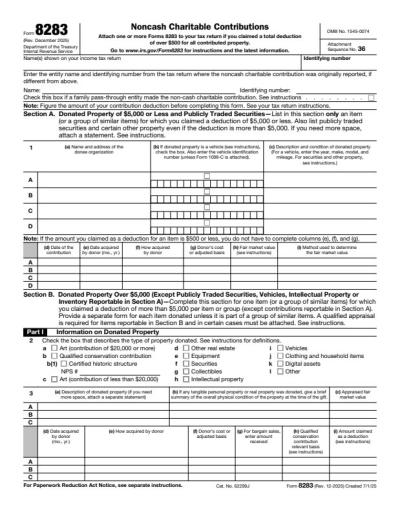
Form 8283, officially titled Noncash Charitable Contributions, is the IRS attachment used to report noncash gifts when the claimed charitable deduction exceeds $500. Individuals, partnerships, and corporations use it to identify the donee organization, describe the donated property, and report the claimed deduction. The current IRS form is Form 8283 (Rev. December 2025).
The form has two main sections. Section A covers property of $5,000 or less per item or group of similar items, plus certain exceptions such as publicly traded securities and some vehicle donations. Section B covers property for which the claimed deduction is more than $5,000 per item or group of similar items and usually requires a qualified appraisal. Within Section B, the form includes Part I (Information on Donated Property), Part II (Partial Interests and Restricted Use Property), Part III (Taxpayer Statement), Part IV (Declaration of Appraiser), and Part V (Donee Acknowledgment).
Who needs to fill this out?
- Individuals file Form 8283 if the deduction for each noncash contribution exceeds $500, or if a group of similar items produces a total deduction over $500.
- Partnerships and S corporations that deduct noncash gifts of more than $500 must file it with Form 1065 or Form 1120-S. If an item or group of similar items exceeds $5,000, they must complete Section B even if each owner receives $5,000 or less on Schedule K-1.
- Members of pass-through entities generally must attach their own Form 8283 plus copies of the lower-tier entity Forms 8283.
- C corporations usually file only when the claimed deduction is more than $5,000 per item or group. Personal service corporations and closely held corporations file when noncash gifts exceed $500.
- Taxpayers claiming more than $5,000 for an item or group of similar items usually must use Section B and obtain a qualified appraisal, unless a Section A exception applies.
- Who does not need to file: taxpayers reporting only cash gifts, credit-card donations, or volunteer out-of-pocket expenses, and taxpayers whose deduction for each noncash contribution and each group of similar items is $500 or less.
Where and how to submit
Form 8283 is filed with the taxpayer's federal income tax return for the year of the gift and any carryover year. It is attached to Form 1040, Form 1065, Form 1120-S, Form 1120, or another applicable return. If the return is e-filed, the IRS says the Form 8283 data must be included in the electronic submission, and the signed form must be attached as a PDF or mailed with Form 8453 when required.
For paper filing, mail Form 8283 in the same envelope as the main return to the IRS address shown in that return's instructions. There is no separate Form 8283 mailing address because the address depends on return type, state, and whether a payment is enclosed. The due date follows the underlying return, including extensions. That is generally April 15 for calendar-year individuals and C corporations and March 15 for calendar-year partnerships and S corporations.
How to fill it out
- Step 1 — Heading and entity information: Enter Name(s) shown on your income tax return and Identifying number. If the gift came through a partnership or S corporation, also complete Name of pass-through entity and Identifying number of pass-through entity.
- Step 2 — Section A, lines 1A through 1D: For Section A property, enter the Name and address of the donee organization, indicate whether the property is a vehicle, add the vehicle identification number if needed, and describe the property and condition. Complete the matching fields for Date of the contribution, Date acquired by donor, How acquired by donor, Donor's cost or adjusted basis, Fair market value, and Method used to determine the fair market value. Then check the property type on lines 2a through 2l.
- Step 3 — Section B, Part I, lines 3A through 3C: For property with a claimed deduction over $5,000, enter the Description of donated property, Brief summary of the overall physical condition, and Appraised fair market value. Complete the lower columns for Date acquired by donor, How acquired by donor, Donor's cost or adjusted basis, Bargain sales, enter amount received, Qualified conservation contribution relevant basis, and Amount claimed as a deduction.
- Step 4 — Section B, Part II, lines 4 and 5: If you gave less than an entire interest in the property or imposed use restrictions, complete line 4a through line 4e and answer the Yes/No questions on lines 5a through 5c.
- Step 5 — Part III and Part IV: Complete the donor statement in Part III. Then have the qualified appraiser complete Appraiser signature, Date of appraisal, Appraiser name, Appraiser title, Appraiser business address, and Appraiser identifying number in Part IV.
- Step 6 — Part V donee acknowledgment: Ask the charity to complete Part V, including whether it intends an unrelated use, the organization name, EIN, address, and authorized title. Attach the completed form to the return.
Important deadlines & penalties
- When to file: File Form 8283 with the tax return for the year you contributed the property and first claimed the deduction. The IRS instructions also require filing it again for any carryover year described in section 170(d).
- Individual deadline: If attached to a calendar-year Form 1040, the usual due date is April 15 following the year of the gift, unless the date moves for a weekend, holiday, disaster relief, or another special rule.
- Pass-through entity deadline: If attached to a calendar-year Form 1065 or Form 1120-S, the usual due date is March 15 following the year of the gift.
- C corporation deadline: If attached to a calendar-year Form 1120, the usual due date is April 15 following the year of the gift.
- Extension options: The Form 8283 deadline extends automatically when the underlying return is properly extended, such as by filing Form 4868 for individuals or Form 7004 for many business returns by the original due date.
- Late-filing penalties: There is no separate Form 8283 penalty schedule, but late filing of the return it accompanies can trigger IRS penalties. For individuals and most business returns, the failure-to-file penalty is generally 5% of unpaid tax for each month or part of a month, up to 25%. If an individual or Form 1120 return is more than 60 days late and the due date was after December 31, 2025, the minimum penalty is generally $525 or 100% of the unpaid tax, whichever is less.
- Late-payment penalties: If tax is not paid when due, the IRS generally charges a 0.5% failure-to-pay penalty per month, up to 25%. If both penalties apply in the same month, the failure-to-file rate is reduced by the failure-to-pay amount for that month.
Common mistakes to avoid
- Using Section A when Section B is required: Reporting a gift over $5,000 on Section A, line 1 instead of Section B, line 3 skips the appraisal and signature rules and can make the filing incomplete.
- Failing to aggregate similar items: Similar property must be grouped when testing the $5,000 threshold. Splitting items across line 1A through 1D can invalidate the deduction.
- Leaving numeric boxes blank: Common problem fields are Donor's cost or adjusted basis, Fair market value, Appraised fair market value, and Amount claimed as a deduction. The IRS says a required number box cannot simply be left empty.
- Missing Section B signatures: Omitting the appraiser signature or donee acknowledgment in Parts IV and V can cause the IRS to disallow the deduction.
- Describing property too vaguely: Generic entries on line 1 or line 3 make valuation harder to defend and can trigger substantiation questions.
- Using the wrong value standard: The form asks for fair market value, not replacement cost or insured value. Overstating value can lead to adjustment and penalty exposure.
Expert tips
- Choose the section first: The threshold is based on the amount of the deduction after required reductions, not just your estimate of value.
- Use consistent item letters: In Section B, the Property identification letter on line 4a should match the item on line 3A, 3B, or 3C.
- Do not leave basis unexplained: If Donor's cost or adjusted basis is low or hard to determine, attach a brief explanation instead of leaving the field blank.
- Keep the full appraisal: Form 8283 is an appraisal summary, not the appraisal itself. Retain the complete qualified appraisal for Section B property.
- Watch the vehicle exception: A donated vehicle may stay in Section A even above $5,000 if the deduction is limited to sale proceeds and the taxpayer has the required acknowledgment, often Form 1098-C.
- Use IRS references together: Read the Form 8283 instructions with Publication 526 for valuation, reduction, and carryover rules.
Related forms & next steps
- Schedule A (Form 1040) — Used by individual taxpayers to claim itemized deductions, including charitable contributions supported by Form 8283.
- Form 1098-C — Acknowledgment for certain contributions of motor vehicles, boats, and airplanes.
- Form 8282 — Donee Information Return filed by the charity if it disposes of donated property within the required period.
- Form 8453 — Transmittal form used when signed paper attachments must be mailed after e-filing.
- Publication 526 — IRS guidance on charitable contribution deduction rules, valuation reductions, partial interests, and carryovers.
- Instructions for Form 8283 — Official line-by-line instructions for Section A, Section B, appraisal rules, and donee acknowledgments.
Frequently asked questions
What is Form 8283 used for?
It reports noncash charitable contributions when the claimed deduction exceeds $500.
Do I need Form 8283 for every noncash donation?
No. You generally file it only when the deduction for a noncash contribution or a group of similar items exceeds $500.
When do I use Section B instead of Section A?
Use Section B when the claimed deduction is more than $5,000 for an item or group of similar items, unless the property fits a Section A exception.
Does Form 8283 require an appraisal?
Usually yes for Section B property. The form is only the appraisal summary; the underlying qualified appraisal is separate.
Where do I send Form 8283 after the charity signs it?
Attach it to your federal income tax return. If you e-file, include the form data electronically and attach or mail the signed form as the IRS requires.
What happens if Form 8283 is incomplete?
The IRS may treat the filing as incomplete, which can put the charitable deduction at risk if descriptions, values, or signatures are missing.
Can I create Form 8283, Noncash Charitable Contributions in bulk?
Yes. PDFengine supports bulk generation of Form 8283, Noncash Charitable Contributions via Excel or CSV upload — upload a spreadsheet with one row per entry and PDFengine generates all PDFs at once. You can also automate bulk creation programmatically via the PDFengine API.
Ready to fill it in?
Fill in this formOfficial sources
- About Form 8283, Noncash Charitable Contributions — IRS overview explaining who files Form 8283 and the basic over-$500 threshold.
- Form 8283 (Rev. December 2025) — Official IRS form showing Section A, Section B, and the actual field names and parts.
- Instructions for Form 8283 (Rev. December 2025) — Official filing rules, section thresholds, pass-through rules, and qualified appraisal requirements.
- Publication 526, Charitable Contributions — IRS guidance on valuation rules, deduction limits, partial interests, and carryovers.
- IRS Failure to File Penalty — Official late-filing penalty rates relevant when Form 8283 is attached to a late return.



