
Form 8379, filled in online.
Injured Spouse Allocation
Type in the panel and watch each answer land on the page. Filling in and signing is free; downloading needs a free account, which includes 5 downloads a month.
Or fill it another way:
- Category
- Tax
- Fillable fields
- 63
- Pages
- 2
- Paper size
- US Letter, 8.5 × 11 in
Five ways to fill this form.
-
Fill it in here
Type in the panel and watch it land on the form. Sign it, then download.
Free to fill and sign Start filling -
Many at once, from a spreadsheet
One row per person, one finished PDF for each.
Paid plan · you can walk through it Start with a spreadsheet -
Send it to someone to fill in
Email a link. They fill it in without an account and you get the answers back.
Paid plan · you can walk through it Send a request -
From your own software
Fill it over the API. One request returns the finished PDF.
Paid plan -
Let an AI assistant do it
Connect ChatGPT or Claude once, then describe what goes on the form.
With a free account
Key facts
| Form number | Form 8379 |
|---|---|
| Official name | Injured Spouse Allocation |
| Issuing agency | Internal Revenue Service, Department of the Treasury |
| Current revision date | Form revised November 2023; instructions revised November 2024 |
| Number of pages | 2 pages |
| Filing frequency | As needed for each tax year in which a joint refund is offset |
| Who signs | The injured spouse signs Part IV; preparer completes the paid preparer section if applicable |
| Related instructions document | Instructions for Form 8379 (Rev. 11/2024) |
What is this form?
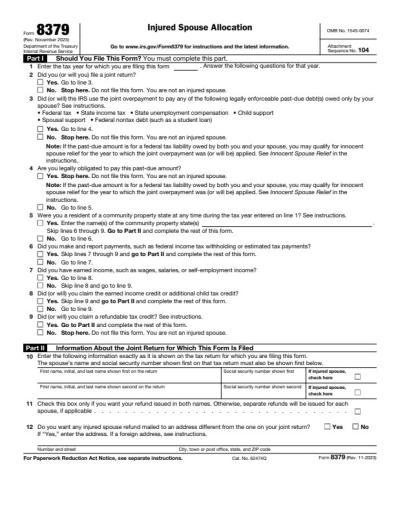
Form 8379, Injured Spouse Allocation, is the IRS form used when a married couple files a joint return and some or all of the joint overpayment is applied to the other spouse's legally enforceable past-due debt. The form lets the injured spouse ask the IRS to calculate and release that spouse's share of the refund instead of letting the entire overpayment be offset. The current IRS form in wide use is Form 8379 (Rev. 11-2023), and the official instructions are revised 11/2024. The form itself is two pages long and is organized into four parts: Part I determines whether the filer qualifies as an injured spouse, Part II identifies the joint return and mailing details, Part III allocates income, deductions, credits, taxes, withholding, and payments between spouses, and Part IV contains the injured spouse's signature and paid preparer section.
The form does not change the tax shown on the joint return. Instead, it reallocates the items already reported on that joint return as if each spouse had filed separately for refund-allocation purposes. Part I uses lines 1 through 9 as an eligibility flowchart, including questions about offset debts, community property states, and refundable credits. Part II uses lines 10 through 12 to identify both spouses, mark which spouse is the injured spouse, indicate whether the refund should be issued in both names, and provide an alternate mailing address if needed.
Part III is the core allocation schedule, with lines 13a through 20 dividing wages, other income, adjustments, deductions, credits, other taxes, withholding, and payments between the injured spouse and the other spouse. The IRS then uses that allocation to determine how much of the offset refund belongs to the injured spouse.
Form 8379 is often confused with innocent spouse relief, but they are different remedies. Form 8379 deals with a refund offset caused by the other spouse's separate debt, such as past-due federal tax, state income tax, child support, state unemployment compensation debt, or a federal nontax debt like a student loan. It does not ask the IRS to excuse joint tax liability for an understatement or underpayment; that is handled on Form 8857. If you are trying to recover your share of a joint refund after an offset, Form 8379 is the correct form number to review first.
Who needs to fill this out?
- Married taxpayers who filed, or will file, a joint return and whose joint overpayment was applied or is expected to be applied to the other spouse's past-due obligation must consider Form 8379.
- The injured spouse is the spouse who is not legally responsible for the debt that triggered the offset and who had income, withholding, estimated tax payments, refundable credits, or other payment items that created part of the joint refund.
- Taxpayers offset for these debts may qualify: past-due federal tax, state income tax, child support, certain state unemployment compensation debts, and federal nontax debts such as defaulted student loans.
- Taxpayers in community property states may still file, but line 5 and the community property rules can change how the refund is allocated. The instructions specifically list Arizona, California, Idaho, Louisiana, Nevada, New Mexico, Texas, Washington, and Wisconsin.
- You must file a separate Form 8379 for each tax year in which you want your share of an offset joint refund returned. One form does not cover multiple years.
- You do not file Form 8379 if you did not file a joint return, if no refund offset applies, or if the debt is your own debt rather than your spouse's separate debt.
- You also do not file Form 8379 for innocent spouse relief. If the issue is relief from joint tax liability because of omitted income, false deductions, or similar liability issues, the IRS says to file Form 8857 instead.
Where and how to submit
You can file Form 8379 with your joint return, with an amended joint return on Form 1040-X, or by itself after the joint return has already been filed. If you file it with an original joint return, attach it in attachment-sequence order and write Injured Spouse in the upper left corner of page 1 of the joint return. Electronic filing is generally available when Form 8379 is attached to the joint return through tax software or an authorized e-file provider. If you file Form 8379 by itself after the original joint return has been processed, the IRS instructions tell you to mail it to the same Internal Revenue Service Center where the original paper return was filed, or to the Internal Revenue Service Center for the area where you live if the original joint return was filed electronically.
The exact mailing address depends on the related Form 1040 filing address for your state and whether a payment is enclosed with the underlying return. Examples from the IRS 2025 paper filing tables include Department of the Treasury, Internal Revenue Service, Austin, TX 73301-0002 for many southern and international paper filings without payment, Department of the Treasury, Internal Revenue Service, Kansas City, MO 64999-0002 for many midwestern and eastern filings without payment, and Department of the Treasury, Internal Revenue Service, Ogden, UT 84201-0002 for many western filings without payment. Form 8379 goes to the IRS, not to an employer, state revenue department, or the Bureau of the Fiscal Service. There is no stand-alone annual calendar deadline built into the form itself, but if you are sending it with a joint Form 1040, use that return's normal due date; if filing it later by itself, the statute in the instructions generally requires filing within 3 years from the original return due date, including extensions, or 2 years from the date the tax was paid that was later offset, whichever is later.
How to fill it out
- Step 1 — Line 1 and tax year: Enter the tax year on line 1. Form 8379 is year-specific, so make sure the year matches the joint return for which the refund was offset or is expected to be offset.
- Step 2 — Part I, lines 2 through 9: Work through the eligibility questions exactly in order. Check the Yes or No boxes on lines 2, 3, 4, 5, 6, 7, 8, and 9 as directed by the form. If line 5 is Yes, enter the community property state(s). If your answers tell you to stop, do not complete the rest of the form; the form itself says you are not an injured spouse in those cases.
- Step 3 — Part II, lines 10 through 12: On line 10, enter the first name, initial, and last name and Social Security number for the spouse shown first on the joint return and for the spouse shown second on the joint return. Check the box next to the spouse who is the injured spouse. On line 11, check the box only if you want the refund issued in both names. On line 12, answer whether the injured spouse refund should be mailed to an address different from the one on the joint return and, if Yes, enter the mailing address.
- Step 4 — Part III, lines 13a through 14: Start the allocation table by entering the amount shown on the joint return in column (a), then divide each item between Allocated to injured spouse and Allocated to other spouse in columns (b) and (c). On line 13a, enter income reported on Form(s) W-2. On line 13b, enter all other income. On line 14, enter adjustments to income. The two allocation columns should reflect which spouse would have reported or claimed each item on a separate return.
- Step 5 — Part III, lines 15 through 18: Continue the allocation by entering standard deduction or itemized deductions on line 15, nonrefundable credits on line 16, refundable credits (do not include any earned income credit) on line 17, and other taxes on line 18. Use the exact field labels on the form and allocate each amount to the spouse who actually owns or would separately claim the item whenever the instructions require that treatment.
- Step 6 — Part III, lines 19 through 20: On line 19, enter federal income tax withheld from the joint return and split it between spouses based on the withholding actually shown on Forms W-2, W-2G, and 1099. On line 20, enter payments and allocate them between spouses. If you file Form 8379 by itself after the joint return was already filed, attach copies of all Forms W-2, W-2G, and any Forms 1099 showing federal income tax withholding for both spouses.
- Step 7 — Part IV signature: Sign on the line labeled Injured spouse's signature and enter the date. Complete paid preparer fields only if a preparer was involved, including Print/Type preparer's name, Firm's name, Firm's EIN, Firm's phone number, and PTIN. An unsigned Form 8379 can delay processing.
Important deadlines & penalties
- With an original joint return: If you attach Form 8379 to Form 1040, use the due date for that joint return. For most calendar-year individual returns, that is usually April 15 unless the IRS announces a weekend, holiday, or disaster change.
- Standalone statute deadline: The IRS instructions say you must file Form 8379 within 3 years from the due date of the original return, including extensions, or 2 years from the date you paid the tax that was later offset, whichever is later.
- Amended return timing: If you file an amended joint return on Form 1040-X to claim an additional refund and want to protect the injured spouse's share of that extra overpayment, attach another Form 8379 at the same time.
- No separate extension form for Form 8379: The IRS instructions do not provide a separate extension just for Form 8379. The relevant timing is tied to the original return deadline or the refund-claim statute described above.
- Penalty reality: The IRS instructions for Form 8379 do not impose a special stand-alone penalty just for filing Form 8379 late. The main risk is that a late claim can cause you to lose the right to recover your share of the offset refund.
- Late Form 1040 consequences still matter: If the joint Form 1040 itself is filed late and tax is due, the general IRS failure-to-file penalty is 5% of unpaid tax for each month or part of a month, up to 25%. If the return is more than 60 days late and due after December 31, 2025, the minimum penalty is generally $525 or 100% of the unpaid tax, whichever is less.
- Processing timelines: The IRS says Form 8379 generally takes about 14 weeks when filed on paper with a joint return, about 11 weeks when filed electronically with a joint return, and about 8 weeks when filed by itself after the joint return has already been processed.
Common mistakes to avoid
- Checking the wrong path in Part I, lines 2 through 9. If you answer the eligibility flow incorrectly, you may file when you are not actually an injured spouse or fail to file when you are entitled to relief. The IRS specifically warns that filing Form 8379 when no past-due obligation exists will delay your refund.
- Marking the wrong spouse on line 10. The check box next to the spouse who is the injured spouse is not cosmetic. If the wrong person is marked, the IRS allocation can be misapplied and processing can be delayed while the IRS resolves the inconsistency.
- Ignoring line 5 community property rules. Taxpayers in Arizona, California, Idaho, Louisiana, Nevada, New Mexico, Texas, Washington, or Wisconsin sometimes check No or leave the state blank. That can produce a wrong allocation because community property law changes how overpayments are treated.
- Putting earned income credit on line 17. Line 17 expressly says do not include any earned income credit. The IRS allocates EIC separately based on each spouse's earned income, so including it on line 17 can distort the refund computation.
- Allocating line 19 withholding by guesswork instead of by Forms W-2, W-2G, and 1099. Withholding must follow the actual federal income tax withheld from each spouse's income. Bad allocations commonly trigger delays or IRS corrections.
- Forgetting attachments when filing Form 8379 by itself. The instructions say to attach copies of all Forms W-2, W-2G, and any 1099 showing federal income tax withholding for both spouses. Missing attachments are a common reason processing is delayed.
- Leaving Part IV unsigned. A missing Injured spouse's signature or incomplete preparer block can keep the IRS from processing the claim promptly.
Expert tips
- Use the joint return as your master document. For every line in Part III, column (a) should tie back to the amounts already shown on the joint Form 1040, schedules, and attachments before you split items between spouses.
- Follow ownership, not convenience, on lines 13a, 14, 18, and 19. Wages, IRA deductions, self-employment tax, and withholding should generally be assigned to the spouse who actually earned the income, owns the account, or paid the tax.
- Do not force a 50/50 split unless the item is truly joint. The instructions say some shared items can be divided as you determine, but many items belong entirely to one spouse. Overusing equal splits is one of the easiest ways to create a bad allocation.
- Check line 12 carefully if the refund mailing address changed. If the address change is permanent, the instructions point you to Form 8822. If the address change is temporary, sending only the temporary address can slow the injured spouse refund.
- Community property filers should review Publication 555. Line 5 is not a simple residency question; it affects how the IRS applies state law to the overpayment and whether only part of the refund can be protected.
- Keep refundable credits straight. Put refundable credits other than EIC on line 17, but let the IRS allocate earned income credit separately. That small distinction prevents a very common allocation error.
- Use the IRS timing rules before you assume you are too late. Many taxpayers think the claim is lost once the offset happens, but the instructions still allow filing within the 3-year or 2-year rule, whichever is later.
Related forms & next steps
- Instructions for Form 8379 — official IRS instructions for eligibility, allocation rules, filing methods, and timing.
- Form 1040 — the joint individual return to which Form 8379 is usually attached.
- Form 1040-X — amended U.S. Individual Income Tax Return used when a joint return is amended and an additional refund is being claimed.
- Form 8857 — Request for Innocent Spouse Relief; used when the issue is joint liability relief rather than refund allocation.
- Form 8822 — Change of Address; relevant if the injured spouse's mailing address has changed permanently.
- Publication 555 — community property guidance used with line 5 and state allocation issues.
- Publication 971 — detailed innocent spouse relief guidance for taxpayers who need Form 8857 instead of Form 8379.
Frequently asked questions
What is Form 8379 used for?
Form 8379 is used to claim the injured spouse's share of a joint tax refund when the IRS or the Treasury Offset Program applied that joint overpayment to the other spouse's separate debt.
Who is considered an injured spouse?
An injured spouse is the spouse on a joint return who is not responsible for the past-due debt that caused the offset and who contributed to the overpayment through income, withholding, estimated payments, or credits.
Is Form 8379 the same as innocent spouse relief?
No. Form 8379 deals with refund allocation after an offset. Innocent spouse relief deals with relief from joint tax liability and is requested on Form 8857.
Can I file Form 8379 electronically?
Usually yes, if you attach it to an electronically filed joint return through supported tax software or an authorized e-file provider. If you file Form 8379 by itself after the original joint return was already filed, the IRS instructions generally direct you to mail it to the appropriate IRS Service Center.
How long does the IRS take to process Form 8379?
The IRS says processing is generally about 14 weeks if filed on paper with a joint return, about 11 weeks if filed electronically with the joint return, and about 8 weeks if filed by itself after the joint return has already been processed.
Do I need to attach W-2s or 1099s?
If you file Form 8379 by itself, yes. The IRS instructions say to attach copies of all Forms W-2 and W-2G for both spouses and any Forms 1099 that show federal income tax withholding.
Can I create Form 8379, Injured Spouse Allocation in bulk?
Yes. PDFengine supports bulk generation of Form 8379, Injured Spouse Allocation via Excel or CSV upload — upload a spreadsheet with one row per entry and PDFengine generates all PDFs at once. You can also automate bulk creation programmatically via the PDFengine API.
Ready to fill it in?
Fill in this formOfficial sources
- IRS Form 8379 (Rev. 11-2023) — official form PDF with the actual parts, lines, checkboxes, and allocation table.
- Instructions for Form 8379 (Rev. 11/2024) — official IRS instructions covering eligibility, timing, allocation rules, and filing methods.
- About Form 8379, Injured Spouse Allocation — IRS overview page summarizing the purpose of the form and linking to current materials.
- IRS injured spouse relief page — official IRS guidance on when and how injured spouse relief applies.
- IRS failure-to-file penalty page — official penalty amounts relevant when the underlying Form 1040 is filed late.



