
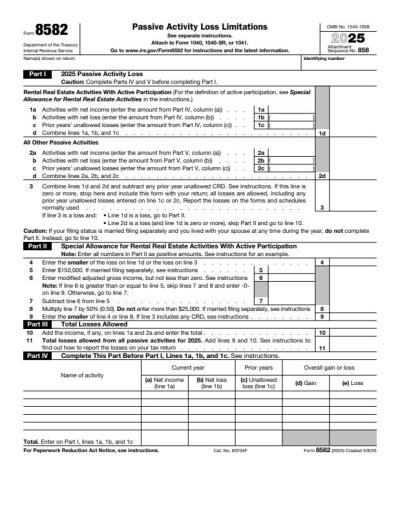
Form 8582, filled in online.
Form 8582 — official IRS fillable PDF form
Type in the panel and watch each answer land on the page. Filling in and signing is free; downloading needs a free account, which includes 5 downloads a month.
Or fill it another way:
- Category
- Tax
- Fillable fields
- 205
- Pages
- 3
- Paper size
- US Letter, 8.5 × 11 in
Five ways to fill this form.
-
Fill it in here
Type in the panel and watch it land on the form. Sign it, then download.
Free to fill and sign Start filling -
Many at once, from a spreadsheet
One row per person, one finished PDF for each.
Paid plan · you can walk through it Start with a spreadsheet -
Send it to someone to fill in
Email a link. They fill it in without an account and you get the answers back.
Paid plan · you can walk through it Send a request -
From your own software
Fill it over the API. One request returns the finished PDF.
Paid plan -
Let an AI assistant do it
Connect ChatGPT or Claude once, then describe what goes on the form.
With a free account
What is this form?
Form 8582 is the IRS worksheet-style form used to determine how much passive activity loss is currently deductible and how much must be suspended. It is commonly used with rental real estate and other passive activities where the tax law limits loss deductions based on income and participation rules. On PDFengine, the template is presented as a fillable PDF so the user can complete the official layout online and download a clean finished file. The field schema behind this template maps the real AcroForm fields, which makes it practical for structured data entry, repeatable office workflows, and later review.
Because this is an official IRS form, accuracy matters more than marketing language. Users should treat it as a filing-ready worksheet: enter names, identification numbers, dates, amounts, and checkboxes exactly as they appear in source records. A reliable PDF workflow is especially useful when multiple people need to review the same filing package or when a taxpayer, executor, employer, or adviser needs to keep a precise copy for audit or recordkeeping purposes.
Who needs to fill this out?
- Individuals with rental or other passive activity losses that may be limited for tax purposes
- Taxpayers tracking allowed and suspended passive losses across years
- Preparers reconciling passive income, passive losses, and special allowance calculations
- Anyone attaching passive loss computations to a federal return
- Anyone who wants to complete the official Form 8582 layout without editing the original government PDF by hand
Where and how to submit
Form 8582 is attached to the taxpayer's federal income tax return when passive loss limitations apply. The completed form should match the rental schedules, K-1 data, and prior-year carryforward records used to compute the current limitation. Because suspended losses can carry into later years, keep the final PDF with the annual tax file so future returns can trace the carryforward amounts accurately.
For Dutch and German users dealing with U.S. tax paperwork, the main practical point is that Form 8582 remains a U.S. federal tax document even when you prepare it from abroad. That means you should follow IRS filing instructions, preserve English names exactly as issued in source documents, and keep a copy of the final PDF together with any schedules, statements, payroll reports, probate records, or correspondence linked to the filing.
Before entering data, assemble the source records that control the filing: the current IRS instructions, the related federal return, statements from payers or custodians, prior-year carryforwards, and any schedules that feed the calculation. Mark which figures are copied, which are calculated, and which require a judgment or election. This simple preparation step prevents a number from being entered twice or carried to the wrong line and gives a reviewer a clear audit trail.
Review the completed form in two passes. In the first pass, check identity data, tax year, addresses, identification numbers, status boxes, and signatures. In the second, recalculate totals and compare every material amount with the source schedule. A mathematically correct total can still be wrong when it belongs to another person, activity, period, or return. Resolve differences before creating the final PDF rather than explaining them after filing.
How to fill it out
- Step 1 — Review the filing context: Start with Identifying number and confirm you are working on the right tax year, transaction, or reporting event before entering numbers.
- Step 2 — Enter identifying details: Complete fields such as Name of activity and any related taxpayer, recipient, business, estate, employer, or child information exactly as shown in the underlying records.
- Step 3 — Add the core reportable amounts: Use entries like Line 1a: Activities with net income (enter the amount from Part IV, column (a)) and Line 1b: Activities with net loss (enter the amount from Part IV, column (b)) to capture the main amounts the IRS expects on Form 8582. Match those figures to source documents instead of estimating.
- Step 4 — Finish supporting selections: Review checkbox or supporting fields such as Line 6: Enter modified adjusted gross income, but not less than zero so the form reflects status, exceptions, filing years, or special circumstances correctly.
- Step 5 — Complete the remaining calculations or narrative: If the PDF includes a text area or explanation field such as Line 11: Total losses allowed from all passive activities for 2025, use it to clarify corrections, reporting assumptions, or transaction details when needed.
- Step 6 — Validate before filing: Compare the finished PDF with the related return, statement, payroll file, probate packet, or support documents and make sure names, amounts, dates, and attachments are consistent before submission.
Frequently asked questions
Why is Form 8582 needed?
It determines whether passive losses can be deducted now or must be carried forward.
Is the form only for rental real estate?
No. It can also apply to other passive activities, depending on the taxpayer's situation.
Why do prior-year records matter?
Because suspended passive losses often carry over and affect the current-year calculation.
Should K-1 information be reconciled to the form?
Yes. Passive activity data from K-1s and schedules should line up with the limitation calculation.
Does Form 8582 replace Schedule E?
No. It works alongside the main schedules and helps determine the allowable deduction.
Can I create Form 8582 in bulk?
Yes. PDFengine supports bulk generation of Form 8582 via Excel or CSV upload — upload a spreadsheet with one row per form and PDFengine generates all PDFs at once. You can also automate bulk creation programmatically via the PDFengine API.
Ready to fill it in?
Fill in this form


