
Form 8829, filled in online.
Expenses for Business Use of Your Home
Type in the panel and watch each answer land on the page. Filling in and signing is free; downloading needs a free account, which includes 5 downloads a month.
Or fill it another way:
- Category
- Tax
- Fillable fields
- 58
- Pages
- 1
- Paper size
- US Letter, 8.5 × 11 in
Five ways to fill this form.
-
Fill it in here
Type in the panel and watch it land on the form. Sign it, then download.
Free to fill and sign Start filling -
Many at once, from a spreadsheet
One row per person, one finished PDF for each.
Paid plan · you can walk through it Start with a spreadsheet -
Send it to someone to fill in
Email a link. They fill it in without an account and you get the answers back.
Paid plan · you can walk through it Send a request -
From your own software
Fill it over the API. One request returns the finished PDF.
Paid plan -
Let an AI assistant do it
Connect ChatGPT or Claude once, then describe what goes on the form.
With a free account
Key facts
| Form number | Form 8829 |
|---|---|
| Official name | Expenses for Business Use of Your Home |
| Issuing agency | Internal Revenue Service (IRS), Department of the Treasury |
| Current revision date | 2025 form; IRS PDF states Created 10/2/25 |
| Number of pages | 1 page |
| Filing frequency | Annual, when attached to the taxpayer's Form 1040 Schedule C return |
| Who files it | Eligible self-employed taxpayers using the regular home office deduction method |
| Related instructions document | Instructions for Form 8829 and IRS Publication 587 |
What is this form?
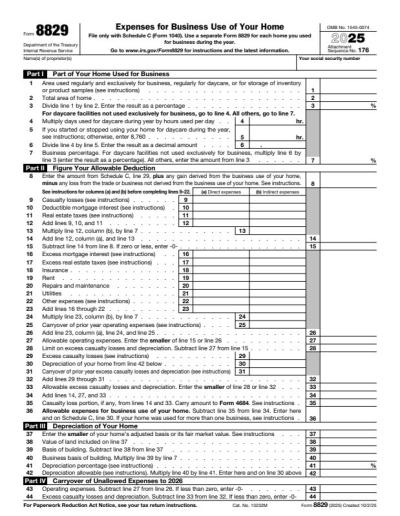
Form 8829, Expenses for Business Use of Your Home, is the IRS form a sole proprietor uses to calculate the regular-method home office deduction for a business reported on Schedule C (Form 1040). The form measures the business-use percentage of the home in Part I, applies the income limitation and allocates direct versus indirect costs in Part II, computes home depreciation in Part III, and carries any disallowed expenses forward in Part IV. The 2025 IRS form says it must be filed only with Schedule C and that a separate Form 8829 is required for each home used for business during the year.
This form is used only for the regular method. It is where taxpayers enter items such as area used for business on lines 1 and 2, business percentage on line 7, deductible mortgage interest and real estate taxes on lines 10 and 11, utilities on line 21, depreciation on line 42, and the final allowable deduction on line 36. The current official PDF used by this template is Form 8829 (2025), a one-page IRS form created 10/2/25. If you use the simplified method for a home office deduction, you generally do not complete Form 8829.
Who needs to fill this out?
- Sole proprietors and single-member LLC owners who file Schedule C (Form 1040) and want to claim home office expenses under the regular method must use Form 8829 to compute the deduction.
- Self-employed taxpayers with qualifying home office use must file it when part of the home is used regularly and exclusively for business, or when the storage-of-inventory or daycare exceptions apply under IRS rules.
- Daycare providers may use Form 8829 even if the space is not used exclusively for business, as long as they apply the special time-and-space calculation in Part I, including lines 4 through 7.
- Taxpayers with more than one home used for business must prepare a separate Form 8829 for each home.
- Taxpayers with limited business income may still need the form because lines 25, 31, 43, and 44 track carryovers of operating expenses and depreciation even when the full current-year deduction is not allowed.
- Do not file Form 8829 if you are an employee working from home, if you are claiming the simplified method instead of actual expenses, or if your use does not meet the IRS business-use rules and no daycare or inventory-storage exception applies.
Where and how to submit
Form 8829 is not mailed to the IRS by itself. It must be attached to Schedule C (Form 1040) and filed as part of the taxpayer's individual federal income tax return. If you e-file, the form is transmitted with the rest of the Form 1040 return through IRS e-file software or an authorized e-file provider. If you file on paper, Form 8829 goes in the same package as Form 1040 and Schedule C.
There is no unique Form 8829 mailing address. Paper filers use the current Form 1040 filing address listed by the IRS for their state and whether a payment is enclosed. For calendar-year filers, the return is generally due April 15 following the tax year; when April 15 falls on a weekend or legal holiday, the deadline moves to the next business day. If you request an automatic extension on Form 4868, the filing deadline generally moves to October 15, but any tax owed is still due by the original April deadline.
How to fill it out
- Step 1 — Part I, lines 1-7: Enter the area used regularly and exclusively for business on line 1 and the total area of home on line 2. Divide line 1 by line 2 on line 3. If the home is used for daycare and not exclusively for business, complete lines 4 through 6 using days used for daycare and hours used per day, then compute the final business percentage on line 7.
- Step 2 — Part II, line 8 and lines 9-15: On line 8, enter the amount from Schedule C, line 29, adjusted for gain or loss derived from business use of the home as the instructions require. Then complete lines 9 through 11 for casualty losses, deductible mortgage interest, and real estate taxes. Add them on line 12, multiply indirect expenses by the line 7 percentage on line 13, total them on line 14, and subtract from line 8 on line 15.
- Step 3 — Part II, lines 16-27: Enter other current-year home expenses in the correct columns: excess mortgage interest on line 16, excess real estate taxes on line 17, insurance on line 18, rent on line 19, repairs and maintenance on line 20, utilities on line 21, and other expenses on line 22. Add lines 16 through 22 on line 23, apply the line 7 percentage to indirect costs on line 24, add any carryover of prior year operating expenses on line 25, and compute allowable operating expenses on line 27.
- Step 4 — Part II, lines 28-36: Use line 28 to find the remaining limit for excess casualty losses and depreciation. Enter any excess casualty losses on line 29, the depreciation of your home from line 42 on line 30, and any carryover of prior year excess casualty losses and depreciation on line 31. After lines 32 through 35, enter the final allowable expenses for business use of your home on line 36 and carry that amount to Schedule C, line 30.
- Step 5 — Part III, lines 37-42: Figure depreciation by entering the smaller of the home's adjusted basis or fair market value on line 37, the value of land on line 38, and the basis of building on line 39. Multiply by the business-use percentage on line 40, enter the IRS depreciation percentage on line 41, and compute depreciation allowable on line 42.
- Step 6 — Part IV, lines 43-44: If the income limitation prevents a full deduction, calculate the carryforward. Line 43 is for operating expenses not allowed this year, and line 44 is for unallowed excess casualty losses and depreciation. Keep these amounts with next year's records because they may be entered on a future Form 8829.
Important deadlines & penalties
- Annual due date: Form 8829 is filed with Form 1040 and Schedule C. For calendar-year taxpayers, the federal individual return is generally due April 15 after the close of the tax year. For the 2025 tax year, the IRS states the due date is April 15, 2026.
- Extension to file: File Form 4868 or use an IRS-approved electronic extension method by the original due date to get an automatic extension, generally until October 15. This extends the time to file the return, not the time to pay.
- Late-filing penalty: If the return including Form 8829 is filed late and tax is due, the IRS failure-to-file penalty is generally 5% of the tax due for each month or part of a month the return is late, up to 25%.
- Late-payment penalty: If tax is not paid by the original due date, the IRS failure-to-pay penalty is generally 0.5% of the unpaid tax for each month or part of a month, up to 25%, plus interest.
- When both penalties apply: In the same month, the combined rate is generally 5% total, made up of 4.5% failure to file and 0.5% failure to pay.
- Special deadline changes: The filing deadline may move if April 15 falls on a weekend or legal holiday, and some taxpayers may receive extra time because of federally declared disaster relief, combat zone service, or living abroad under IRS rules.
Common mistakes to avoid
- Using the wrong square footage on lines 1 and 2: Taxpayers often estimate loosely or include nonqualifying space. An incorrect business percentage on line 7 affects nearly every indirect expense line and can overstate or understate the deduction.
- Entering mortgage interest or real estate taxes on lines 10 and 11 while taking the standard deduction: The instructions say standard-deduction taxpayers generally should not use lines 10 and 11 that way. Misplacing these amounts can duplicate deductions or distort lines 15 through 17.
- Putting indirect costs in column (a) instead of column (b): On lines such as 18 Insurance, 20 Repairs and maintenance, and 21 Utilities, taxpayers sometimes enter whole-house costs as direct expenses. That bypasses the line 7 percentage and can overclaim the deduction.
- Forgetting prior-year carryovers on lines 25 and 31: If last year's Form 8829 showed amounts on line 43 or line 44, leaving them off wastes deductions that may be allowed this year.
- Depreciating land on lines 37-42: Land is not depreciable. If line 38 is skipped or understated, line 39 and line 42 become inflated, which can create an improper deduction and future recapture issues when the home is sold.
- Ignoring line 35 casualty-loss coordination: The casualty-loss portion from lines 14 and 33 may have to be carried to Form 4684. If it is left only on Form 8829, the return can be internally inconsistent.
- Using Form 8829 when the simplified method was chosen: The regular and simplified methods are not completed together. Filing Form 8829 unnecessarily can cause mismatches with Schedule C, line 30 and confuse carryover tracking.
Expert tips
- Match the method to the return: Before you start, decide whether you are using the regular method or the simplified method. Only the regular method uses Form 8829.
- Keep support for line 37: Save purchase documents, improvement records, and any basis calculations. The adjusted basis or fair market value entry on line 37 drives depreciation and is hard to reconstruct later.
- Do not guess at line 38 land value: Use a reasonable allocation from the property tax assessment, closing statement, or another documented method so the basis of building on line 39 is defensible.
- Use the special daycare computation correctly: If the space is used for daycare and not exclusively for business, attach the required computation and enter See attached computation above the line 7 percentage as the IRS instructions direct.
- Compare direct and indirect treatment carefully: A repair only to the office generally belongs in column (a), but a whole-house repair usually belongs in column (b). This distinction matters on lines 20 and 22.
- Allocate line 36 if one home serves multiple businesses: The instructions say if the home was used for more than one business, the amount on line 36 should be allocated to each business using a reasonable method under the circumstances.
- Use the IRS guidance documents: Publication 587 is the main home-office reference, and Publication 946 helps with depreciation. They answer issues the one-page form itself does not explain.
Related forms & next steps
- Schedule C (Form 1040) — Reports profit or loss from a sole proprietorship; the Form 8829 deduction flows to Schedule C, line 30.
- Form 1040 — The individual income tax return with which Form 8829 is filed.
- Instructions for Form 8829 — Official line-by-line IRS instructions for Parts I through IV, including special rules for daycare, standard-deduction taxpayers, and carryovers.
- Publication 587 — IRS publication covering business use of the home, qualification tests, actual-expense rules, and the simplified method.
- Form 4684 — Used when casualty losses related to business use of the home must be reported, including the amount referenced on line 35.
- Publication 946 — IRS depreciation guide used to determine the correct depreciation percentage for Part III.
- Form 4868 — Requests an automatic extension of time to file the individual return that includes Form 8829.
Frequently asked questions
Who can claim a home office deduction with Form 8829?
Generally, self-employed taxpayers who file Schedule C and use part of their home regularly and exclusively for business can use Form 8829 under the regular method. Daycare providers and some inventory-storage situations have special exceptions to the exclusive-use rule.
Do remote employees file Form 8829?
No. Form 8829 is filed only with Schedule C for a trade or business. Employees working from home for an employer generally do not use Form 8829 for federal tax purposes.
Can I use Form 8829 if I take the simplified home office deduction?
No. The simplified method is an alternative to actual-expense reporting. If you choose the simplified method, you generally do not complete Form 8829.
Where does the Form 8829 deduction go on my tax return?
The final allowable deduction is entered on line 36 of Form 8829 and then carried to Schedule C, line 30. If casualty-loss coordination applies, line 35 may also affect Form 4684.
What records should I keep for Form 8829?
Keep floor-plan or square-footage records for lines 1 and 2, receipts for insurance, rent, utilities, and repairs, mortgage and tax statements, and basis records for depreciation lines 37 through 42. Good records matter because line 7 and line 42 affect multiple-year deductions.
What happens if my Form 8829 deduction is limited by income?
You may not lose the deduction permanently. Amounts that cannot be deducted because of the business-income limit may carry forward through line 43 for operating expenses and line 44 for excess casualty losses and depreciation, subject to the next year's rules.
Can I create Form 8829 in bulk?
Yes. PDFengine supports bulk generation of Form 8829 via Excel or CSV upload — upload a spreadsheet with one row per entry and PDFengine generates all PDFs at once. You can also automate bulk creation programmatically via the PDFengine API.
Ready to fill it in?
Fill in this formOfficial sources
- IRS: About Form 8829 — Official IRS overview of the form and its purpose.
- IRS: Instructions for Form 8829 — Line-by-line filing instructions, special rules, and carryover guidance.
- IRS: Form 8829 PDF — Current official IRS form showing Parts I-IV and line references.
- IRS Publication 587 — Detailed IRS guidance on business use of the home and the simplified method.
- IRS: Failure to File Penalty — Official penalty rules relevant when the return including Form 8829 is filed late.



