
Form 8863, filled in online.
Education Credits (American Opportunity and Lifetime Learning)
Type in the panel and watch each answer land on the page. Filling in and signing is free; downloading needs a free account, which includes 5 downloads a month.
Or fill it another way:
- Category
- Tax
- Fillable fields
- 77
- Pages
- 2
- Paper size
- US Letter, 8.5 × 11 in
Five ways to fill this form.
-
Fill it in here
Type in the panel and watch it land on the form. Sign it, then download.
Free to fill and sign Start filling -
Many at once, from a spreadsheet
One row per person, one finished PDF for each.
Paid plan · you can walk through it Start with a spreadsheet -
Send it to someone to fill in
Email a link. They fill it in without an account and you get the answers back.
Paid plan · you can walk through it Send a request -
From your own software
Fill it over the API. One request returns the finished PDF.
Paid plan -
Let an AI assistant do it
Connect ChatGPT or Claude once, then describe what goes on the form.
With a free account
Key facts
| Item | Details |
|---|---|
| Form number | Form 8863 |
| Official name | Education Credits (American Opportunity and Lifetime Learning Credits) |
| Issuing agency | Internal Revenue Service, Department of the Treasury |
| Current revision date | 2025 revision; official IRS PDF shows Created 9/23/25 |
| Number of pages | 2 pages, with additional copies of page 2 used as needed |
| Filing frequency | Annual, only when claiming eligible education credits on a federal return |
| Attached to | Form 1040 or Form 1040-SR |
| Related instructions document | Instructions for Form 8863 (2025) |
What is this form?
Form 8863, officially titled Education Credits (American Opportunity and Lifetime Learning Credits), is the IRS attachment used to calculate and claim the two main federal higher-education tax credits on an individual income tax return. The form attaches to Form 1040 or Form 1040-SR and is used when a taxpayer, spouse, or dependent paid qualified postsecondary education expenses to an eligible educational institution. For 2025, the form covers both the American opportunity credit, which is partly refundable, and the lifetime learning credit, which is nonrefundable.
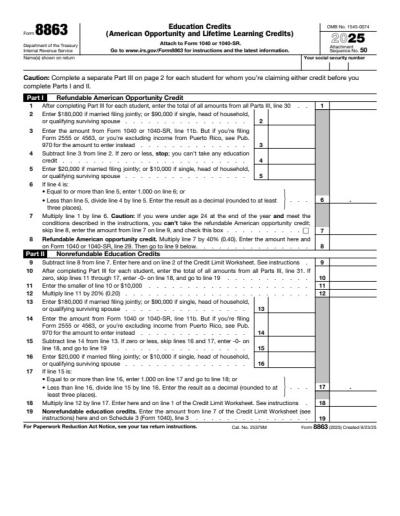
The current form in this template is the 2025 Form 8863, and the IRS PDF shows it was created 9/23/25. Page 1 contains Part I for the refundable portion of the American opportunity credit and Part II for nonrefundable education credits. Page 2 contains Part III, which must be completed separately for each student and asks for the student's name and SSN, the school's information, Form 1098-T questions, and the line-by-line calculation that determines whether the student qualifies for the American opportunity credit or only the lifetime learning credit.
Form 8863 does more than report tuition. It also applies the income phaseout, tests American opportunity credit eligibility, and routes the result to the main return. For example, Part III, lines 23 through 26 ask whether the credit was already claimed for 4 prior tax years, whether the student was at least half-time, whether the first 4 years of postsecondary education were already completed, and whether there was a felony drug conviction. Then lines 27 through 30 compute the American opportunity credit amount per student, while line 31 carries adjusted qualified education expenses for the lifetime learning credit calculation in Part II.
Who needs to fill this out?
- Individual taxpayers filing Form 1040 or Form 1040-SR who want to claim an education credit for themselves, a spouse, or a dependent must file Form 8863.
- Taxpayers claiming the American opportunity credit must meet the MAGI limits: the credit phases out between $160,000 and $180,000 for married filing jointly and between $80,000 and $90,000 for single, head of household, or qualifying surviving spouse. At $180,000 or $90,000 and above, no credit is allowed.
- Taxpayers claiming the lifetime learning credit use the same 2025 MAGI limits and must have paid adjusted qualified education expenses for eligible students enrolled at an eligible educational institution.
- Only the taxpayer who claims the student as a dependent can claim the credit for that student's expenses. If the student is not claimed as a dependent, only the student can claim the credit.
- American opportunity credit filers must complete Part III for each student and generally must show the institution's EIN at line 22a(4) or 22b(4), confirm the 4-prior-year rule at line 23, half-time enrollment at line 24, first-4-years test at line 25, and felony-drug-conviction test at line 26.
- You do not file Form 8863 if you are married filing separately, if you or your spouse were a nonresident alien for any part of the year and did not elect resident treatment, if your MAGI is too high, or if no qualified education expenses were paid.
- You also do not file it for a student who was not issued a required TIN by the due date of the return, or for an American opportunity credit claim where the student does not meet the enrollment, year-of-study, or prior-year-credit limits. In those cases, the American opportunity credit is not available, though the lifetime learning credit may still be.
Where and how to submit
Form 8863 is not mailed by itself. It must be attached to Form 1040 or Form 1040-SR and submitted with the taxpayer's federal individual income tax return to the Internal Revenue Service. Most filers submit it electronically through IRS e-file, IRS Free File, Direct File where available, commercial tax software, or an authorized e-file provider. There is no employer, school, or state agency that receives Form 8863 from the taxpayer; it goes only with the federal return package.
If filing by paper, attach Form 8863 behind the Form 1040 or 1040-SR and mail the full return to the IRS paper-filing address shown in the current Form 1040/1040-SR instructions for the taxpayer's state and whether a payment is enclosed. Because the IRS uses different addresses by state and payment status, there is no separate nationwide mailing address dedicated to Form 8863. For a 2025 return, the regular deadline is April 15, 2026, unless an extension, overseas rule, or IRS disaster relief postpones the due date. Educational institutions generally must furnish Form 1098-T by January 31, 2026, and if it is required but not received, the taxpayer must request it before filing if they want to rely on the IRS exception procedure.
How to fill it out
- Step 1 — Heading and taxpayer information: Enter the Name(s) shown on return and Your social security number at the top of page 1 exactly as they appear on Form 1040 or Form 1040-SR. The IRS matches Form 8863 to the main return using this information.
- Step 2 — Part III, student and school details: Before Parts I and II, complete a separate Part III on page 2 for each student. Enter the Student name on line 20 and Student social security number on line 21. For each institution, complete line 22a or 22b with the school name, address, whether the student received Form 1098-T for 2025, whether a 2024 Form 1098-T had box 7 checked, and the institution'sEIN if required.
- Step 3 — Part III, American opportunity eligibility questions: Answer line 23 on whether the American opportunity credit has been claimed for the student for any 4 prior tax years. Then answer line 24 on at least half-time enrollment in a program leading to a degree or other recognized credential, line 25 on whether the first 4 years of postsecondary education were completed before 2025, and line 26 on felony drug convictions. The yes-or-no path on these lines determines whether you continue to lines 27 through 30 or stop and use line 31 instead.
- Step 4 — Part III, American opportunity credit computation: If the student qualifies, enter Adjusted qualified education expenses on line 27, but do not enter more than $4,000. On line 28, subtract $2,000. On line 29, multiply line 28 by 25% (0.25). On line 30, if line 28 is zero, enter line 27; otherwise add $2,000 to line 29. Total all Part III line 30 amounts and carry that total to Part I, line 1.
- Step 5 — Part I, refundable American opportunity credit: In Part I, enter the Part III total on line 1. On line 2, enter $180,000 if married filing jointly or $90,000 for single, head of household, or qualifying surviving spouse. On line 3, enter Form 1040 or 1040-SR, line 11b, unless the special Form 2555, Form 4563, or Puerto Rico exclusion rule applies. Complete lines 4 through 7 to apply the phaseout fraction. If the under-age-24 rule in the instructions blocks the refundable portion, check the box on line 7, skip line 8, and move the amount to line 9. Otherwise compute the refundable amount on line 8 and also enter it on Form 1040 or 1040-SR, line 29.
- Step 6 — Part II, nonrefundable education credits: On line 9, subtract line 8 from line 7. On line 10, enter the total of all Part III, line 31 amounts for lifetime learning credit students. On line 11, enter the smaller of line 10 or $10,000. On line 12, multiply by 20%. Then use lines 13 through 18 to apply the same MAGI phaseout structure used in Part I.
- Step 7 — Credit limit and carryover to the return: Enter the result from line 18 into the Credit Limit Worksheet as instructed, then enter the final Nonrefundable education credits amount on line 19. That amount goes to Schedule 3 (Form 1040), line 3. Review all student-level Part III pages before filing, because one student cannot be used for both the American opportunity credit and the lifetime learning credit in the same year.
Important deadlines & penalties
- 2025 return deadline: File Form 8863 with Form 1040 or Form 1040-SR by April 15, 2026, unless a weekend, holiday, disaster postponement, or special rule changes the due date.
- Automatic extension: File Form 4868 by April 15, 2026 to request an automatic extension of time to file the individual return. That generally extends the filing deadline to October 15, 2026, but it does not extend the time to pay tax due.
- 1098-T timing: Schools generally furnish Form 1098-T by January 31, 2026. If a required 1098-T is missing, the IRS instructions say the taxpayer or student must request it after January 31, 2026, but before filing the return.
- Late-filing penalty: Because Form 8863 is part of the Form 1040 package, the normal individual failure-to-file penalty can apply if the return is late: generally 5% of the tax due per month or part of a month, up to 25%.
- Minimum late-filing penalty: If the Form 1040 return is more than 60 days late and the due date is after December 31, 2025, the minimum penalty is generally $525 or 100% of the unpaid tax, whichever is less.
- Late-payment penalty: If tax is not paid by the original due date, the IRS generally charges 0.5% of unpaid tax per month, up to 25%, plus interest.
- Credit-specific consequences: If the IRS makes a final determination that an improper American opportunity credit claim was due to reckless or intentional disregard of the rules, the taxpayer can be barred from claiming that credit for 2 years; if due to fraud, the ban can be 10 years. A prior disallowance after 2015 may also require Form 8862 on a later claim.
- Special deadline changes: Taxpayers abroad generally get an automatic 2-month filing extension to June 15, 2026, and IRS disaster relief can move the filing deadline for the entire return, including Form 8863.
Common mistakes to avoid
- Using the same student for both credits: The form expressly warns that you cannot use the same student for the American opportunity credit and the lifetime learning credit in the same year. Completing lines 27 through 30 and also including that student on line 31 can cause the IRS to recompute or deny the credit.
- Leaving out the institution's EIN: If claiming the American opportunity credit, the institution's EIN belongs on line 22a(4) or 22b(4). Omitting it can block the American opportunity credit even if tuition was paid.
- Answering line 23 incorrectly: If the American opportunity credit was already claimed for the student for 4 prior tax years, the student is not eligible again. Marking No when the correct answer is Yes can trigger an IRS adjustment, repayment, and possible Form 8862 issues later.
- Claiming AOC after the first four years were completed: Line 25 asks whether the student completed the first 4 years of postsecondary education before 2025. A mistaken No answer can produce an improper American opportunity credit that the IRS may disallow.
- Entering too much on line 27: Adjusted qualified education expenses for American opportunity credit purposes are capped at $4,000 on line 27. Entering a larger amount overstates line 30 and can inflate both the refundable and nonrefundable portions.
- Using Form 1098-T as the only tuition number without adjustments: The IRS instructions say the amount on Form 1098-T may not equal the amount actually eligible for the credit. Failing to reduce for scholarships or other tax-free educational assistance can make line 27 or line 31 too high and lead to credit recapture.
- Pulling the wrong AGI onto lines 3 or 14: The form tells filers to use Form 1040 or 1040-SR, line 11b, unless the special Form 2555, Form 4563, or Puerto Rico rule applies. Using taxable income, total income, or an unadjusted foreign-income figure causes a wrong phaseout percentage and a wrong credit amount.
Expert tips
- Complete all Part III pages first: The form itself says to finish every student's Part III before Parts I and II. That avoids misreporting the totals on Part I, line 1 and Part II, line 10.
- Do not rely blindly on Form 1098-T: Use the school statement as a starting point, then adjust for scholarships, grants, employer assistance, veteran benefits, and prepaid periods. IRS Publication 970 is the main guide for these adjustments.
- Use AOC first when a student qualifies: For a student who meets the American opportunity credit tests on lines 23 through 26, the IRS instructions note that the American opportunity credit is generally more valuable than the lifetime learning credit.
- Watch the under-age-24 rule on line 7: Some younger taxpayers with limited earned income can lose the refundable part of the American opportunity credit even though the credit itself is otherwise allowed. That box in Part I matters.
- Keep proof when no 1098-T is available: If the school was not required to issue Form 1098-T, or failed to furnish it after you requested it, keep enrollment records, billing statements, and payment proof showing the student attended an eligible institution and paid qualified expenses.
- Check TIN timing before filing: The IRS says the filer and, where required, the student must have been issued the needed TIN by the due date of the return, including extensions. An amended return usually cannot cure a missing timely TIN for the American opportunity credit.
- Know when Form 8862 may be needed: If the American opportunity credit was denied or reduced in a prior post-2015 year for reasons other than math or clerical error, review whether Form 8862 must be attached before claiming it again.
Related forms & next steps
- Form 1040 — The main U.S. individual income tax return to which Form 8863 is attached.
- Form 1040-SR — Senior version of the individual return that can also include Form 8863.
- Form 1098-T — Tuition Statement issued by eligible educational institutions and referenced in line 22.
- Form 8862 — Used to claim certain credits again after prior IRS disallowance, including some American opportunity credit cases.
- Form 4868 — Requests the automatic extension of time to file the individual return that includes Form 8863.
- Publication 970 — IRS Tax Benefits for Education, the main reference for qualified expenses and credit coordination rules.
- Instructions for Form 8863 — Official IRS line-by-line instructions and eligibility tests for the 2025 form.
Frequently asked questions
What is Form 8863 used for?
Form 8863 is used to figure and claim the American opportunity credit and the lifetime learning credit on a federal individual income tax return.
Do I need Form 1098-T to file Form 8863?
Usually yes, but the IRS instructions allow limited exceptions. If the school was not required to issue Form 1098-T, or if it was required but did not furnish it after you requested it, you may still qualify if you can prove enrollment at an eligible institution and substantiate qualified education expenses.
Can I claim both education credits in the same year?
Yes, but not for the same student. One student can generate an American opportunity credit while another student on the same return generates a lifetime learning credit.
What is the maximum credit on Form 8863?
The American opportunity credit can be worth up to $2,500 per eligible student, and up to 40% of that amount may be refundable. The lifetime learning credit can be worth up to $2,000 per return.
Can I claim Form 8863 if I am married filing separately?
No. The IRS instructions say taxpayers with married filing separately status cannot claim an education credit on Form 8863.
What if the IRS denied my American opportunity credit before?
You may need to attach Form 8862 before claiming it again, unless the prior denial was only for a math or clerical error. A reckless claim can trigger a 2-year ban, and a fraudulent claim can trigger a 10-year ban.
Can I create Form 8863, Education Credits (American Opportunity and Lifetime Learning Credits) in bulk?
Yes. PDFengine supports bulk generation of Form 8863, Education Credits (American Opportunity and Lifetime Learning Credits) via Excel or CSV upload — upload a spreadsheet with one row per entry and PDFengine generates all PDFs at once. You can also automate bulk creation programmatically via the PDFengine API.
Ready to fill it in?
Fill in this formOfficial sources
- About Form 8863 — IRS overview of the form and the two education credits it covers.
- 2025 Form 8863 PDF — Official IRS form showing the 2025 lines, parts, and student-level questions.
- Instructions for Form 8863 (2025) — Official IRS filing rules, MAGI limits, TIN requirements, 1098-T rules, and line instructions.
- Publication 970, Tax Benefits for Education — IRS publication covering qualified education expenses, scholarships, and coordination rules.
- IRS Failure to File Penalty — Official penalty page for late individual returns that include Form 8863.



