
Form 8889, filled in online.
Health Savings Accounts (HSAs)
Type in the panel and watch each answer land on the page. Filling in and signing is free; downloading needs a free account, which includes 5 downloads a month.
Or fill it another way:
- Category
- Tax
- Fillable fields
- 27
- Pages
- 1
- Paper size
- US Letter, 8.5 × 11 in
Five ways to fill this form.
-
Fill it in here
Type in the panel and watch it land on the form. Sign it, then download.
Free to fill and sign Start filling -
Many at once, from a spreadsheet
One row per person, one finished PDF for each.
Paid plan · you can walk through it Start with a spreadsheet -
Send it to someone to fill in
Email a link. They fill it in without an account and you get the answers back.
Paid plan · you can walk through it Send a request -
From your own software
Fill it over the API. One request returns the finished PDF.
Paid plan -
Let an AI assistant do it
Connect ChatGPT or Claude once, then describe what goes on the form.
With a free account
Key facts
| Form number | Form 8889 |
|---|---|
| Official name | Health Savings Accounts (HSAs) |
| Issuing agency | Internal Revenue Service, Department of the Treasury |
| Current revision date | 2025 form edition |
| Number of pages | 1 page form |
| Filing frequency | Annually, only when HSA activity or testing-period rules require it |
| Primary filing attachment | Attached to Form 1040, Form 1040-SR, or Form 1040-NR |
| Related instructions document | Instructions for Form 8889 (2025) |
What is this form?
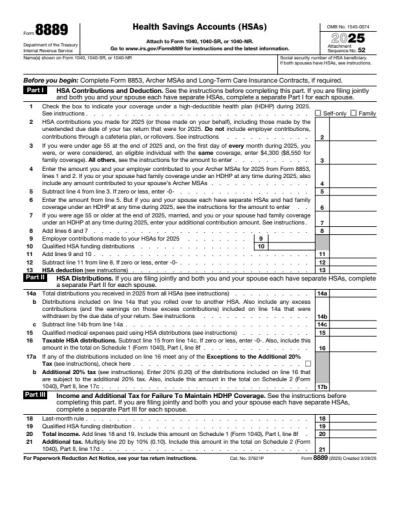
Form 8889, officially titled Health Savings Accounts (HSAs), is the IRS form used to report HSA activity for an individual tax return. You use it to report contributions made by you, your employer, or anyone else on your behalf; calculate any HSA deduction you can claim; report distributions taken from the account; and compute any income inclusion or additional tax that applies when HSA rules were not followed. The current IRS form is the 2025 edition of Form 8889, and the IRS About Form 8889 page was last reviewed on March 31, 2026.
The form is short, but each part does a different job. Part I — HSA Contributions and Deduction covers eligibility type on line 1, personal contributions on line 2, catch-up amounts on lines 3 and 7, employer and funding amounts on lines 9 and 10, and the final HSA deduction on line 13. Part II — HSA Distributions starts with total distributions on line 14a, subtracts rollovers on line 14b, measures qualified medical expenses on line 15, and calculates any taxable amount on line 16 plus the additional 20% tax on line 17b when no exception applies.
Part III — Income and Additional Tax for Failure To Maintain HDHP Coverage deals with the last-month rule testing period. If you used the last-month rule and later failed to remain an eligible individual, lines 18 through 21 determine how much must be added back into income and whether the 10% additional tax applies. In practice, Form 8889 is where the IRS reconciles your HSA contribution limit, your HSA withdrawals, and the tax consequences of mistakes or ineligible coverage.
Who needs to fill this out?
- Any individual with HSA contributions for 2025 must file Form 8889 if contributions were made by the taxpayer, an employer, or another person on the taxpayer's behalf. There is no income threshold for this filing requirement.
- Anyone who received an HSA distribution in 2025 must file, including taxpayers who used all distributions for qualified medical expenses and owe no tax. The IRS instructions say you must attach Form 8889 to Form 1040, 1040-SR, or 1040-NR even if you otherwise would not have to file a return.
- Taxpayers who used the last-month rule and later failed the testing period must file to complete Part III and report the required income inclusion and 10% additional tax.
- A beneficiary who acquired an interest in an HSA because the account beneficiary died may need to file, especially when the beneficiary is not a surviving spouse and the account stops being treated as an HSA.
- Married couples with two HSAs do not file one combined HSA form. Each spouse with an HSA files a separate Form 8889, even on a joint return.
- Contribution-limit situations that commonly trigger filing include self-only HDHP coverage with a basic annual limit of $4,300, family coverage with a basic annual limit of $8,550, and an extra $1,000 catch-up contribution for each eligible person age 55 or older.
- Who usually does not need to file: a taxpayer with no HSA contributions, no HSA distributions, no testing-period failure, and no inherited HSA interest generally does not file Form 8889. Employees without an HSA and businesses filing entity returns such as Forms 1120 or 1065 do not use this form.
Where and how to submit
Form 8889 is not mailed to an employer, HSA bank, or state agency. It is filed with your federal individual income tax return — typically Form 1040, Form 1040-SR, or Form 1040-NR. The normal filing method is electronic filing through IRS e-file, commercial tax software, or a paid preparer. If you file a paper return, attach Form 8889 to the return package and mail the whole return to the IRS address listed for your state and payment status in the current Form 1040 Where to File instructions.
For the 2025 tax year, the standard federal due date for a calendar-year individual return is April 15, 2026, and Form 8889 follows that deadline because it is an attachment to the return. You do not send Form 8889 separately to the HSA trustee. Keep Forms W-2 showing employer HSA contributions, Form 5498-SA for contributions, and Form 1099-SA for distributions with your records in case the IRS asks for support.
How to fill it out
- Step 1 — Identification and coverage type: Enter the name(s) shown on Form 1040, 1040-SR, or 1040-NR and the social security number of the HSA beneficiary at the top of the form. On line 1, check whether your HDHP coverage for 2025 was Self-only or Family. That box controls the annual limit used later in Part I.
- Step 2 — Part I, lines 2 through 5: On line 2, enter HSA contributions you made for 2025, including eligible contributions made by the unextended filing deadline in 2026. On line 3, enter your additional contribution if you were age 55 or older and eligible for the catch-up amount. On line 4, enter employer contributions to your Archer MSA for 2025 if applicable, then complete line 5 by subtracting line 4 from line 3.
- Step 3 — Part I, lines 6 through 13: Carry the amount to line 6, enter any spouse catch-up amount on line 7, and add lines 6 and 7 on line 8. Enter employer contributions made to your HSAs for 2025 on line 9 and any qualified HSA funding distributions on line 10. Add lines 9 and 10 on line 11, subtract line 11 from line 8 on line 12, and enter the final HSA deduction on line 13.
- Step 4 — Part II, lines 14a through 16: Enter total 2025 HSA distributions on line 14a. On line 14b, enter distributions included on line 14a that you rolled over to another HSA. Line 14c is the remainder after subtracting line 14b from line 14a. On line 15, enter qualified medical expenses paid with HSA funds. Then compute line 16, Taxable HSA distributions, which is the amount not used for qualified medical expenses.
- Step 5 — Part II, lines 17a and 17b: If any taxable amount on line 16 qualifies for an exception to the extra tax, check line 17a. Common exceptions include distributions made after age 65, after disability, or after death. On line 17b, enter 20% of the non-excepted taxable amount from line 16.
- Step 6 — Part III, lines 18 through 21: Complete this part only if you failed to remain an eligible individual during the testing period after using the last-month rule or after taking a qualified HSA funding distribution. Enter the recomputed excess amount on line 18, the qualified HSA funding distribution amount on line 19, add them on line 20, Total income, and multiply line 20 by 10% on line 21, Additional tax.
- Step 7 — Transfer and attach: Transfer the line 13 deduction and any income or tax amounts from lines 16, 17b, 20, and 21 to the lines referenced in the Form 8889 instructions and attach the form to your federal income tax return. If both spouses have HSAs, attach both Forms 8889.
Important deadlines & penalties
- Annual return deadline: For most calendar-year taxpayers, attach Form 8889 to the 2025 federal return due April 15, 2026.
- Contribution deadline for line 2 amounts: Personal HSA contributions for 2025 can generally be made up to the unextended filing deadline, April 15, 2026, and still be reported on line 2.
- Rollover deadline: A distribution generally must be rolled over to another HSA within 60 days to qualify for the line 14b rollover treatment.
- Excess contribution penalty: Excess HSA contributions can trigger a 6% excise tax under section 4973, generally reported through Form 5329, for each year the excess remains in the account.
- Nonqualified distribution penalty: Taxable HSA distributions on line 16 are generally subject to the 20% additional tax on line 17b unless an exception applies.
- Testing-period failure penalty: If you fail the last-month rule testing period, the amount added back into income in Part III is also subject to a 10% additional tax on line 21.
- General return penalties still matter: Because Form 8889 is part of the individual income tax return, filing the return late can also expose you to the normal IRS failure-to-file penalty of 5% per month, up to 25%, plus the failure-to-pay penalty of 0.5% per month, up to 25%, if tax is due.
- Special deadline extensions: Combat-zone relief, disaster relief, and other IRS postponements can move both the return due date and the deadline for HSA contributions tied to that return.
Common mistakes to avoid
- Checking the wrong box on line 1: Marking Self-only when you actually had family HDHP coverage, or vice versa, changes the annual contribution ceiling and can create an excess-contribution problem that later triggers Form 5329.
- Putting employer money on line 2 instead of line 9: Line 2 is for contributions you made for 2025. Employer contributions belong on line 9. Mixing those lines can overstate the deduction on line 13.
- Forgetting the $1,000 catch-up limit on lines 3 or 7: Taxpayers age 55 or older often enter the wrong catch-up amount or put a spouse's catch-up on the wrong form. That can distort lines 8, 12, and 13.
- Reporting a trustee-to-trustee transfer on line 14a: Direct transfers are not rollovers and should not be treated as taxable distributions. If you put them on line 14a, you may incorrectly create tax on line 16.
- Using line 15 for nonqualified expenses: Line 15 only includes qualified medical expenses. Entering insurance premiums or general wellness costs that do not qualify can understate taxable distributions and lead to IRS adjustment.
- Missing the line 17a exception box: If the line 16 distribution occurred after age 65, disability, or death, failing to check line 17a can wrongly produce a 20% tax on line 17b.
- Skipping Part III after using the last-month rule: Taxpayers who contributed based on December 1 eligibility but lost HDHP eligibility during the testing period often forget lines 18 through 21. That leaves required income and the 10% additional tax off the return.
Expert tips
- Reconcile three documents before you start: Use Form W-2, box 12 code W, Form 5498-SA, and Form 1099-SA together before entering anything on lines 2, 9, and 14a. Most Form 8889 errors start with unreconciled source documents.
- Remember that line 2 can include timely 2026 contributions for 2025: If you made a designated prior-year contribution by April 15, 2026, it may still belong on line 2 even though the deposit happened in 2026.
- Use Pub. 969 for edge cases: If you had midyear coverage changes, Medicare enrollment, or both spouses covered under one family HDHP, Publication 969 explains the contribution-limit math better than the one-page form.
- Do not confuse a rollover with a direct transfer: Only a true rollover goes on line 14b, and it usually must be completed within 60 days. Trustee-to-trustee transfers stay off the form.
- Keep a medical-expense ledger for line 15: The IRS does not require you to submit receipts with Form 8889, but keeping dates, payees, and amounts makes it much easier to defend qualified medical expenses if line 15 is questioned later.
- Spouse catch-up contributions are separate: If both spouses are age 55 or older, each spouse needs his or her own HSA to make a catch-up contribution. That detail affects line 7 and is frequently missed in joint-return planning.
- Review Form 5329 whenever line 12 shows an excess: Form 8889 calculates the contribution picture, but the continuing penalty on excess amounts usually lives on Form 5329. Do not stop at line 13 if the numbers do not reconcile cleanly.
Related forms & next steps
- Publication 969 — IRS guide to HSAs, Archer MSAs, health FSAs, and HRAs; the main background reference for Form 8889.
- Form 1099-SA — reports distributions from an HSA, Archer MSA, or Medicare Advantage MSA and feeds Part II of Form 8889.
- Form 5498-SA — reports HSA or Archer MSA contributions and year-end value information.
- Form 5329 — used to report the 6% excise tax on excess HSA contributions that remain uncorrected.
- Form 1040 — the main individual return to which Form 8889 is attached.
- Form 1040-NR — the nonresident return that can also require an attached Form 8889.
- Instructions for Form 8889 — the official line-by-line instructions for the current form.
Frequently asked questions
Do I have to file Form 8889 if my employer contributed to my HSA?
Yes. The IRS instructions say you must file Form 8889 if you, your employer, or someone else made contributions to your HSA. Employer contributions usually appear in box 12, code W of Form W-2 and belong on line 9.
Can I file Form 8889 by itself?
No. Form 8889 is generally filed as an attachment to Form 1040, Form 1040-SR, or Form 1040-NR. It is not a stand-alone submission in the usual filing process.
What happens if I used HSA money for non-medical expenses?
The nonqualified amount usually becomes taxable on line 16. If no exception applies, you also calculate the 20% additional tax on line 17b.
Can I still make a 2025 HSA contribution in 2026?
Usually yes. The IRS instructions for line 2 say contributions designated for 2025 can generally be made by the unextended federal return due date, which for most taxpayers is April 15, 2026.
Do married spouses share one Form 8889?
No. If both spouses have HSAs, each spouse files a separate Form 8889. The return may be joint, but the HSA reporting is still done per beneficiary.
What if I inherited an HSA?
If the surviving spouse is the designated beneficiary, the HSA is generally treated as the spouse's own HSA. If the beneficiary is not a surviving spouse, special death-beneficiary rules apply and Form 8889 may still be required to report the account value and any qualified medical expenses paid after death.
Can I create Form 8889 in bulk?
Yes. PDFengine supports bulk generation of Form 8889 via Excel or CSV upload — upload a spreadsheet with one row per entry and PDFengine generates all PDFs at once. You can also automate bulk creation programmatically via the PDFengine API.
Ready to fill it in?
Fill in this formOfficial sources
- IRS: About Form 8889 — official overview of what Form 8889 reports and who uses it.
- IRS: Instructions for Form 8889 (2025) — the official line-by-line instructions, contribution deadlines, rollover rules, and testing-period rules.
- IRS Publication 969 — the main IRS publication explaining HSAs and related tax-favored health plans.
- IRS: Where to file Form 1040 — official mailing-address resource for paper returns that include Form 8889.
- IRS: About Form 5329 — official reference for additional taxes, including the excise tax on excess HSA contributions.



