
Form 8962, filled in online.
Premium Tax Credit (PTC)
Type in the panel and watch each answer land on the page. Filling in and signing is free; downloading needs a free account, which includes 5 downloads a month.
Or fill it another way:
- Category
- Tax
- Fillable fields
- 139
- Pages
- 2
- Paper size
- US Letter, 8.5 × 11 in
Five ways to fill this form.
-
Fill it in here
Type in the panel and watch it land on the form. Sign it, then download.
Free to fill and sign Start filling -
Many at once, from a spreadsheet
One row per person, one finished PDF for each.
Paid plan · you can walk through it Start with a spreadsheet -
Send it to someone to fill in
Email a link. They fill it in without an account and you get the answers back.
Paid plan · you can walk through it Send a request -
From your own software
Fill it over the API. One request returns the finished PDF.
Paid plan -
Let an AI assistant do it
Connect ChatGPT or Claude once, then describe what goes on the form.
With a free account
Key facts
| Form number | Form 8962 |
|---|---|
| Official name | Premium Tax Credit (PTC) |
| Issuing agency | Internal Revenue Service (IRS), Department of the Treasury |
| Current revision date | 2025 edition; form footer states Created 3/25/25 |
| Number of pages | 2 pages |
| Filing frequency | Annual, with the taxpayer's federal income tax return |
| Main input document | Form 1095-A, Health Insurance Marketplace Statement |
| Related instructions document | Instructions for Form 8962 (2025), IRS publication i8962 |
What is this form?
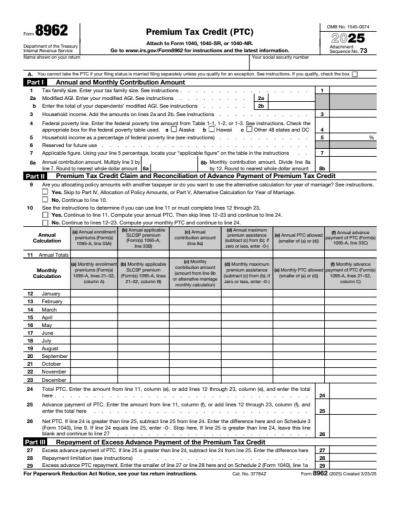
Form 8962, Premium Tax Credit (PTC), is the IRS form used to calculate the premium tax credit for Marketplace health insurance and to reconcile that credit with any advance payment of the premium tax credit (APTC) that was paid to an insurer during the year. The current IRS form in this template is Form 8962 (2025), a two-page form that states Created 3/25/25 in the footer. It must be attached to Form 1040, 1040-SR, or 1040-NR when a taxpayer claims a net premium tax credit or must repay excess advance credit.
The form is organized into five parts. Part I figures household income, federal poverty line percentage, and the annual and monthly contribution amounts on lines 1 through 8b. Part II computes the annual or monthly credit using line 11 or lines 12 through 23, then compares the allowed credit on line 24 with advance payments on line 25. Part III determines any excess APTC repayment on lines 27 through 29. Part IV handles allocation of policy amounts when another taxpayer shares a Marketplace policy, using lines 30 through 34. Part V provides the alternative calculation for year of marriage on lines 35 and 36 for eligible newly married taxpayers.
In practice, Form 8962 ties together data from Form 1095-A, Health Insurance Marketplace Statement, with the taxpayer's return. Annual totals from Form 1095-A line 33 flow into line 11 of Form 8962 when the annual calculation is allowed. Otherwise, monthly figures from Form 1095-A lines 21 through 32 feed lines 12 through 23. Because the form can either create an additional refundable credit or produce a tax repayment, accuracy matters.
Who needs to fill this out?
- Taxpayers who want to claim the Premium Tax Credit for at least one month of Marketplace coverage in a qualified health plan must file Form 8962 with Form 1040, 1040-SR, or 1040-NR.
- Taxpayers for whom APTC was paid for themselves or any other individual in their tax family must file Form 8962, even if they would not otherwise have a filing requirement.
- Taxpayers for whom APTC was paid for a person they told the Marketplace would be in their tax family, but neither they nor anyone else actually included that person in a tax family, must file Form 8962.
- Taxpayers who were covered through a Marketplace policy shared with another taxpayer because of divorce, shared custody, or another allocation situation may need Form 8962 and Part IV.
- Taxpayers married at year-end who are otherwise eligible for the credit generally must file jointly; limited exceptions apply for certain victims of domestic abuse or spousal abandonment, as described in the IRS instructions.
- Taxpayers whose household income is generally at least 100% of the federal poverty line for their family size may qualify; under current rules, income above 400% of the federal poverty line does not automatically disqualify a taxpayer for tax year 2025.
- Do not file Form 8962 if you are being claimed as a dependent on someone else's return; the taxpayer claiming you files it if needed. You also generally do not file it if you had no Marketplace coverage, received no Form 1095-A, are not claiming the PTC, and had no APTC paid on your behalf.
Where and how to submit
Form 8962 is not filed by itself. It must be attached to the taxpayer's federal income tax return — specifically Form 1040, Form 1040-SR, or Form 1040-NR. If you e-file your return, Form 8962 is transmitted electronically with the return. If you paper file, include Form 8962 in the return package you mail to the IRS filing address that applies to your state or country and whether you are enclosing a payment, as listed in the current Form 1040 or 1040-NR instructions.
One example IRS paper-filing address used for some individual returns without a payment is Department of the Treasury, Internal Revenue Service, Austin, TX 73301-0002, but taxpayers must use the address that matches their own filing situation.
The filing deadline is generally the due date of the federal income tax return, usually April 15 for calendar-year taxpayers, unless the date falls on a weekend or legal holiday. If you request an automatic extension with Form 4868, the return — and Form 8962 attached to it — is generally due by October 15. Do not send Form 8962 to the Health Insurance Marketplace or to your insurer; the Marketplace instead provides Form 1095-A, which you use to complete this form.
How to fill it out
- Step 1 — Heading and filing-status exception: Enter the name shown on your return and social security number at the top of page 1. If your filing status is married filing separately but you qualify for the exception described in the instructions, check box A before completing the rest of the form.
- Step 2 — Part I, lines 1 through 8b: Enter your tax family size on line 1, your modified AGI on line 2a, and the total of dependents' modified AGI on line 2b. Add those amounts on line 3 for household income. On line 4, enter the federal poverty line amount and check whether you used the Alaska, Hawaii, or Other 48 states and DC table. Use line 5 to determine the percentage of federal poverty line, find the applicable figure for line 7, then compute the annual contribution amount on line 8a and the monthly contribution amount on line 8b.
- Step 3 — Part II, lines 9 through 11: Answer line 9 to show whether you are allocating policy amounts with another taxpayer or electing the alternative calculation for year of marriage. Then use line 10 to determine whether you may use the annual calculation on line 11 or must complete monthly lines 12 through 23. If line 11 applies, transfer annual totals from Form 1095-A line 33A to column (a), line 33B to column (b), and line 33C to column (f), then compute columns (c) through (e), including annual PTC allowed in column (e).
- Step 4 — Part II, lines 12 through 23: If the annual calculation is not allowed, complete the monthly grid for January through December. For each month, enter monthly enrollment premiums from Form 1095-A column A in column (a), monthly applicable SLCSP premium from Form 1095-A column B in column (b), your line 8b amount or alternative marriage amount in column (c), compute the monthly maximum premium assistance in column (d), the monthly PTC allowed in column (e), and the monthly advance payment of PTC from Form 1095-A column C in column (f).
- Step 5 — Part II totals and Part III repayment: Enter total allowed credit on line 24 and total advance payments on line 25. If line 24 is greater, enter the difference on line 26 and carry it to Schedule 3 (Form 1040), line 9. If line 25 is greater, skip line 26, enter the excess on line 27, enter any repayment limitation on line 28, and report the smaller amount on line 29 and Schedule 2 (Form 1040), line 1a.
- Step 6 — Part IV, lines 30 through 34: If another taxpayer shares the Marketplace policy, complete up to four allocations. For each allocation on lines 30 through 33, enter the Policy Number from Form 1095-A line 2, the SSN of other taxpayer, the allocation start month, allocation stop month, and the percentages for Premium, SLCSP, and Advance Payment of the PTC. Then answer line 34 to indicate whether all policy amount allocations have been completed.
- Step 7 — Part V, lines 35 and 36: If you are eligible to elect the Alternative Calculation for Year of Marriage, complete line 35 for your SSN and line 36 for your spouse's SSN. Enter the alternative family size, alternative monthly contribution amount, alternative start month, and alternative stop month, then use those amounts to finish the monthly calculations in Part II.
Important deadlines & penalties
- Regular due date: File Form 8962 with your Form 1040, 1040-SR, or 1040-NR by the normal federal income tax return due date, generally April 15 for calendar-year taxpayers.
- Extension: An automatic extension to file the return is generally available through Form 4868, moving the filing deadline to October 15. This extends the time to file Form 8962, but not the time to pay tax owed.
- Marketplace statement timing: The Marketplace is generally required to provide Form 1095-A by January 31, and HealthCare.gov states it may appear in your Marketplace account from mid-January to February 1. Do not file until you have an accurate Form 1095-A.
- Appeal-related premium rule: If you became eligible for APTC because of a successful eligibility appeal and retroactive enrollment, the taxpayer portion of enrollment premiums generally must be paid by the 120th day after the appeals decision for the month to qualify as a coverage month.
- Late-filing penalty: There is no separate standalone Form 8962 penalty schedule, but if failing to attach it causes your return to be late or incomplete and tax is due, the standard late-filing penalty on the return can apply — generally 5% of the unpaid tax per month or part of a month, up to 25%.
- Late-payment charges: If excess APTC increases the tax due and you do not pay by the return due date, the IRS may charge the standard late-payment penalty, generally 0.5% of unpaid tax per month, plus interest until paid.
- E-file rejection risk: Returns that should include Form 8962 can be rejected electronically if the IRS records show Marketplace coverage or APTC but the form is missing. That usually causes processing delays until the return is corrected and resubmitted.
Common mistakes to avoid
- Using the wrong Form 1095-A: Taxpayers sometimes complete line 11 or lines 12 through 23 from an original Form 1095-A after receiving a corrected one. The IRS instructions say to use the form marked “CORRECTED”; using the wrong statement can misstate columns (a), (b), and (f) and trigger a notice or amended return.
- Filing before Form 1095-A is accurate: If Part III, column B on Form 1095-A has a blank or zero SLCSP amount for a month, taxpayers often still complete Form 8962. That usually causes the line 11 or lines 12–23 credit calculation to be wrong and can delay the refund.
- Choosing line 11 when monthly lines are required: Some filers use the annual calculation on line 11 even though their circumstances require the monthly calculation on lines 12 through 23. That can overstate the allowed credit and create excess APTC repayment later.
- Skipping Part IV when a policy is shared: If divorce, separation, or another shared-policy situation applies, failing to complete lines 30 through 34 can cause the taxpayer to report the full policy amounts instead of only their allocated share. The result may be an inflated repayment on line 29 or an overstated credit on line 26.
- Entering household income incorrectly: On lines 2a and 2b, taxpayers often omit dependents' modified AGI that must be included or confuse AGI with modified AGI. That error flows through lines 3, 5, 7, 8a, and 8b and changes the monthly contribution amount.
- Forgetting the filing-status rule: Married taxpayers filing separately sometimes overlook the warning above the form and fail to evaluate box A. If the exception does not apply, the taxpayer generally cannot claim the PTC, and the return may need correction.
- Misreporting repayment limitation: Taxpayers who owe excess APTC sometimes enter the full excess on line 29 without checking whether a repayment limitation belongs on line 28. Others incorrectly claim a limitation when they are not eligible. Either mistake changes tax due and may generate IRS correspondence.
Expert tips
- Wait for the final Marketplace statement: If your Marketplace account shows a corrected Form 1095-A, use that version only. Rechecking this before you fill line 11 or lines 12–23 prevents one of the most common IRS mismatches.
- Verify SLCSP before doing any math: Review Form 1095-A Part III, column B first. If any month is blank or zero when coverage existed, use the Marketplace tax tool or contact the Marketplace before completing Form 8962.
- Use monthly calculations when income or family changed during the year: If marriage, divorce, dependent changes, or shared policy issues affected coverage, assume you may need lines 12 through 23 or Part IV and confirm in the IRS instructions rather than defaulting to line 11.
- Check modified AGI rules in Pub. 974: Lines 2a and 2b are not always the same as AGI from your return. Foreign earned income exclusions, tax-exempt interest, and nontaxable social security can matter.
- Keep allocation support with the return copy: If you complete lines 30 through 33, retain divorce decrees, custody agreements, or written allocation support showing why the percentages were used. The form itself does not explain the backstory.
- Review where the result goes: A net credit from line 26 belongs on Schedule 3 (Form 1040), line 9, while excess repayment from line 29 goes to Schedule 2 (Form 1040), line 1a. Misplacing the carryover can distort the entire return.
- Use IRS tools when marriage is involved: Part V is specialized and often overlooked. If you married during the year and excess APTC is an issue, read the Instructions for Form 8962 together with Pub. 974 before deciding whether the alternative calculation reduces repayment.
Related forms & next steps
- Form 1095-A — Health Insurance Marketplace Statement; provides the premium, SLCSP, and APTC data used throughout Form 8962.
- Instructions for Form 8962 — Official IRS line-by-line instructions, worksheets, repayment limitation guidance, and allocation rules.
- Form 1040 — U.S. Individual Income Tax Return to which Form 8962 is attached.
- Schedule 3 (Form 1040) — Used to claim the net premium tax credit from Form 8962 line 26.
- Schedule 2 (Form 1040) — Used to report excess advance premium tax credit repayment from Form 8962 line 29.
- Form 4868 — Automatic extension of time to file the return that includes Form 8962.
- Publication 974 — Premium Tax Credit guidance, including detailed rules on household income, marriage, and shared allocations.
Frequently asked questions
What is Form 8962 used for?
Form 8962 is used to calculate the Premium Tax Credit and reconcile it with any advance premium tax credit paid to your insurer through a Health Insurance Marketplace. It can either increase your refund through line 26 or increase tax due through line 29.
Do I have to file Form 8962 if I received Form 1095-A?
Usually yes if you want to claim the Premium Tax Credit or if APTC was paid for you or someone in your tax family. Form 1095-A is the Marketplace statement; Form 8962 is the IRS reconciliation form that goes with your tax return.
Can I file my tax return without Form 1095-A?
You generally should not. HealthCare.gov specifically warns taxpayers not to file until they have an accurate Form 1095-A, because the data on that statement drives Form 8962 line 11 or lines 12 through 23.
What happens if my advance premium tax credit was too high?
If total advance payments on line 25 exceed the allowed credit on line 24, you have excess APTC. You compute the excess on line 27, apply any repayment limitation on line 28 if allowed, and report the repayment on line 29 and Schedule 2 (Form 1040), line 1a.
When do I need Part IV allocation of policy amounts?
Part IV is used when a Marketplace policy must be split with another taxpayer, such as after divorce, separation, or a dependent coverage arrangement. You complete lines 30 through 33 with the policy number, other taxpayer's SSN, months, and allocation percentages, then use line 34 to confirm whether all allocations were completed.
Can I e-file Form 8962?
Yes. Form 8962 is normally e-filed as part of your federal income tax return. If the IRS rejects the return because Form 8962 is missing or inconsistent with Marketplace records, you must correct the return and resubmit it with the proper Marketplace information.
Can I create Form 8962, Premium Tax Credit (PTC) in bulk?
Yes. PDFengine supports bulk generation of Form 8962, Premium Tax Credit (PTC) via Excel or CSV upload — upload a spreadsheet with one row per entry and PDFengine generates all PDFs at once. You can also automate bulk creation programmatically via the PDFengine API.
Ready to fill it in?
Fill in this formOfficial sources
- IRS — About Form 8962, Premium Tax Credit — Official overview of the form, purpose, and related resources.
- IRS — Instructions for Form 8962 (2025) — Official filing rules, eligibility requirements, line instructions, and repayment limitation guidance.
- IRS — Form 8962 (2025) PDF — Current official form showing line numbers, parts, and attachment instructions.
- HealthCare.gov — How to Use Form 1095-A — Official Marketplace guidance on obtaining and verifying Form 1095-A before filing.
- IRS Publication 974 — Detailed IRS guidance on Premium Tax Credit calculations, marriage, and shared policy situations.



