
Form 941, filled in online.
Employer's Quarterly Federal Tax Return
Type in the panel and watch each answer land on the page. Filling in and signing is free; downloading needs a free account, which includes 5 downloads a month.
Or fill it another way:
- Category
- Tax
- Fillable fields
- 106
- Pages
- 3
- Paper size
- US Letter, 8.5 × 11 in
Five ways to fill this form.
-
Fill it in here
Type in the panel and watch it land on the form. Sign it, then download.
Free to fill and sign Start filling -
Many at once, from a spreadsheet
One row per person, one finished PDF for each.
Paid plan · you can walk through it Start with a spreadsheet -
Send it to someone to fill in
Email a link. They fill it in without an account and you get the answers back.
Paid plan · you can walk through it Send a request -
From your own software
Fill it over the API. One request returns the finished PDF.
Paid plan -
Let an AI assistant do it
Connect ChatGPT or Claude once, then describe what goes on the form.
With a free account
Key facts
| Form number | Form 941 |
|---|---|
| Official name | Employer's Quarterly Federal Tax Return |
| Issuing agency | Internal Revenue Service (Department of the Treasury) |
| Current revision date in this template | Rev. March 2025 |
| Number of pages | 3 pages total, including page 2 and Form 941-V payment voucher |
| Filing frequency | Quarterly |
| Main reporting sections | Part 1 through Part 5, plus Form 941-V when payment with return is allowed |
| Related instructions document | Instructions for Form 941 and Publication 15 (Employer's Tax Guide) |
What is this form?
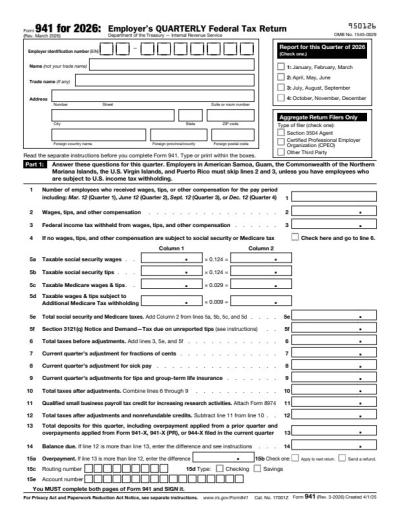
Form 941, Employer's Quarterly Federal Tax Return, is the IRS return employers use to report federal income tax withheld from employees' wages and both the employer and employee shares of Social Security and Medicare tax for a calendar quarter. The 2025 version of the form is labeled Rev. March 2025. On the face of the return, Part 1 calculates wages, withholding, taxable Social Security and Medicare wages, adjustments, credits, deposits, and any balance due or overpayment.
The form is not just a summary sheet. It also tells the IRS when payroll tax liability arose and whether the employer was a monthly or semiweekly depositor. Part 2 covers deposit schedule and tax liability, including line 16 and the requirement to attach Schedule B for semiweekly depositors. Parts 3 through 5 cover business status changes, seasonal employer status, third-party designee authorization, and the required signature.
Employers typically file Form 941 four times per year unless the IRS has instructed them to use a different employment tax return, such as Form 944. The return ties directly into payroll compliance, deposit rules under Publication 15, year-end Forms W-2, and correction procedures on Form 941-X if the original filing later proves inaccurate.
Who needs to fill this out?
- Employers engaged in a trade or business who paid wages subject to federal income tax withholding, Social Security tax, or Medicare tax during the quarter generally must file Form 941.
- Employers in U.S. territories that use Form 941 instead of discontinued territory-specific quarterly payroll returns must also file when they have wages subject to these federal employment taxes.
- Third-party payroll filers, including approved section 3504 agents, certified professional employer organizations, and other aggregate filers, may file Form 941 for clients and may need attached schedules such as Schedule R (Form 941).
- Semiweekly depositors and employers that triggered a $100,000 next-day deposit rule still file Form 941; their deposit history changes how Part 2 is completed, not whether the return is required.
- Do not file Form 941 if the IRS notified you in writing to file Form 944 instead, if you are filing Form 943 for agricultural wages, or if compensation is subject to Railroad Retirement Tax Act reporting on Form CT-1.
- Seasonal employers do not have to file for quarters in which they paid no wages, but when they do file a quarter's return they should check the seasonal employer box on line 18.
Where and how to submit
Employers can file Form 941 electronically through IRS-authorized e-file providers, payroll software, or other approved business e-file methods. Electronic filing is generally the fastest option and reduces processing errors. Paper filing is still allowed, but the mailing address depends on the employer's state and whether a payment is enclosed. The return is filed with the Internal Revenue Service, not given to employees or a state payroll agency.
For paper returns without a payment, employers in states including New York, New Jersey, Pennsylvania, Virginia, North Carolina, Georgia, Illinois, Michigan, Ohio, Tennessee, and other listed eastern and midwestern jurisdictions mail Form 941 to Department of the Treasury, Internal Revenue Service, Kansas City, MO 64999-0005. Employers in states including California, Texas, Florida, Washington, Arizona, Colorado, Oregon, Utah, and other listed western and southern jurisdictions generally mail it to Department of the Treasury, Internal Revenue Service, Ogden, UT 84201-0005. Employers with no legal residence or principal place of business in any state, including employers in American Samoa, Guam, the CNMI, the U.S. Virgin Islands, and Puerto Rico, generally use Internal Revenue Service, PO Box 409101, Ogden, UT 84409. If a payment is enclosed, the IRS where-to-file table directs Form 941 filers to Internal Revenue Service, P.O. Box 932100, Louisville, KY 40293-2100.
The normal due dates are April 30, July 31, October 31, and January 31, subject to weekend and holiday rules.
How to fill it out
- Step 1 — Header and quarter selection: Enter the employer identification number (EIN), legal name, trade name if any, and mailing address at the top of page 1. Then check the correct quarter box: 1 for January-March, 2 for April-June, 3 for July-September, or 4 for October-December.
- Step 2 — Part 1, payroll and withholding amounts: Complete line 1 with the number of employees who received wages for the pay period including March 12, June 12, September 12, or December 12, depending on the quarter. Enter total wages on line 2 and federal income tax withheld on line 3. If no wages were subject to Social Security or Medicare tax, check the box on line 4 and skip directly to line 6.
- Step 3 — Part 1, Social Security and Medicare tax computation: Enter taxable Social Security wages on line 5a, taxable Social Security tips on line 5b, taxable Medicare wages and tips on line 5c, and wages subject to Additional Medicare Tax withholding on line 5d. Calculate line 5e by adding the Column 2 tax amounts from lines 5a through 5d. If applicable, enter tax due on unreported tips from a Section 3121(q) notice on line 5f.
- Step 4 — Part 1, adjustments, credits, deposits, and balance: Add lines 3, 5e, and 5f for line 6. Enter current-quarter adjustments on line 7 for fractions of cents, line 8 for sick pay, and line 9 for tips and group-term life insurance, then combine them for line 10. If claiming the qualified small business payroll tax credit for increasing research activities, enter it on line 11 and attach Form 8974; subtract it to reach line 12. Enter total deposits and applied overpayments on line 13, then complete line 14 for balance due or line 15 for overpayment and choose whether to apply it to the next return or receive a refund.
- Step 5 — Part 2, deposit schedule and tax liability: On line 16, check the statement that applies. If line 12 for the quarter is less than $2,500 and you did not trigger a $100,000 next-day deposit obligation, you may qualify to pay with the return. If you were a monthly schedule depositor for the entire quarter, enter Month 1, Month 2, Month 3 liability amounts and the quarter total; that total must equal line 12. If you were a semiweekly depositor for any part of the quarter, attach Schedule B (Form 941).
- Step 6 — Parts 3 through 5, business status and authorization: If the business closed or stopped paying wages, check line 17 and enter the final date wages were paid, then attach the required statement. If you are a seasonal employer, check line 18. In Part 4, either authorize a third-party designee by listing the designee's name, phone number, and 5-digit PIN, or check No.
- Step 7 — Signature and payment voucher: In Part 5, an authorized person must sign, print their name and title, date the return, and provide a daytime phone number. Complete the paid preparer section if applicable. If you are allowed to pay with the return, complete Form 941-V with the EIN, payment amount, quarter, and business name and address, and send it with the return and payment.
Important deadlines & penalties
- Quarter 1 deadline: April 30 for wages paid in January, February, and March.
- Quarter 2 deadline: July 31 for wages paid in April, May, and June.
- Quarter 3 deadline: October 31 for wages paid in July, August, and September.
- Quarter 4 deadline: January 31 of the following year for wages paid in October, November, and December.
- If a due date falls on a Saturday, Sunday, or legal holiday, the return is timely if filed on the next business day.
- If you timely deposited all taxes when due, the IRS gives you 10 additional calendar days to file Form 941.
- There is generally no separate extension form for Form 941. The practical filing relief is the automatic 10-day extension for timely depositors, plus the normal next-business-day rule for weekends and legal holidays.
- Late filing penalty: the IRS failure-to-file penalty is generally 5% of the tax due for each month or part of a month the return is late, up to a maximum of 25%. If failure-to-file and failure-to-pay both apply, the filing penalty is reduced by the failure-to-pay amount.
- Late deposit penalty: failure-to-deposit penalties generally run 2% for deposits 1-5 calendar days late, 5% for 6-15 days late, 10% for more than 15 days late, and 15% if the amount remains unpaid more than 10 days after the first IRS notice or after an immediate payment notice.
- Interest can apply on unpaid tax and on certain penalties until the balance is paid in full.
Common mistakes to avoid
- Checking the wrong quarter box at the top of page 1. This can post wages and deposits to the wrong period, causing mismatch notices and making later corrections on Form 941-X more likely.
- Entering a headcount on line 1 from the wrong payroll date. Line 1 is tied to the pay period including March 12, June 12, September 12, or December 12. Using month-end or average headcount produces inaccurate employment reporting.
- Reporting line 2 wages but failing to complete lines 5a through 5d correctly. If taxable Social Security or Medicare wages are omitted, line 5e and line 12 will be understated, which can trigger underpayment assessments and deposit penalties.
- Checking line 4 improperly. The line 4 box is only for quarters in which no wages, tips, and other compensation were subject to Social Security or Medicare tax. Checking it while still reporting taxable FICA wages is internally inconsistent and often leads to IRS correspondence.
- Claiming the research payroll tax credit on line 11 without attaching Form 8974. The IRS specifically requires the attachment. Missing it can delay processing or cause the credit to be disallowed until documentation is supplied.
- Completing line 16 monthly liabilities that do not equal line 12. The form explicitly says the total monthly liability for the quarter must equal line 12. If it does not, the IRS may treat the return as mathematically inconsistent and question deposit timing.
- Failing to attach Schedule B (Form 941) when you were a semiweekly depositor for any part of the quarter. That often leads to failure-to-deposit mismatch notices because the IRS cannot reconcile when liabilities arose.
- Submitting an unsigned return in Part 5. An unsigned Form 941 is not properly executed and can be treated as not filed, exposing the employer to late-filing consequences even if the numbers were otherwise complete.
Expert tips
- Use the payroll register for the specific pay period that includes March 12, June 12, September 12, or December 12 when completing line 1. Many filers mistakenly use a monthly average instead of the form's fixed measurement date.
- Before filing, reconcile line 3 federal income tax withheld and lines 5a-5d taxable wage bases to quarter-end payroll reports. Catching mismatches before filing is much easier than fixing them later on Form 941-X.
- If your liability for the quarter is under $2,500, review line 16 and IRS Topic 757 carefully. Some employers can pay with the return, but if the $100,000 next-day deposit rule was triggered, deposit obligations still apply.
- For monthly depositors, prepare Part 2 from actual tax liability by month, not from when deposits cleared your bank. The month totals on line 16 should reflect when liability arose from wages paid.
- If the business is done paying wages, use line 17 and attach the final-return statement right away. Skipping this step often causes the IRS to keep expecting future quarterly filings.
- Keep the entity name and EIN consistent everywhere: page headers, payment voucher, payroll records, and any attached schedules. Small formatting differences can slow posting, especially when a payment is enclosed.
- Use IRS tools that many quick guides skip: EFTPS for deposits, the IRS business tax account for transcripts and payments, Publication 15 for deposit rules, and the official Instructions for Form 941 for quarter-specific line guidance.
Related forms & next steps
- Form 941-X — Adjusted Employer's Quarterly Federal Tax Return or Claim for Refund, used to correct a previously filed Form 941.
- Schedule B (Form 941) — Report of Tax Liability for Semiweekly Schedule Depositors.
- Schedule R (Form 941) — Allocation Schedule for Aggregate Form 941 Filers.
- Form 8974 — Qualified Small Business Payroll Tax Credit for Increasing Research Activities; required when claiming the credit on line 11.
- Form 944 — Employer's Annual Federal Tax Return for small employers the IRS instructs to file annually instead of quarterly.
- Form 943 — Employer's Annual Federal Tax Return for Agricultural Employees.
- Form 940 — Employer's Annual Federal Unemployment (FUTA) Tax Return.
- Publication 15 — Employer's Tax Guide, including deposit schedule rules referenced by Form 941.
Frequently asked questions
Who has to file Form 941?
Most employers that pay wages subject to federal income tax withholding or Social Security and Medicare tax must file Form 941 for each quarter. You generally should not file it if the IRS instructed you to file Form 944 instead, or if the wages belong on Form 943 or Form CT-1.
Do I have to file Form 941 if I had no payroll this quarter?
If you are a regular Form 941 filer, you generally continue filing until the IRS changes your requirement or you file a final return. Seasonal employers may skip quarters with no wages, but when filing they should mark line 18 to show seasonal status.
Can I e-file Form 941?
Yes. The IRS allows electronic filing through approved e-file methods and many payroll systems. E-filing is usually faster than paper filing and reduces the chance of transcription or posting errors.
When do I need to attach Schedule B to Form 941?
Attach Schedule B (Form 941) if you were a semiweekly schedule depositor for any part of the quarter. If you are a monthly schedule depositor for the entire quarter, you instead complete the monthly liability section on line 16.
What if I already filed Form 941 and later found a mistake?
Do not file another original Form 941 for the same quarter. Corrections are generally made on Form 941-X, which is filed separately and is used to adjust underreported or overreported wages, taxes, credits, and other amounts.
What is the difference between Form 941 and Form 944?
Form 941 is quarterly and Form 944 is annual. Small employers with annual employment tax liabilities of $1,000 or less may file Form 944 only if the IRS specifically notifies them in writing to do so.
Can I create Form 941 in bulk?
Yes. PDFengine supports bulk generation of Form 941 via Excel or CSV upload — upload a spreadsheet with one row per entry and PDFengine generates all PDFs at once. You can also automate bulk creation programmatically via the PDFengine API.
Ready to fill it in?
Fill in this formOfficial sources
- IRS — About Form 941 — official overview of the form, schedules, and current revision links.
- IRS — Instructions for Form 941 — official line instructions, filing rules, and credit/deposit guidance.
- IRS — Where to file your taxes for Form 941 — official mailing addresses based on location and whether payment is enclosed.
- IRS — Employment tax due dates — official quarterly deadlines and the 10-day additional filing window for timely depositors.
- IRS — Failure to Deposit Penalty — official penalty percentages for late or improper employment tax deposits.



