
Form 982, filled in online.
Reduction of Tax Attributes Due to Discharge of Indebtedness
Type in the panel and watch each answer land on the page. Filling in and signing is free; downloading needs a free account, which includes 5 downloads a month.
Or fill it another way:
- Category
- Tax
- Fillable fields
- 27
- Pages
- 1
- Paper size
- US Letter, 8.5 × 11 in
Five ways to fill this form.
-
Fill it in here
Type in the panel and watch it land on the form. Sign it, then download.
Free to fill and sign Start filling -
Many at once, from a spreadsheet
One row per person, one finished PDF for each.
Paid plan · you can walk through it Start with a spreadsheet -
Send it to someone to fill in
Email a link. They fill it in without an account and you get the answers back.
Paid plan · you can walk through it Send a request -
From your own software
Fill it over the API. One request returns the finished PDF.
Paid plan -
Let an AI assistant do it
Connect ChatGPT or Claude once, then describe what goes on the form.
With a free account
Key facts
| Item | Details |
|---|---|
| Form number | Form 982 |
| Official name | Reduction of Tax Attributes Due to Discharge of Indebtedness (and Section 1082 Basis Adjustment) |
| Issuing agency | Internal Revenue Service, Department of the Treasury |
| Current revision date | Form revised March 2018; official instructions revised December 2021 |
| Number of pages | 1 page |
| Filing frequency | As needed for any tax year in which canceled debt is excluded under section 108 |
| Main related information return | Form 1099-C, Cancellation of Debt |
| Related instructions document | Instructions for Form 982 (12/2021) |
What is this form?
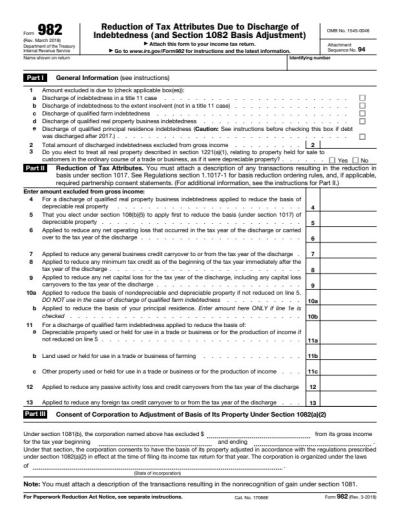
Form 982, officially titled Reduction of Tax Attributes Due to Discharge of Indebtedness \(and Section 1082 Basis Adjustment\), is the IRS form used when canceled debt would otherwise be taxable but qualifies for exclusion under section 108. It is commonly used for bankruptcy, insolvency, qualified farm debt, qualified real property business debt, and qualified principal residence debt. The current IRS form PDF is Form 982 \(Rev\. March 2018\), and the official instructions were revised in December 2021.
Part I shows why the debt is excludable by using lines 1a through 1e and reports the excluded amount on line 2. Line 3 contains a separate election for certain real property. Part II reports the required reduction of tax attributes on lines 4 through 13, including losses, credits, and basis. Part III is a narrower corporate consent section under section 1082\(a\)\(2\). Form 982 is an attachment to the return, not a substitute for the return itself.
Who needs to fill this out?
- Individuals in a title 11 bankruptcy case who exclude canceled debt should file Form 982 and check line 1a.
- Individuals who were insolvent immediately before discharge may use line 1b, but only up to the amount by which liabilities exceeded the fair market value of assets.
- Farmers with qualified farm indebtedness may use line 1c if at least 50% of aggregate gross receipts for the prior 3 tax years came from farming and the debt was canceled by a qualified person.
- Taxpayers with qualified real property business indebtedness may use line 1d to exclude the discharge and reduce basis. This exclusion generally does not apply to a corporation other than an S corporation.
- Homeowners with qualified principal residence indebtedness may use line 1e only for debt discharged before January 1, 2026, or under a written arrangement entered into before that date. The maximum eligible debt is \$750,000, or \$375,000 if married filing separately.
- You generally do not file Form 982 if the canceled amount is fully taxable, no section 108 exclusion applies, or a nonrecourse foreclosure creates only gain-or-loss treatment instead of cancellation-of-debt income. A Form 1099-C alone does not automatically require Form 982.
Where and how to submit
Form 982 is generally not mailed as a stand-alone form to a special IRS office. The IRS instructions say to file Form 982 with your federal income tax return for the year in which the discharged debt is excluded under section 108(a). That means individuals usually attach it to Form 1040, corporations attach it to the appropriate business return, and it goes to the same IRS filing location or e-file transmission used for that return. If the original return was already filed without a required election on line 1d or line 5, you may still make the election by filing an amended return within the special 6-month period described in the instructions.
Electronic filing is allowed when the underlying tax return is e-filed through software or a tax professional that supports attachments. For paper filing, send the form with the return package to the IRS address listed in the instructions for that return; there is no separate national mailing address printed for Form 982 itself. If you make the late election through an amended return, write 'Filed pursuant to section 301.9100-2' on the amended return and file it at the same place the original return was filed. The normal deadline is the due date, including extensions, for the attached return.
How to fill it out
- Step 1 — Identify the taxpayer: Enter the taxpayer's name and identifying number at the top of Form 982. This should match the Social Security number, EIN, or other taxpayer identification number shown on the return to which the form is attached.
- Step 2 — Part I, line 1 reason for exclusion: In Part I, check the box or boxes on line 1a, 1b, 1c, 1d, or 1e that explain why the discharged debt is excluded. Use line 1a for a title 11 case, line 1b for insolvency, line 1c for qualified farm indebtedness, line 1d for qualified real property business indebtedness, and line 1e for qualified principal residence indebtedness. Do not check line 1e if the discharge occurred in bankruptcy; the instructions say to use line 1a instead.
- Step 3 — Part I, line 2 excluded amount: On line 2, enter the total amount of discharged indebtedness excluded from gross income. If you are using the insolvency exclusion on line 1b, do not enter more than the amount of insolvency immediately before the discharge. If you are using line 1e, include only the amount of qualified principal residence indebtedness that actually qualifies for exclusion.
- Step 4 — Part I, line 3 election: Answer line 3 only if you want to elect under section 1017(b)(3)(E) to treat certain real property described in section 1221(a)(1) as depreciable property for basis-reduction purposes. Check Yes or No exactly as the form provides.
- Step 5 — Part II, basis-first elections and reductions: If you checked line 1d, enter on line 4 the amount of qualified real property business indebtedness applied to reduce the basis of depreciable real property. If you are making the separate section 108(b)(5) election, enter that amount on line 5. Then complete the remaining attribute reductions in order: line 6 net operating loss, line 7 general business credit carryovers, line 8 minimum tax credit, line 9 net capital loss, line 10a basis of nondepreciable and depreciable property, line 10b basis of your principal residence, line 11a through 11c basis reductions for qualified farm debt, line 12 passive activity loss and credit carryovers, and line 13 foreign tax credit carryovers.
- Step 6 — Attach required basis statement when needed: If you complete line 5 to reduce basis first, the IRS instructions require a statement describing the transactions that resulted in the basis reduction under section 1017 and identifying the property whose basis was reduced. Taxpayers using line 10b for principal residence debt should enter the smaller of the relevant amount on line 2 or the basis of the main home.
- Step 7 — Part III, corporate consent if applicable: Complete Part III only if the corporation is excluding income under section 1081(b). Enter the amount excluded, the corporation's tax year beginning and ending dates, and the state of incorporation. If the corporation wants a basis adjustment method other than the general rule, it must attach a request for variation from the general rule.
Important deadlines & penalties
- No standalone annual deadline: Form 982 is due with the federal income tax return for the year the discharged debt is excluded. For many calendar-year individuals, that is generally April 15 of the following year unless the IRS moves the date for a weekend, holiday, or disaster relief.
- Timely-filed return rule for elections: The election for qualified real property business indebtedness on line 1d and the election to reduce basis first on line 5 under section 108(b)(5) must be made on a timely filed return, including extensions.
- Special amended-return deadline: If you timely filed the original return but missed the line 1d or line 5 election, the instructions allow you to file an amended return within 6 months of the original due date, excluding extensions. The amended return must be marked 'Filed pursuant to section 301.9100-2'.
- Qualified principal residence debt cutoff: The exclusion for line 1e applies only to debt discharged before January 1, 2026, or debt discharged under a written arrangement entered into before January 1, 2026.
- Failure-to-file penalty on the underlying return: If you file the tax return late, the IRS generally charges 5% of the unpaid tax for each month or part of a month, up to 25%. If a Form 1040 or 1120 return is more than 60 days late and its due date is after December 31, 2025, the minimum late-filing penalty is generally $525 or 100% of the unpaid tax, whichever is less.
- Failure-to-pay penalty and interest: If canceled debt should have been taxed because Form 982 was omitted or completed incorrectly, the IRS may assess the unpaid tax plus a 0.5% per month failure-to-pay penalty, up to 25%, and interest. If an approved payment plan is later in effect, the IRS says the rate is generally reduced to 0.25% per month.
- Accuracy-related penalty: If a taxpayer understates tax by wrongly excluding canceled debt, the IRS may impose an accuracy-related penalty equal to 20% of the portion of the underpayment attributable to negligence or substantial understatement.
Common mistakes to avoid
- Checking the wrong box on line 1: Taxpayers sometimes check line 1e for a home mortgage discharge that actually occurred in bankruptcy. The instructions say a title 11 case belongs on line 1a. Using the wrong exclusion can cause the IRS to reject the treatment or recompute taxable income.
- Entering the full Form 1099-C amount on line 2 without applying the insolvency cap: For line 1b, the exclusion cannot exceed the amount by which liabilities exceeded asset FMV immediately before discharge. Overstating line 2 can create an underpayment and possible 20% accuracy-related penalty.
- Forgetting line 10b after checking line 1e: If the taxpayer still owns the residence, the instructions specifically require line 10b. Leaving it blank can mean the basis reduction was not properly reported.
- Using line 1d for an ineligible taxpayer: The qualified real property business indebtedness exclusion generally does not apply to a corporation other than an S corporation. Claiming it anyway can make the exclusion invalid.
- Skipping the line 5 statement: A taxpayer who elects under section 108(b)(5) on line 5 must attach a statement identifying the property and the transactions that caused the basis reduction. Omitting the statement can trigger IRS correspondence and delay processing.
- Reducing attributes in the wrong order in Part II: The form follows a statutory sequence from line 6 through line 13, unless line 1d or the line 5 election changes the order. Misordering reductions can distort carryovers and property basis in later years.
- Assuming Form 1099-C always means taxable income: Some taxpayers report the entire amount as ordinary income and ignore Form 982 even though they qualify under line 1a, 1b, 1c, 1d, or 1e. That can lead to overpaying tax and later needing an amended return.
Expert tips
- Use Publication 4681 for insolvency cases: Its worksheet is the easiest way to support the number on line 2 when using line 1b.
- Do not copy Form 1099-C box 2 blindly: Verify what portion of the canceled amount actually qualifies before entering line 2.
- Compare line 1b and line 1e for home debt: If the taxpayer was insolvent, the insolvency exclusion may be available instead of the principal-residence exclusion, and that choice affects whether basis reduction goes to line 10a or line 10b.
- Do not overlook line 3: The election to treat certain real property held for sale as depreciable property can matter when calculating basis reductions.
- Keep a carryover schedule after Part II: If you reduce items on lines 6 through 13, update your NOL, credit, and loss carryforward records right away.
Related forms & next steps
- Form 1099-C — Information return creditors file when $600 or more of debt is canceled.
- Publication 4681 — IRS guide for canceled debts, insolvency, foreclosures, repossessions, and the Form 982 exclusions.
- Form 3800 — Used when Part II requires reduction of a general business credit carryover on line 7.
- Publication 523 — Selling Your Home; useful when a principal residence foreclosure or short sale may create gain separate from Form 982.
- Publication 908 — Bankruptcy Tax Guide; relevant for taxpayers using the title 11 exclusion on line 1a.
- Form 1040-X — Amended U.S. Individual Income Tax Return, commonly used when Form 982 was missed on the original filing.
- Instructions for Form 982 — Official IRS line-by-line rules, limits, and election procedures.
Frequently asked questions
What is Form 982 used for\?
It reports that canceled debt is excluded from gross income under section 108 and, when required, shows the related reduction of tax attributes.
Do I need Form 982 if I received Form 1099-C\?
Not always. You use Form 982 only when you qualify for an exclusion such as bankruptcy, insolvency, qualified farm debt, qualified real property business indebtedness, or qualified principal residence indebtedness.
Can I use Form 982 for credit card debt\?
Yes, usually when the discharge happened in a title 11 bankruptcy case or while you were insolvent. Those cases usually go on line 1a or line 1b.
What happens if I forget to file Form 982\?
The IRS may treat the canceled debt as taxable income. You may need an amended return, such as Form 1040-X, to add Form 982.
How do I know whether to use line 10a or line 10b\?
Use line 10b only for qualified principal residence indebtedness when line 1e is checked and you still own the home. Line 10a is for other basis reductions.
Can I create Form 982, Reduction of Tax Attributes Due to Discharge of Indebtedness \(and Section 1082 Basis Adjustment\) in bulk\?
Yes. PDFengine supports bulk generation of Form 982, Reduction of Tax Attributes Due to Discharge of Indebtedness \(and Section 1082 Basis Adjustment\) via Excel or CSV upload — upload a spreadsheet with one row per entry and PDFengine generates all PDFs at once. You can also automate bulk creation programmatically via the PDFengine API.
Ready to fill it in?
Fill in this formOfficial sources
- About Form 982 — IRS overview of the form, current revision links, and related materials.
- Form 982 PDF — Official IRS form showing the actual lines, boxes, and Part I through Part III layout.
- Instructions for Form 982 — Official IRS instructions covering filing timing, elections, definitions, and line-by-line rules.
- Publication 4681 — Official IRS publication explaining canceled debt, insolvency worksheets, and home, farm, and foreclosure examples.
- Accuracy-Related Penalty — IRS penalty guidance relevant when canceled debt is wrongly excluded or underreported.



