
Arkansas Tax Form Ar1000 Adj, filled in online.
Arkansas Tax Form Ar1000 Adj — official fillable PDF form
Type in the panel and watch each answer land on the page. Filling in and signing is free; downloading needs a free account, which includes 5 downloads a month.
Or fill it another way:
- Category
- Tax
- Fillable fields
- 61
- Pages
- 1
- Paper size
- US Letter, 8.5 × 11 in
Five ways to fill this form.
-
Fill it in here
Type in the panel and watch it land on the form. Sign it, then download.
Free to fill and sign Start filling -
Many at once, from a spreadsheet
One row per person, one finished PDF for each.
Paid plan · you can walk through it Start with a spreadsheet -
Send it to someone to fill in
Email a link. They fill it in without an account and you get the answers back.
Paid plan · you can walk through it Send a request -
From your own software
Fill it over the API. One request returns the finished PDF.
Paid plan -
Let an AI assistant do it
Connect ChatGPT or Claude once, then describe what goes on the form.
With a free account
What is this form?
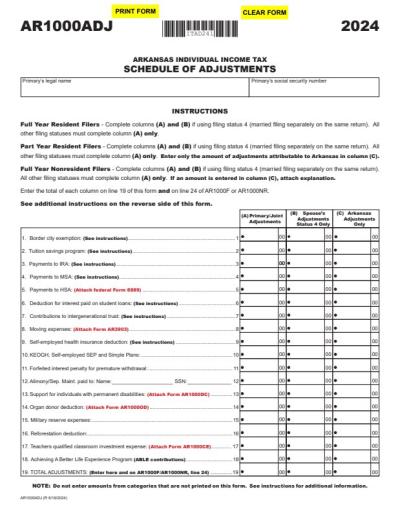
Arkansas Tax Form AR1000 ADJ is an Arkansas adjustment schedule used together with the main state income tax return. It is published by the Arkansas Department of Finance and Administration and is designed for taxpayers who need to report additions, subtractions, or Arkansas-only adjustments that do not fit neatly on the main return itself.
The schema is line-driven, which is exactly what you want in an adjustment form. It begins with identity fields like Primary's legal name and Primary's social security number, then moves directly into itemized adjustment lines such as Line 1: Border city exemption: (A) Primary-Joint Adjustments, Line 2: Tuition savings program: (A) Primary-Joint Adjustments, and Line 5: Payments to HSA: Primary Adjustments. That structure makes the template suitable for careful worksheet-style completion.
Use this PDF when the Arkansas return instructions tell you to list specific adjustment categories separately, especially where the state distinguishes between primary taxpayer, spouse, and Arkansas-only values. A typed schedule is easier to review and less likely to create line-entry confusion.
Before you submit the final PDF, compare every typed entry against the official instructions, supporting schedules, and source records. Small mismatches in names, identification numbers, dates, totals, or checkbox selections are one of the most common reasons official forms need to be corrected later. Using a fillable PDF helps readability, but careful review is still what makes the filing usable.
It is also smart to keep the source documents used for each line close to the finished PDF. If a preparer, employer, buyer, seller, or state agency asks how a figure or identifier was entered, you can quickly trace each box back to the form, title, tax worksheet, or record it came from.
When a form belongs to an older tax year or to a state-specific process, always confirm that you are using the correct version before submission. Government agencies may reject a perfectly completed PDF if it was prepared on the wrong revision, missing a required attachment, or sent to the wrong filing address.
If another person needs to review the form before filing, send them the typed PDF together with the source records you used. That makes it easier to spot missing signatures, inconsistent totals, and data-entry mistakes before the document reaches the agency or counterparty.
Who needs to fill this out?
- Arkansas taxpayers whose return requires additional adjustment detail
- Joint filers who must separate primary, spouse, and Arkansas-only figures by line
- People claiming deductions or modifications such as IRA, HSA, MSA, or other state-specific items
- Preparers attaching a readable adjustment schedule to the main Arkansas return
Where and how to submit
Attach the completed schedule to the related Arkansas income tax return and file it with the Arkansas Department of Finance and Administration according to the annual return instructions. Make sure every line on the schedule matches the totals carried to the main return so the state can reconcile the adjustment amounts.
How to fill it out
- Step 1 — Primary's legal name: Start by copying the information exactly as it appears on your official documents or tax records.
- Step 2 — Primary's social security number: Use the matching line or box from your supporting paperwork so the PDF stays consistent with the filing record.
- Step 3 — Line 1: Border city exemption: (A) Primary-Joint Adjustments: If the field applies only in a special case, leave it blank unless the instructions tell you to complete it.
- Step 4 — Line 1: Border city exemption: (C) Arkansas Adjustments Only: Review spelling, numbers, and line mapping before moving to the next section.
- Step 5 — Line 1: Border city exemption: (B) Spouse's Adjustments Status 4 Only: For calculated amounts, enter the final figure from your worksheet or state instructions rather than estimating inside the PDF.
- Step 6 — Line 2: Tuition savings program: (A) Primary-Joint Adjustments: Finish by checking related signature, date, and submission requirements before you print or file the form.
Frequently asked questions
Is AR1000ADJ a standalone return?
No. It is generally a supporting schedule that works together with the main Arkansas individual income tax return.
Why are there separate primary and spouse columns?
Because many Arkansas adjustments must be tracked by taxpayer, especially on joint returns where one spouse may qualify and the other may not.
Do I need backup documentation?
Usually yes. Keep statements, contribution records, and any supporting worksheets for each line you complete.
Can I leave unused lines blank?
Yes, unless the instructions require zeros. Only complete the adjustment lines that apply to your situation.
Should the totals match my main return?
Yes. Any amount carried from AR1000ADJ to the main return should reconcile exactly with the corresponding return line.
Can I create Arkansas Form AR1000ADJ in bulk?
Yes. PDFengine supports bulk generation of Arkansas Form AR1000ADJ via Excel or CSV upload — upload a spreadsheet with one row per form and PDFengine generates all PDFs at once. You can also automate bulk creation programmatically via the PDFengine API.
Ready to fill it in?
Fill in this form


