
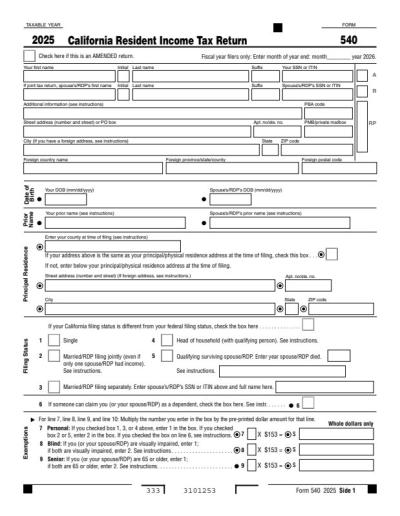
California Form 540 Resident Income Tax Return, filled in online.
California Form 540 Resident Income Tax Return — official fillable PDF form
Type in the panel and watch each answer land on the page. Filling in and signing is free; downloading needs a free account, which includes 5 downloads a month.
Or fill it another way:
- Category
- Tax
- Fillable fields
- 184
- Pages
- 6
- Paper size
- US Letter, 8.5 × 11 in
Five ways to fill this form.
-
Fill it in here
Type in the panel and watch it land on the form. Sign it, then download.
Free to fill and sign Start filling -
Many at once, from a spreadsheet
One row per person, one finished PDF for each.
Paid plan · you can walk through it Start with a spreadsheet -
Send it to someone to fill in
Email a link. They fill it in without an account and you get the answers back.
Paid plan · you can walk through it Send a request -
From your own software
Fill it over the API. One request returns the finished PDF.
Paid plan -
Let an AI assistant do it
Connect ChatGPT or Claude once, then describe what goes on the form.
With a free account
What is this form?
California Form 540 Resident Income Tax Return is an official form issued by the California Franchise Tax Board (FTB) to report a California resident’s annual income, deductions, credits, payments, tax due, or refund on the state individual income tax return. Form 540 reconciles federal income information with California law and includes filing status, dependents, taxable income, credits, withholding, estimated payments, and refund or balance-due calculations. Residents generally use it for worldwide income, with Schedule CA and other schedules supplying California adjustments.
\nUse the official instructions for the relevant filing year alongside this fillable version. PDFengine helps you enter data into the original PDF and download a completed copy, but it does not decide eligibility, calculate facts that are not supplied, or submit the form for you. Before signing, compare every identifier, date, amount, checkbox, and attachment against source records. A technically complete PDF can still be rejected when information is inconsistent, a required schedule is missing, or an outdated revision is used.
Who needs to fill this out?
This template is most relevant to people and organizations in the following situations:
\n- Full-year California residents required to file a state income tax return. Review the official eligibility and filing rules before relying on this form.
- Residents claiming California withholding, refundable credits, or estimated payments. Review the official eligibility and filing rules before relying on this form.
- Married couples and registered domestic partners filing a joint or separate return. Review the official eligibility and filing rules before relying on this form.
- Taxpayers filing an amended California resident return. Review the official eligibility and filing rules before relying on this form.
If your facts fall outside these examples, consult the issuing agency’s current instructions or a qualified adviser. Do not enter placeholder identifiers or estimates merely to make every field appear complete; leave fields blank only when the instructions permit it and use the required notation when a line calls for zero, none, or not applicable.
Where and how to submit
File Form 540 electronically through an approved service or mail the signed return to the FTB address that matches whether a payment is enclosed. Attach required schedules and copies of withholding forms. California individual returns are generally due in April, with an automatic filing extension but no automatic extension to pay. PDFengine does not transmit this form to the issuing agency. Download the final PDF, check that all entries remain visible, and use only the agency’s accepted filing channel. Protect the file in storage and transit because tax, identity, financial, or personnel information may be sensitive. Record the submission date, delivery or confirmation number, amount paid when applicable, and the exact version sent so you can answer a later notice or prepare a correction.
How to fill it out
Gather identification records, the related return or transaction documents, and the current agency instructions before starting. Then complete the PDF in this order:
\n- \n
- Step 1 — Check here if this is an AMENDED return: Select this option only when it accurately describes the filing or transaction, and review nearby alternatives so that conflicting choices are not marked. This label comes directly from the official PDF, so match it to the same line in the agency instructions.
- Step 2 — Your first name: Enter the complete legal name used in the related agency record or source document; use a trade name only when the label or instructions specifically request it. This label comes directly from the official PDF, so match it to the same line in the agency instructions.
- Step 3 — Your SSN or ITIN: Copy this identifier exactly from the official record, preserving every digit and any required leading zero; then compare it a second time before continuing. This label comes directly from the official PDF, so match it to the same line in the agency instructions.
- Step 4 — Street address (number and street) or PO box: Enter the requested address component exactly as used for official correspondence, including unit, state, postal code, and foreign-address details when applicable. This label comes directly from the official PDF, so match it to the same line in the agency instructions.
- Step 5 — Your DOB (mm/dd/yyyy): Enter the applicable date or period in the format printed on the form and confirm that it matches the tax year, transaction, or supporting record. This label comes directly from the official PDF, so match it to the same line in the agency instructions.
- Step 6 — Enter your county at time of filing (see instructions): Provide the specific value requested by this label from the corresponding source record, using the official instructions for its required format and scope. This label comes directly from the official PDF, so match it to the same line in the agency instructions.
After completing these steps, inspect the entire PDF page by page. Calculated totals should reconcile to source schedules, checkbox answers should not conflict, and names and identifiers should remain consistent across all pages. Sign and date only after that review, and add any schedules, statements, payment, or evidence required by the official instructions.
Frequently asked questions
Who should use Form 540 instead of Form 540NR?
\nFull-year residents generally use Form 540; nonresidents and part-year residents generally use Form 540NR. Always verify the current instructions when dates, thresholds, addresses, or agency procedures could have changed.
\nDoes a federal extension extend the California payment deadline?
\nNo. California may extend the filing deadline automatically, but unpaid tax is still due by the original payment deadline. Always verify the current instructions when dates, thresholds, addresses, or agency procedures could have changed.
\nWhy is Schedule CA often required?
\nSchedule CA translates federal amounts into California amounts by reporting state additions and subtractions. Always verify the current instructions when dates, thresholds, addresses, or agency procedures could have changed.
\nCan spouses use different filing statuses for California and federal returns?
\nCalifornia generally follows federal filing status, with limited exceptions explained in the FTB instructions. Always verify the current instructions when dates, thresholds, addresses, or agency procedures could have changed.
\nWhere do I report California withholding?
\nEnter withholding in the designated payments section and attach the required wage or withholding statements. Always verify the current instructions when dates, thresholds, addresses, or agency procedures could have changed.
\nCan I create California Form 540 Resident Income Tax Return in bulk?
\nYes. PDFengine supports bulk generation of California Form 540 Resident Income Tax Return via Excel or CSV upload: use one row per form and map each spreadsheet column to the corresponding PDF field. PDFengine then generates the completed PDFs together. You can also automate bulk creation programmatically through the PDFengine API. Bulk generation speeds up data entry but does not replace record-by-record validation, signatures, attachments, or submission through the issuing agency’s approved channel.
Ready to fill it in?
Fill in this form


