
Form 1099-LTC, filled in online.
Long-Term Care and Accelerated Death Benefits
Type in the panel and watch each answer land on the page. Filling in and signing is free; downloading needs a free account, which includes 5 downloads a month.
Or fill it another way:
- Category
- Tax
- Fillable fields
- 64
- Pages
- 5
- Paper size
- US Letter, 8.5 × 11 in
Five ways to fill this form.
-
Fill it in here
Type in the panel and watch it land on the form. Sign it, then download.
Free to fill and sign Start filling -
Many at once, from a spreadsheet
One row per person, one finished PDF for each.
Paid plan · you can walk through it Start with a spreadsheet -
Send it to someone to fill in
Email a link. They fill it in without an account and you get the answers back.
Paid plan · you can walk through it Send a request -
From your own software
Fill it over the API. One request returns the finished PDF.
Paid plan -
Let an AI assistant do it
Connect ChatGPT or Claude once, then describe what goes on the form.
With a free account
What is this form?
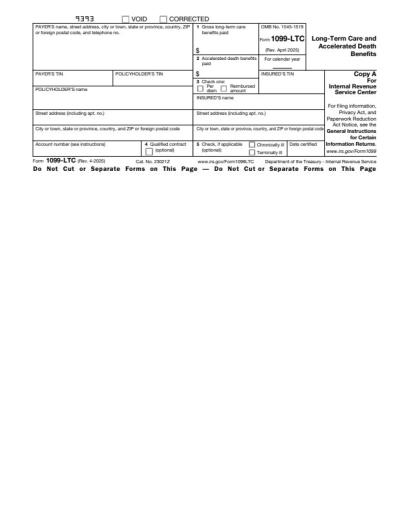
Form 1099-LTC is the IRS information return for long-term care benefits and accelerated death benefits. It reports the payer, policyholder, and insured details together with the gross long-term care benefits paid, accelerated death benefits paid, whether payments were made on a per diem or reimbursed basis, and status indicators such as chronically ill, terminally ill, date certified, and qualified contract.
The form is important because the recipient may need the details to determine later tax treatment. PDFengine uses the official fillable IRS PDF so you can complete the exact reporting fields, confirm which party is listed as policyholder versus insured, and review the benefit type and coding before the form is sent or stored.
Using PDFengine for Form 1099-LTC also makes internal review easier when more than one person touches the filing process. Because the output follows the official IRS layout, a payroll manager, bookkeeper, broker operations specialist, or outside tax advisor can compare the draft line by line against source records without first translating a custom interface back into tax-form language. That is especially useful when the form later feeds another schedule, information return, withholding setup, or compliance archive.
Another practical advantage is consistency across repeated reviews. If the same payer, employer, or preparer needs to revisit the form later, the saved PDF shows exactly which line items, checkboxes, and reference amounts were used at the time of preparation. That reduces confusion when a recipient asks for clarification, when an auditor wants to trace a number back to source material, or when a correction has to be prepared without rebuilding the entire document from scratch.
Who needs to fill this out?
- Insurers and payers that must report long-term care benefits or accelerated death benefits
- Benefits administrators preparing a review copy before filing or recipient delivery
- Tax professionals checking whether payments were per diem or reimbursement based
- Organizations that need a clean PDF record showing policyholder and insured data accurately
- Teams that want a standardized PDF draft for approval, reconciliation, recordkeeping, or secure client review
Where and how to submit
Form 1099-LTC is furnished to the recipient and filed with the IRS under the information return rules that apply to the payer. Because later tax treatment may depend on whether the benefits were per diem or reimbursed and whether the insured was chronically or terminally ill, keep the underlying benefit records and certification support with the filing documentation.
After completion, keep both the finished PDF and the records that support every amount, checkbox, or identification field on the form. The PDF is useful for review and recipient delivery, but the supporting ledger, worksheet, payroll file, brokerage statement, or benefits record is what allows you to answer later questions from the recipient, an accountant, or the IRS. A saved copy also makes future corrections easier if you later need to issue an updated version.
Before you file, share, or archive the form, compare the completed PDF once more against the source records and any related forms mentioned in the instructions. Small mismatches in names, TINs, dates, line references, or payment amounts can create extra follow-up work later. A final review pass is usually faster than correcting a distributed or filed form after the fact.
How to fill it out
- Step 1 — Payer, policyholder, and insured details: Enter the payer name, address, and TIN, then complete the policyholder name and TIN together with the insured name and TIN in the matching fields.
- Step 2 — Benefit amounts: Fill in the gross long-term care benefits paid and any accelerated death benefits paid for the calendar year.
- Step 3 — Payment type and contract details: Mark whether the payments were per diem or reimbursed, and note whether the contract is a qualified contract when that designation applies.
- Step 4 — Medical status indicators: Use the chronically ill, terminally ill, and date certified fields to capture the status details required for the information return.
- Step 5 — Final review: Check the corrected box only when needed, confirm account number usage if applicable, and verify that all parties and amounts match the payer records.
Frequently asked questions
What does Form 1099-LTC report?
It reports long-term care benefits and accelerated death benefits paid during the year.
Why are there separate fields for policyholder and insured?
The policyholder and the insured may be different people, so the form captures both roles separately.
What is the difference between per diem and reimbursed on the form?
Those fields identify the payment method, which can matter for later tax analysis.
Does the form include illness status indicators?
Yes. It includes fields such as chronically ill, terminally ill, and date certified.
Who receives Form 1099-LTC?
The relevant recipient receives a copy, and the payer follows the IRS filing requirements.
Should I keep a copy after sending it?
Yes. Keep the completed PDF together with the supporting records so you can verify what was reported if questions come up later.
Can I use PDFengine for review before filing or sharing?
Yes. Many teams use PDFengine to prepare and review the official layout first, then file or distribute the final version through their normal workflow.
What should I check before I finalize the PDF?
Review names, identification numbers, dates, line references, and every amount against the source records so the final version matches the underlying paperwork.
Can I create Form 1099-LTC in bulk?
Yes. PDFengine supports bulk generation of Form 1099-LTC via Excel or CSV upload — upload a spreadsheet with one row per form and PDFengine generates all PDFs at once. You can also automate bulk creation programmatically via the PDFengine API.
Ready to fill it in?
Fill in this form


