
Form 1120 W, filled in online.
Form 1120 W — official fillable PDF form
Type in the panel and watch each answer land on the page. Filling in and signing is free; downloading needs a free account, which includes 5 downloads a month.
Or fill it another way:
- Category
- Tax
- Fillable fields
- 213
- Pages
- 3
- Paper size
- US Letter, 8.5 × 11 in
Five ways to fill this form.
-
Fill it in here
Type in the panel and watch it land on the form. Sign it, then download.
Free to fill and sign Start filling -
Many at once, from a spreadsheet
One row per person, one finished PDF for each.
Paid plan · you can walk through it Start with a spreadsheet -
Send it to someone to fill in
Email a link. They fill it in without an account and you get the answers back.
Paid plan · you can walk through it Send a request -
From your own software
Fill it over the API. One request returns the finished PDF.
Paid plan -
Let an AI assistant do it
Connect ChatGPT or Claude once, then describe what goes on the form.
With a free account
What is this form?
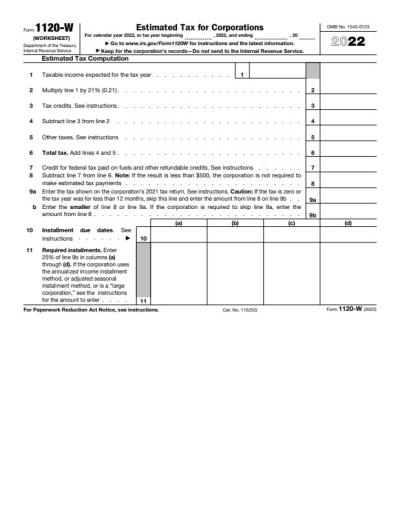
IRS Form 1120-W, Estimated Tax for Corporations, is a worksheet corporations use to estimate federal income tax and determine required installment payments. It combines expected taxable income, the corporate tax calculation, credits, other taxes, refundable credits, and prior-year tax to establish the required annual payment. The form also contains alternative calculations for corporations whose income varies during the year, including the annualized-income installment and adjusted seasonal installment methods.
Form 1120-W is generally retained with the corporation's records rather than filed as the tax return. It supports the amounts paid through the Electronic Federal Tax Payment System and helps document how each installment was determined. Because estimated tax is based on reasonable current-year projections, update the worksheet when revenue, deductions, credits, or extraordinary transactions materially change.
Before calculating, document the assumptions behind expected income, credits, and other taxes. Compare the projection with current ledgers, budgets, prior payments, and known one-time events. Review ownership or large-corporation rules that can restrict the prior-year method. A dated calculation trail makes later revisions easier to explain and helps the annual return preparer reconcile estimated payments, refunds, and any Form 2220 penalty analysis.
Check the current IRS instructions before finalizing the worksheet because thresholds, exceptions, disaster relief, and payment dates may change. Record who prepared and reviewed the estimate, the preparation date, and the source of each material assumption. This control is particularly valuable when several employees share responsibility for forecasting, treasury payments, and the annual corporate return.
Who needs to fill this out?
- Domestic corporations expecting to owe federal income tax of $500 or more for the tax year.
- Tax departments and accounting teams calculating quarterly corporate estimated-tax deposits.
- Corporations using the prior-year safe-harbor calculation when eligible.
- Seasonal or rapidly changing businesses that may benefit from the annualized-income or adjusted seasonal installment method.
- Tax professionals preparing payment schedules and supporting workpapers for corporate clients.
Where and how to submit
Keep Form 1120-W in the corporation's tax file and use its installment amounts when scheduling payments through EFTPS or another IRS-authorized electronic method. Corporations generally pay four installments during the tax year, but exact dates depend on the tax-year start and special rules. A short tax year, large-corporation status, disaster relief, or weekend and holiday rules can alter the schedule. Save payment confirmations with the worksheet and update the calculation before the next payment when projections change.
How to fill it out
- Step 1 — Tax year: Enter the Tax year beginning and Tax year ending fields exactly as used on the corporation's Form 1120-series return. Confirm whether the year is calendar, fiscal, or short because installment dates depend on that period.
- Step 2 — Expected tax: Enter Line 1 Taxable income expected for the tax year, multiply it by 21% on Line 2, and enter applicable Tax credits on Line 3. Subtract the credits on Line 4, add Other taxes on Line 5, and calculate Total tax on Line 6.
- Step 3 — Refundable amounts: Enter the Credit for federal tax paid on fuels and other refundable credits on Line 7, then subtract that amount on Line 8. Use documented credits only and avoid including estimated-tax deposits in this field.
- Step 4 — Required annual payment: Enter the tax shown on the corporation's prior-year return in Line 9a when the corporation qualifies to use it. Complete Line 9b with the smaller permitted amount and retain the prior return supporting the figure.
- Step 5 — Installments: Verify the four Installment due dates in Line 10 and allocate the Required installments across columns (a) through (d) on Line 11. If the standard equal-installment approach is used, reconcile the four amounts to the required annual payment.
- Step 6 — Alternative method: If income is uneven, complete the monthly Taxable income fields and related calculations for the annualized-income or adjusted seasonal method. Carry the permitted installment amounts back to the main schedule and recalculate after later-period actual results become available.
Frequently asked questions
Is Form 1120-W filed with the IRS?
Usually no. It is a worksheet used to calculate estimated tax, while the actual installments are transmitted through an authorized payment method and the annual liability is reported on the corporate return.
When does a corporation need to pay estimated tax?
A corporation generally makes estimated payments when it expects federal income tax of $500 or more. Exceptions and special computations apply, so confirm eligibility in the current instructions.
Can the prior-year tax always be used?
No. The prior-year return must cover 12 months and show tax, and large corporations face additional restrictions. Verify the safe-harbor rules before using Line 9a.
What if the corporation's income changes during the year?
Recalculate the remaining installments using updated estimates. The annualized-income method may better match payments to income earned in each period.
How are underpayments handled?
The IRS may assess an underpayment penalty for an installment that was late or too small even if the corporation later receives a refund. Form 2220 is used to calculate or explain many corporate underpayments.
Can I create Form 1120-W in bulk?
Yes. PDFengine supports bulk generation of Form 1120-W via Excel or CSV upload — upload a spreadsheet with one row per form and PDFengine generates all PDFs at once. You can also automate bulk creation programmatically via the PDFengine API.
Ready to fill it in?
Fill in this form


