
Form 12203, filled in online.
Form 12203 — official fillable PDF form
Type in the panel and watch each answer land on the page. Filling in and signing is free; downloading needs a free account, which includes 5 downloads a month.
Or fill it another way:
- Category
- Tax
- Fillable fields
- 29
- Pages
- 2
- Paper size
- US Letter, 8.5 × 11 in
Five ways to fill this form.
-
Fill it in here
Type in the panel and watch it land on the form. Sign it, then download.
Free to fill and sign Start filling -
Many at once, from a spreadsheet
One row per person, one finished PDF for each.
Paid plan · you can walk through it Start with a spreadsheet -
Send it to someone to fill in
Email a link. They fill it in without an account and you get the answers back.
Paid plan · you can walk through it Send a request -
From your own software
Fill it over the API. One request returns the finished PDF.
Paid plan -
Let an AI assistant do it
Connect ChatGPT or Claude once, then describe what goes on the form.
With a free account
What is this form?
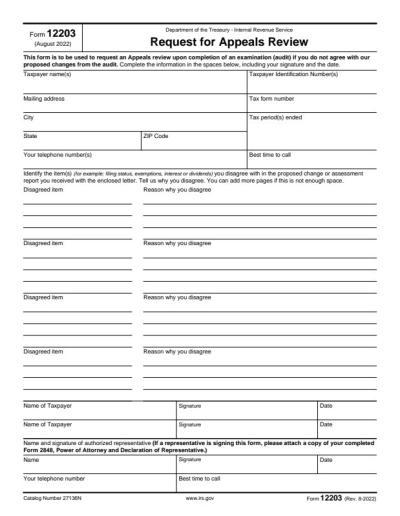
IRS Form 12203, Request for Appeals Review, is issued by the Internal Revenue Service. It provides a concise written request for review by the IRS Independent Office of Appeals when an IRS letter offers this simplified procedure. The taxpayer identifies the tax periods and disputed items, explains why each proposed adjustment is incorrect, and signs the request so the case can be considered for transfer to Appeals.
This fillable version helps you type into the form’s existing fields and produce a readable PDF, but it does not decide eligibility, calculate every legal or tax consequence, or replace the issuing agency’s instructions. Start with the notice, petition, return, account record, or source documents connected to the form. Confirm that you are using the correct edition and reporting period, because field labels and submission rules can change. Enter names, identifiers, dates, and amounts consistently across the form and attachments. If a question does not apply, follow the official instruction for leaving it blank, entering zero, or writing an explanation; do not guess merely to fill every box.
Who needs to fill this out?
- An individual taxpayer whose IRS letter specifically permits Form 12203. Review the official eligibility or role requirements before relying on this form.
- Joint filers responding together to proposed adjustments. Review the official eligibility or role requirements before relying on this form.
- A business or other taxpayer contesting eligible issues within the limits stated in the IRS notice. Review the official eligibility or role requirements before relying on this form.
- An authorized representative preparing the explanation and signing only when authorized. Review the official eligibility or role requirements before relying on this form.
The person with authority to make the declaration remains responsible for accuracy even when a preparer, employee, volunteer, or representative enters the data. Use professional advice when the form affects court rights, immigration status, tax liability, public benefits, or vehicle ownership and the facts are uncertain.
Where and how to submit
Send Form 12203 and supporting documents to the IRS office and address printed in the letter that gave appeal rights. It is a response to that case, so do not use a generic IRS address and do not send the only copy of supporting records. The response date in the IRS letter controls. Appeals rights can be affected by late submission, so allow delivery time and retain tracking or other proof of timely response.
Use only the current submission channel published by the receiving authority or printed in the case-specific correspondence. Before sending, make a complete copy and verify the destination, required attachments, signatures, payment method, and delivery format. Redact sensitive numbers only on informal working copies, never on a filing when the authority requires the full identifier. Keep the notice, completed form, attachments, calculations, delivery proof, and later IRS or Appeals correspondence. Record the submission date and retain a receipt, tracking number, portal confirmation, fax report, or file-stamped copy so you can show what was delivered.
How to fill it out
- Step 1 — Taxpayer name(s) and Taxpayer Identification Number(s): Copy names and identifiers from the IRS notice and relevant return without adding unrelated accounts. Check the entry against the underlying record, and use the same spelling, number format, and reporting period throughout related documents.
- Step 2 — Mailing address, telephone number, and Best time to call: Provide current contact details so Appeals can reach the taxpayer or authorized representative. Check the entry against the underlying record, and use the same spelling, number format, and reporting period throughout related documents.
- Step 3 — Tax form number and Tax period(s) ended: Enter each return type and period exactly as shown in the proposed-adjustment letter. Check the entry against the underlying record, and use the same spelling, number format, and reporting period throughout related documents.
- Step 4 — Disagreed item: List each adjustment separately and use the notice terminology so the reviewer can match it to the examination issue. Check the entry against the underlying record, and use the same spelling, number format, and reporting period throughout related documents.
- Step 5 — Reason why you disagree: Give facts, law, computations, and referenced evidence for every item; attach organized copies rather than original records. Check the entry against the underlying record, and use the same spelling, number format, and reporting period throughout related documents.
- Step 6 — Name, Signature, and Date: Have each required taxpayer or properly authorized representative sign and date the request before sending it. Check the entry against the underlying record, and use the same spelling, number format, and reporting period throughout related documents.
Before finalizing, review the PDF page by page. Make sure selected checkboxes do not contradict written answers, totals reconcile to schedules, continuation pages are identified, and every referenced attachment is present. Do not place a digital image or typed name in a signature field unless the receiving authority accepts that signature method. Save an unsigned review copy when another person must approve the information, then create the final signed version without changing the reviewed facts.
Frequently asked questions
Is IRS Form 12203 the current official edition?
Check the edition date on the PDF against the issuer’s current website or the instructions in the notice or case package. PDFengine provides a fillable workflow, but the receiving authority decides which edition it accepts.
Which documents should I collect before filling it out?
Gather the notice or case papers, identification details, source records for every amount or date, and all schedules mentioned by the form. Keep the notice, completed form, attachments, calculations, delivery proof, and later IRS or Appeals correspondence.
Can PDFengine tell me which legal, tax, or eligibility answer to choose?
No. PDFengine helps populate the PDF fields; it does not make factual determinations or provide individualized legal or tax advice. Read the official instructions and consult a qualified professional when the correct treatment is unclear.
What should I do if there is not enough space?
Use the continuation method allowed by the official instructions. Label every attachment with the filer or case identifier, form name, relevant line or item, reporting period, and page count, while avoiding unnecessary sensitive information.
How should I protect personal information on this form?
Use a trusted device, verify recipients, restrict access to completed files, and transmit them only through an approved secure channel. Delete unneeded temporary copies and retain the official record according to the applicable policy.
Can I create IRS Form 12203 in bulk?
Yes. PDFengine supports bulk generation of IRS Form 12203 via Excel or CSV upload — upload a spreadsheet with one row per form and PDFengine generates all PDFs at once. You can also automate bulk creation programmatically via the PDFengine API. Review bulk output carefully because identical column mapping does not guarantee that every row is factually complete or eligible.
Ready to fill it in?
Fill in this form


