
Form 15103 Return Delinquency, filled in online.
Form 15103 Return Delinquency — official fillable PDF form
Type in the panel and watch each answer land on the page. Filling in and signing is free; downloading needs a free account, which includes 5 downloads a month.
Or fill it another way:
- Category
- Tax
- Fillable fields
- 52
- Pages
- 2
- Paper size
- US Letter, 8.5 × 11 in
Five ways to fill this form.
-
Fill it in here
Type in the panel and watch it land on the form. Sign it, then download.
Free to fill and sign Start filling -
Many at once, from a spreadsheet
One row per person, one finished PDF for each.
Paid plan · you can walk through it Start with a spreadsheet -
Send it to someone to fill in
Email a link. They fill it in without an account and you get the answers back.
Paid plan · you can walk through it Send a request -
From your own software
Fill it over the API. One request returns the finished PDF.
Paid plan -
Let an AI assistant do it
Connect ChatGPT or Claude once, then describe what goes on the form.
With a free account
What is this form?
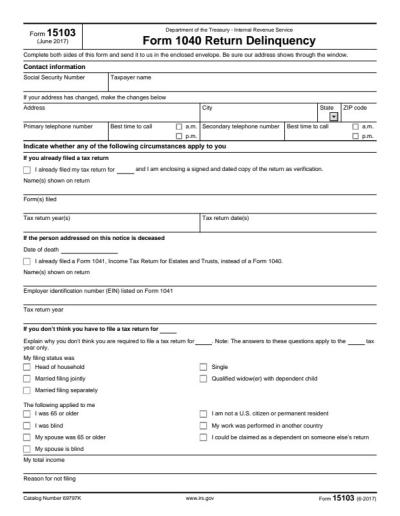
IRS Form 15103, Form 1040 Return Delinquency, is issued by the Internal Revenue Service. It is an IRS notice-response form for a person the agency believes may not have filed a required Form 1040. The taxpayer can confirm that a return was already filed, report a death and an estate return, explain why no return was required, describe filing status and income, or state when the delinquent return will be filed.
This fillable version helps you type into the form’s existing fields and produce a readable PDF, but it does not decide eligibility, calculate every legal or tax consequence, or replace the issuing agency’s instructions. Start with the notice, petition, return, account record, or source documents connected to the form. Confirm that you are using the correct edition and reporting period, because field labels and submission rules can change. Enter names, identifiers, dates, and amounts consistently across the form and attachments. If a question does not apply, follow the official instruction for leaving it blank, entering zero, or writing an explanation; do not guess merely to fill every box.
Who needs to fill this out?
- A taxpayer who received Form 15103 with an IRS delinquent-return inquiry. Review the official eligibility or role requirements before relying on this form.
- A surviving representative responding for a deceased taxpayer. Review the official eligibility or role requirements before relying on this form.
- A taxpayer who already filed and needs to provide verification. Review the official eligibility or role requirements before relying on this form.
- A taxpayer explaining nonfiling based on filing status, age, residency, income, or another relevant circumstance. Review the official eligibility or role requirements before relying on this form.
The person with authority to make the declaration remains responsible for accuracy even when a preparer, employee, volunteer, or representative enters the data. Use professional advice when the form affects court rights, immigration status, tax liability, public benefits, or vehicle ownership and the facts are uncertain.
Where and how to submit
Complete both sides and return the form in the enclosed envelope so the IRS address shows through the window, as the form directs. Include only the copies requested, write the notice reference on attachments when appropriate, and use tracked delivery if desired. The date in the accompanying IRS notice controls. A prompt complete response can reduce follow-up and the risk of the IRS preparing a substitute return from available information.
Use only the current submission channel published by the receiving authority or printed in the case-specific correspondence. Before sending, make a complete copy and verify the destination, required attachments, signatures, payment method, and delivery format. Redact sensitive numbers only on informal working copies, never on a filing when the authority requires the full identifier. Keep the notice, completed response, filed returns or income records, attachments, and proof of mailing. Record the submission date and retain a receipt, tracking number, portal confirmation, fax report, or file-stamped copy so you can show what was delivered.
How to fill it out
- Step 1 — Social Security Number and Taxpayer name: Identify the account exactly as printed on the notice and update the address only when it changed. Check the entry against the underlying record, and use the same spelling, number format, and reporting period throughout related documents.
- Step 2 — Primary and Secondary telephone number and Best time to call: Provide current contact details and indicate a practical calling window. Check the entry against the underlying record, and use the same spelling, number format, and reporting period throughout related documents.
- Step 3 — I already filed my tax return: If applicable, enter the year, names, form, and filing date and include the signed copy requested by the form. Check the entry against the underlying record, and use the same spelling, number format, and reporting period throughout related documents.
- Step 4 — Date of death and Form 1041 information: Complete the deceased-taxpayer section only when relevant and provide the estate EIN and year requested. Check the entry against the underlying record, and use the same spelling, number format, and reporting period throughout related documents.
- Step 5 — Explain why you don't think you are required to file: State the facts for the specified year and accurately complete filing-status, age, citizenship, location-of-work, and income items. Check the entry against the underlying record, and use the same spelling, number format, and reporting period throughout related documents.
- Step 6 — Signatures and intended filing date: Complete the final declaration, sign and date, and state when a missing return will be filed if that is the response. Check the entry against the underlying record, and use the same spelling, number format, and reporting period throughout related documents.
Before finalizing, review the PDF page by page. Make sure selected checkboxes do not contradict written answers, totals reconcile to schedules, continuation pages are identified, and every referenced attachment is present. Do not place a digital image or typed name in a signature field unless the receiving authority accepts that signature method. Save an unsigned review copy when another person must approve the information, then create the final signed version without changing the reviewed facts.
Frequently asked questions
Is IRS Form 15103 the current official edition?
Check the edition date on the PDF against the issuer’s current website or the instructions in the notice or case package. PDFengine provides a fillable workflow, but the receiving authority decides which edition it accepts.
Which documents should I collect before filling it out?
Gather the notice or case papers, identification details, source records for every amount or date, and all schedules mentioned by the form. Keep the notice, completed response, filed returns or income records, attachments, and proof of mailing.
Can PDFengine tell me which legal, tax, or eligibility answer to choose?
No. PDFengine helps populate the PDF fields; it does not make factual determinations or provide individualized legal or tax advice. Read the official instructions and consult a qualified professional when the correct treatment is unclear.
What should I do if there is not enough space?
Use the continuation method allowed by the official instructions. Label every attachment with the filer or case identifier, form name, relevant line or item, reporting period, and page count, while avoiding unnecessary sensitive information.
How should I protect personal information on this form?
Use a trusted device, verify recipients, restrict access to completed files, and transmit them only through an approved secure channel. Delete unneeded temporary copies and retain the official record according to the applicable policy.
Can I create IRS Form 15103 in bulk?
Yes. PDFengine supports bulk generation of IRS Form 15103 via Excel or CSV upload — upload a spreadsheet with one row per form and PDFengine generates all PDFs at once. You can also automate bulk creation programmatically via the PDFengine API. Review bulk output carefully because identical column mapping does not guarantee that every row is factually complete or eligible.
Ready to fill it in?
Fill in this form


