
Form 2210, filled in online.
Form 2210 — official fillable PDF form
Type in the panel and watch each answer land on the page. Filling in and signing is free; downloading needs a free account, which includes 5 downloads a month.
Or fill it another way:
- Category
- Tax
- Fillable fields
- 199
- Pages
- 3
- Paper size
- US Letter, 8.5 × 11 in
Five ways to fill this form.
-
Fill it in here
Type in the panel and watch it land on the form. Sign it, then download.
Free to fill and sign Start filling -
Many at once, from a spreadsheet
One row per person, one finished PDF for each.
Paid plan · you can walk through it Start with a spreadsheet -
Send it to someone to fill in
Email a link. They fill it in without an account and you get the answers back.
Paid plan · you can walk through it Send a request -
From your own software
Fill it over the API. One request returns the finished PDF.
Paid plan -
Let an AI assistant do it
Connect ChatGPT or Claude once, then describe what goes on the form.
With a free account
What is this form?
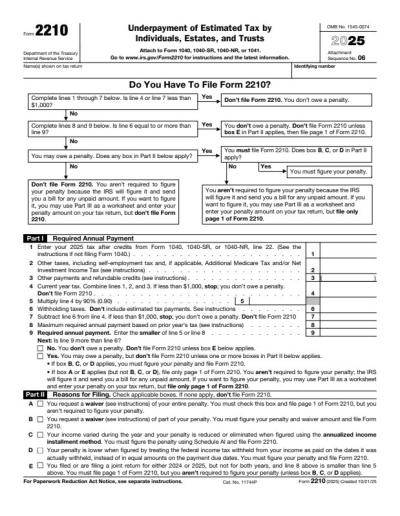
IRS Form 2210, Underpayment of Estimated Tax by Individuals, Estates, and Trusts, determines whether a taxpayer owes a penalty for paying too little tax during the year or paying an installment late. The 2025 form compares current-year tax, withholding, refundable credits, prior-year tax, and estimated payments. It also supports special calculations when income varied during the year, withholding should be treated as paid on actual dates, or a waiver is requested.
Many taxpayers do not need to file Form 2210 because the IRS can calculate the penalty and send a notice. Filing is necessary in specific situations identified on the form and may be beneficial when the annualized-income installment method reduces the penalty. Use the exact tax and payment figures from the related return and keep records showing the dates of withholding and estimated payments.
Complete the calculation in chronological order because an overpayment from one period may reduce a later underpayment but cannot automatically erase an earlier late installment. When figures come from a joint return, changed filing status, or multiple income sources, retain a worksheet showing how each amount was assigned. Verify the published interest-rate periods used in the penalty computation rather than applying one rate to the entire year.
Who needs to fill this out?
- Individuals, estates, or trusts whose withholding and timely estimated payments were below the required annual amount.
- Taxpayers with uneven income from self-employment, investments, a business sale, farming, or another seasonal source.
- People requesting a full or partial waiver because of casualty, disaster, unusual circumstances, retirement, or disability.
- Taxpayers choosing to treat federal withholding as paid on the dates actually withheld rather than evenly throughout the year.
- Joint filers whose filing status changed between 2024 and 2025 and who meet the form's filing conditions.
Where and how to submit
Attach Form 2210 to the 2025 federal income-tax return when the form or instructions require filing. If the return has already been filed and a separate response is needed, follow the address and procedure on the IRS notice rather than mailing this PDF without context. The final individual estimated-tax installment is generally due January 15, 2026, although filing and paying the annual return by the permitted early date can affect that installment. Keep payment confirmations, payroll statements, and calculation workpapers.
How to fill it out
- Step 1 — Taxpayer identity: Enter the Name(s) shown on tax return and Identifying number exactly as they appear on the 2025 return. If filing jointly, follow the instructions for the identifying number and prior-year comparison.
- Step 2 — Required annual payment: Enter 2025 tax after credits on Line 1, Other taxes on Line 2, and Other payments and refundable credits on Line 3. Calculate Current year tax, the 90% amount, Withholding taxes, the remaining tax, prior-year maximum, and Required annual payment on Lines 4 through 9.
- Step 3 — Filing reason: Answer whether Line 9 exceeds Line 6 and select only the applicable boxes for a waiver, annualized income, actual withholding dates, or changed joint-return status. Each selected reason determines which pages and schedules must accompany the return.
- Step 4 — Installment schedule: For columns (a) through (d), use the listed 4/15/25, 6/15/25, 9/15/25, and 1/15/26 dates. Enter Required installments, Estimated tax paid and tax withheld, and any carryforward, then calculate underpayment balances period by period.
- Step 5 — Penalty calculation: Apply the rate and day-count instructions to each underpayment for the time it remained unpaid. Use actual payment dates, transfer excess payments to later periods correctly, and total the separate penalty amounts.
- Step 6 — Schedule AI or waiver: If income varied, complete Schedule AI with income, deductions, self-employment tax, and annualization factors for each period. For a waiver, enter the requested amount and attach a statement and evidence explaining the qualifying circumstances.
Frequently asked questions
Do I need Form 2210 if the IRS can calculate the penalty?
Often no, but filing is required for several special situations and is useful when a waiver or alternative calculation reduces the penalty. Review Part II before deciding not to attach it.
Can withholding be treated as paid evenly?
Federal withholding is generally treated as paid evenly across the installment dates unless you elect and document actual withholding dates. Choose the treatment that follows the instructions and your records.
What is the annualized-income installment method?
It calculates required payments using income actually earned in successive parts of the year. It can reduce a penalty when income arrived late or unevenly.
Can the penalty be waived?
The IRS may waive all or part of it for casualty, disaster, other unusual circumstances, or qualifying retirement or disability when the underpayment was due to reasonable cause rather than willful neglect.
Does paying the full balance with the tax return remove the penalty?
Not necessarily. Estimated tax is measured by installment due dates, so a later full payment can stop further accrual without erasing an earlier underpayment.
Can I create Form 2210 in bulk?
Yes. PDFengine supports bulk generation of Form 2210 via Excel or CSV upload — upload a spreadsheet with one row per form and PDFengine generates all PDFs at once. You can also automate bulk creation programmatically via the PDFengine API.
Ready to fill it in?
Fill in this form


