
Form 8822, filled in online.
Change of Address
Type in the panel and watch each answer land on the page. Filling in and signing is free; downloading needs a free account, which includes 5 downloads a month.
Or fill it another way:
- Category
- Tax
- Fillable fields
- 25
- Pages
- 2
- Paper size
- US Letter, 8.5 × 11 in
Five ways to fill this form.
-
Fill it in here
Type in the panel and watch it land on the form. Sign it, then download.
Free to fill and sign Start filling -
Many at once, from a spreadsheet
One row per person, one finished PDF for each.
Paid plan · you can walk through it Start with a spreadsheet -
Send it to someone to fill in
Email a link. They fill it in without an account and you get the answers back.
Paid plan · you can walk through it Send a request -
From your own software
Fill it over the API. One request returns the finished PDF.
Paid plan -
Let an AI assistant do it
Connect ChatGPT or Claude once, then describe what goes on the form.
With a free account
Key facts
| Form number | Form 8822 |
|---|---|
| Official name | Change of Address (For Individual, Gift, Estate, or Generation-Skipping Transfer Tax Returns) |
| Issuing agency | Internal Revenue Service, Department of the Treasury |
| Current revision date | Rev. February 2021 |
| Number of pages | 2 pages |
| Filing frequency | As needed when an address changes |
| Primary sections | Part I — address and taxpayer information; Part II — signature |
| Related instructions document | Instructions printed on page 2 of Form 8822 and the IRS About Form 8822 page |
What is this form?
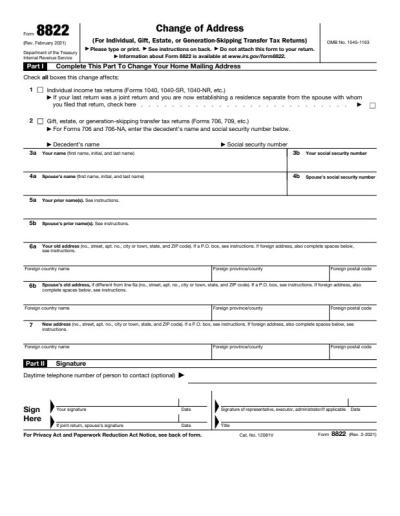
Form 8822, officially titled Change of Address (For Individual, Gift, Estate, or Generation-Skipping Transfer Tax Returns), is the IRS form used to notify the Internal Revenue Service that the mailing address on an individual or transfer-tax account has changed. The current official PDF is labeled Form 8822 (Rev. February 2021). It is a short form, but it matters because the IRS uses the address on file to send refund checks, notices, notices of deficiency, and other time-sensitive correspondence.
The form is split into two parts. Part I is where you identify what kind of tax account the change affects and enter the taxpayer information, prior names, old address, and new address. Line 1 applies to individual income tax returns such as Forms 1040, 1040-SR, and 1040-NR. Line 2 applies to gift, estate, or generation-skipping transfer tax returns such as Forms 706 and 709, and it asks for the decedent's name and Social Security number when relevant. Part II is the signature section, including the daytime telephone number, signatures, dates, and representative title if someone signs in a fiduciary or authorized capacity.
Form 8822 does not change a business address for business tax accounts; the IRS directs taxpayers to use Form 8822-B for that purpose. It is also not attached to a tax return. Instead, it is mailed separately to the address printed on page 2 of the form. The IRS states that processing a change of address generally takes 4 to 6 weeks.
Who needs to fill this out?
- Individuals whose home mailing address changed and who file federal income tax returns such as Forms 1040, 1040-SR, or 1040-NR may use Form 8822. There is no income threshold; the trigger is the address change itself.
- Taxpayers connected to gift, estate, or generation-skipping transfer tax filings may use Form 8822 when the mailing address for those accounts changes. This includes accounts tied to Forms 706 and 709; if line 2 applies, the form asks for the decedent's name and Social Security number.
- Joint filers should file when the joint account's mailing address changes. If the last return was joint and the spouses now live separately, the spouse establishing a separate residence should check the box on line 1 and each spouse should notify the IRS of the separate address.
- Children who filed their own income tax returns need a separate Form 8822 for each child if the address change affects their IRS records.
- Executors, administrators, donors, and authorized representatives may sign and submit Form 8822 for the taxpayer, but an authorized representative must attach a copy of the power of attorney, typically Form 2848.
- Who does not need this form: taxpayers whose address changed before they file the current return can generally use the new address on that return; businesses changing a business address or responsible party should use Form 8822-B, not Form 8822; and unauthorized third parties cannot change a taxpayer's address with this form.
Where and how to submit
Form 8822 is sent to the IRS, not to an employer. The form itself says do not attach this form to your return. If you checked line 2, mail Form 8822 to Department of the Treasury, Internal Revenue Service Center, Kansas City, MO 64999-0023. If you did not check line 2, the mailing address depends on the taxpayer's old home mailing address: many eastern and midwestern states use Kansas City, MO 64999-0023; Florida, Louisiana, Mississippi, and Texas use Austin, TX 73301-0023; many western states use Ogden, UT 84201-0023; and foreign-country, APO/FPO, Puerto Rico, section 933, Form 2555, Form 4563, dual-status, and certain Guam or Virgin Islands situations use Austin, TX 73301-0023.
There are also special government addresses for territorial bona fide residents: Department of Revenue and Taxation, Government of Guam, P.O. Box 23607, GMF, GU 96921 for Guam bona fide residents, and V.I. Bureau of Internal Revenue, 6115 Estate Smith Bay, Suite 225, St. Thomas, VI 00802 for Virgin Islands bona fide residents. The IRS does not provide a dedicated electronic filing channel on the form itself. Instead, taxpayers can also update an address by using the new address on a return filed after the move, by sending a signed written statement, or by calling the IRS, but Form 8822 is the paper form specifically designed for this purpose. There is no fixed annual due date; file it as soon as the address changes and allow about 4 to 6 weeks for processing.
How to fill it out
- Step 1 — Identify the affected tax account: In Part I, check the box on line 1 if the change affects individual income tax returns such as Forms 1040, 1040-SR, or 1040-NR. Check line 2 if the change affects gift, estate, or generation-skipping transfer tax returns such as Forms 706 or 709. If line 2 applies for Forms 706 or 706-NA, enter the decedent's name and Social Security number in the spaces below line 2.
- Step 2 — Enter taxpayer names and Social Security numbers: Complete line 3a with your name and line 3b with your Social Security number. If applicable, complete line 4a with the spouse's name and line 4b with the spouse's Social Security number. Use the same names and numbers the IRS should match to the account.
- Step 3 — Report any prior names: On line 5a, enter your prior name if it changed because of marriage, divorce, or another reason. On line 5b, enter the spouse's prior name if applicable. The IRS instructions specifically say to complete line 5 when a name changed, and to update the Social Security Administration as well so IRS and SSA records match.
- Step 4 — Enter the old address correctly: On line 6a, enter your old address exactly as it appeared in IRS records, including apartment, room, or suite number. If the spouse's old address was different, complete line 6b. For a foreign address, also complete the foreign country name, foreign province/county, and foreign postal code spaces. If you use a P.O. box, follow the form's instruction to use the box number only if the post office does not deliver mail to the street address.
- Step 5 — Enter the new address exactly as the IRS should use it: On line 7, enter the full new address, again including any apartment or suite information. If it is a foreign address, complete the foreign country, province/county, and postal code fields beneath line 7. If mail should go through a third party, the instructions allow an "in care of" entry using C/O followed by that person's name and address.
- Step 6 — Sign Part II: In Part II, enter the daytime telephone number of the contact person if desired, then sign and date the form. If the last return was joint, the spouse must also sign unless the box on line 1 was checked because one spouse is establishing a separate residence. Representatives, executors, and administrators should also sign the representative line and enter their title.
- Step 7 — Mail the form separately to the correct address: Do not attach Form 8822 to a tax return. Mail it to the address shown in the Where To File table on page 2, based on whether you checked line 2 and where the old home mailing address was located.
Important deadlines & penalties
- No fixed calendar deadline: Form 8822 does not have a recurring annual due date such as April 15 or January 31. The IRS guidance is practical rather than date-based: file the form promptly after the address changes.
- If you move before filing a return: you can usually use the new address on the return you are about to file, which updates IRS records when that return is processed.
- Processing time: the IRS says a change of address request generally takes 4 to 6 weeks to process after receipt.
- No separate late-filing penalty is stated for Form 8822 itself: the form and IRS topic guidance do not impose a standalone dollar penalty for mailing Form 8822 after a move.
- But the consequences can still be serious: the Privacy Act notice on the form warns that if you do not provide the IRS with your current mailing address, you may not receive a notice of deficiency or a notice and demand for tax.
- Penalties and interest on underlying tax can continue: even if you never receive those notices because the address was outdated, the form states that penalties and interest will continue to accrue on tax deficiencies. That means the cost comes from the underlying tax issue, not from a separate Form 8822 filing charge.
- Special timing cases: if the address change relates to an employment tax return, the IRS says it issues confirmation notices 148A and 148B to both the new and former address. That is not an extension, but it is a timing-related safeguard taxpayers should expect after the update.
Common mistakes to avoid
- Checking the wrong box on line 1 or line 2: line 1 is for individual income tax returns, while line 2 is for gift, estate, or generation-skipping transfer tax returns. Using the wrong line can route the form to the wrong processing stream and delay the change.
- Leaving out prior names on line 5a or 5b: if the taxpayer or spouse changed names because of marriage or divorce and line 5 is blank, the IRS may have trouble matching the address update to the correct account, which can delay notices or refunds.
- Entering the new address on line 6 instead of the old address: line 6a is for the old address, and line 7 is for the new address. Reversing them can leave the IRS record wrong even though the form was processed.
- Skipping the foreign address fields below lines 6 or 7: taxpayers with a foreign address often enter only the street line and omit the foreign country name, foreign province/county, or foreign postal code. That can produce incomplete records and misdirected mail.
- Missing a required spouse signature in Part II: when the last return was joint and the spouses still share the account, the spouse should also sign. If the second signature is missing, the IRS may not fully update the joint account.
- A representative signing without attaching authority: the instructions warn that the IRS will not complete an address change from an unauthorized third party. If a representative signs but does not attach a copy of the power of attorney, often Form 2848, the request can be rejected.
- Mailing the form to the wrong address or attaching it to a return: page 2 contains the official mailing table, and page 1 says do not attach this form to your return. Sending it with a return or to the wrong service center can slow processing beyond the normal 4 to 6 weeks.
Expert tips
- Match line 6 to the IRS record, not just your memory: copy the old address from the most recent filed return or IRS notice so the account match is clean.
- Use line 5 whenever a name changed: many filers overlook line 5a and 5b, but the IRS instructions specifically mention marriage and divorce. Completing that line reduces matching issues.
- Update the Social Security Administration too: the IRS instructions say a name change should also be reported to the SSA. If SSA and IRS records do not match, refund processing can be delayed.
- Include apartment, room, or suite numbers everywhere relevant: the IRS calls this out in the instructions. A technically correct street address without the unit number still causes delivery failures.
- Use a P.O. box only when the post office does not deliver to the street address: that rule appears in the instructions for lines 6 and 7, and it is easy to miss.
- If a third party receives your mail, format it as C/O: the instructions allow an "In Care Of" address. That is useful for estates, temporary relocations, and taxpayers using an attorney or accountant for mail handling.
- Keep a copy and plan around the 4-to-6-week lag: if you are expecting a refund, a notice, or transfer-tax correspondence soon, mail Form 8822 early and keep proof of mailing because the IRS says the update is not immediate.
Related forms & next steps
- Form 8822-B — used to change a business address or responsible party for business tax accounts.
- Form 2848 — power of attorney form that an authorized representative can attach when signing Form 8822 for a taxpayer.
- Form 1040 — the standard individual income tax return referenced by line 1.
- Form 1040-NR — the nonresident individual income tax return also covered by line 1.
- Form 706 — United States Estate (and Generation-Skipping Transfer) Tax Return referenced in the line 2 instructions.
- Form 709 — United States Gift (and Generation-Skipping Transfer) Tax Return referenced in line 2.
- Form 2555 — foreign earned income exclusion form mentioned in the special mailing rules on page 2.
- Instructions for Form 1040 — useful when deciding whether using the new address on a newly filed return is enough instead of separately mailing Form 8822.
Frequently asked questions
What is Form 8822 used for?
Form 8822 is used to tell the IRS that the mailing address on an individual, gift-tax, estate-tax, or generation-skipping transfer-tax account has changed. It helps the IRS send notices, refunds, and other correspondence to the correct address.
Do I have to file Form 8822 every time I move?
If the move changes the address the IRS should use for mail, Form 8822 is the dedicated IRS form for that update. If you move before filing your next return, using the new address on that return may also update IRS records when the return is processed.
Can I use Form 8822 for a business address change?
No. The IRS instructions on Form 8822 say to use Form 8822-B if you are changing a business address. Form 8822 is for individual, gift, estate, and generation-skipping transfer tax accounts.
How long does the IRS take to process Form 8822?
The IRS says it generally takes 4 to 6 weeks to process a change of address request. During that window, it is smart to keep copies and watch for mail at both the old and new address if possible.
Can an accountant or executor sign Form 8822 for me?
Yes, but only if that person is authorized. The form instructions say the taxpayer, executor, donor, or authorized representative may sign, and a representative must attach a copy of the power of attorney. Unauthorized third parties cannot complete an address change for a taxpayer.
What happens if I do not update my address with the IRS?
The Privacy Act notice on Form 8822 warns that you may fail to receive a notice of deficiency or notice and demand for tax. Even if you never receive those notices because the address was outdated, penalties and interest on the underlying tax can still continue to accrue.
Can I create Form 8822 in bulk?
Yes. PDFengine supports bulk generation of Form 8822 via Excel or CSV upload — upload a spreadsheet with one row per entry and PDFengine generates all PDFs at once. You can also automate bulk creation programmatically via the PDFengine API.
Ready to fill it in?
Fill in this formOfficial sources
- IRS: About Form 8822 — official overview of the form and links to the current PDF.
- IRS Form 8822 PDF — the official Form 8822 (Rev. February 2021) with page 2 instructions and mailing addresses.
- IRS Topic no. 157, Change your address — official IRS guidance on when to use Form 8822, written notification, phone updates, and processing time.
- IRS FAQ: Address changes — official FAQ covering joint filers, power of attorney requirements, and confirmation notices for employment tax address changes.
- IRS: Updated where-to-file addresses for Form 8822 — official state-by-state and territorial mailing addresses reflected in the IRS filing guidance.



