
Schedule C (Form 1040), filled in online.
Profit or Loss From Business (Sole Proprietorship)
Type in the panel and watch each answer land on the page. Filling in and signing is free; downloading needs a free account, which includes 5 downloads a month.
Or fill it another way:
- Category
- Tax
- Fillable fields
- 105
- Pages
- 2
- Paper size
- US Letter, 8.5 × 11 in
Five ways to fill this form.
-
Fill it in here
Type in the panel and watch it land on the form. Sign it, then download.
Free to fill and sign Start filling -
Many at once, from a spreadsheet
One row per person, one finished PDF for each.
Paid plan · you can walk through it Start with a spreadsheet -
Send it to someone to fill in
Email a link. They fill it in without an account and you get the answers back.
Paid plan · you can walk through it Send a request -
From your own software
Fill it over the API. One request returns the finished PDF.
Paid plan -
Let an AI assistant do it
Connect ChatGPT or Claude once, then describe what goes on the form.
With a free account
Key facts
| Property | Details |
|---|---|
| Form number | Schedule C (Form 1040) |
| Official name | Profit or Loss From Business (Sole Proprietorship) |
| Issuing agency | Internal Revenue Service (IRS), U.S. Department of the Treasury |
| Current revision | 2025 tax year revision |
| Number of pages | 2 pages |
| Filing frequency | Annual, filed with the taxpayer's federal income tax return |
| Related instructions | Instructions for Schedule C (Form 1040) and the filing instructions for Form 1040 |
What is this form?
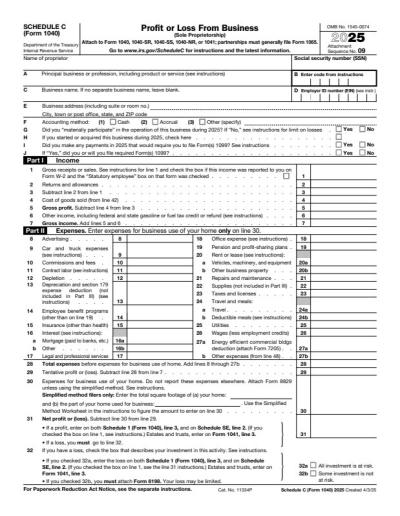
Schedule C (Form 1040), Profit or Loss From Business (Sole Proprietorship), is the Internal Revenue Service form used to report income and deductible expenses from a trade or business run by an individual. The 2025 revision of Schedule C is a two-page attachment to Form 1040, Form 1040-SR, Form 1040-SS, Form 1040-NR, and in limited cases Form 1041. It converts your bookkeeping records into a taxable net profit or deductible loss that flows to the rest of your federal return and often to Schedule SE for self-employment tax.
The form is organized into five main parts. Part I, lines 1 through 7, reports gross receipts, returns and allowances, cost of goods sold from line 42, and other income to arrive at gross income. Part II, lines 8 through 32, lists business deductions such as advertising, contract labor, office expense, rent or lease, travel, deductible meals, utilities, wages, and business use of home on line 30. Part III covers cost of goods sold on lines 33 through 42, Part IV asks for vehicle information on lines 43 through 47, and Part V itemizes other expenses that feed line 48.
Schedule C is not a general-purpose income form for every side activity. The IRS instructions say it is for a business operated with continuity and regularity and with a primary profit motive. That distinction matters because hobby income, rental income that belongs on Schedule E, and farming income that belongs on Schedule F are reported elsewhere. When used correctly, Schedule C is the core federal tax form for sole proprietors, freelancers, independent contractors, statutory employees, and certain qualified joint ventures between spouses.
Who needs to fill this out?
- Sole proprietors who operated a trade or business during the tax year and need to report business income or loss on an individual return.
- Independent contractors, freelancers, gig workers, creators, and consultants who received business income, including amounts reported on Form 1099-NEC, Form 1099-MISC, or Form 1099-K, and whose activity rises to the level of a business.
- Statutory employees who received Form W-2 with the statutory employee box checked and need to report related wages and expenses on Schedule C.
- Single-member domestic LLC owners if the LLC is disregarded for federal tax purposes and has not elected corporate treatment.
- Spouses making a qualified joint venture election generally file a separate Schedule C for each spouse based on each person's share of income and deductions.
- Do not file Schedule C for a hobby or sporadic not-for-profit activity, for rental real estate or royalties typically reported on Schedule E, for farming reported on Schedule F, or for a partnership that must file Form 1065 unless a qualified joint venture or community property exception applies.
Where and how to submit
Schedule C is submitted to the Internal Revenue Service as an attachment to your federal individual income tax return; it is not mailed as a standalone form. Most filers submit it electronically through IRS-authorized e-file software, a paid preparer, or IRS Free File options when eligible. If you file on paper, include Schedule C behind your Form 1040 or 1040-SR and mail the full return to the IRS paper-filing address for your state and whether a payment is enclosed, using the official IRS Form 1040 mailing tables at Where to File Form 1040.
For calendar-year sole proprietors filing the 2025 revision, the federal due date is generally April 15, 2026. If you need more time to file, request an automatic six-month extension with Form 4868 by that same date; the extension moves the filing deadline to October 15, 2026, but it does not extend the time to pay tax due. If you use Schedule C income to compute quarterly estimated tax, estimated payments are generally made with Form 1040-ES or electronically through IRS Direct Pay or EFTPS.
How to fill it out
- Step 1 — Heading and identification: Enter the principal business or profession, the six-digit business code, business name if any, EIN if you have one, business address, and your SSN at the top of page 1. Then answer the boxes for accounting method, material participation, whether you started or acquired the business during the year, and the Form 1099 questions in lines I and J.
- Step 2 — Part I, Income: On line 1 enter gross receipts or sales and check the statutory employee box if applicable. Enter returns and allowances on line 2, subtract to get line 3, carry cost of goods sold from line 42 to line 4 if you sell inventory, then complete line 5 gross profit, line 6 other income, and line 7 gross income.
- Step 3 — Part II, Expenses: Complete the deduction lines that match your records, including line 8 advertising, line 9 car and truck expenses, line 11 contract labor, line 18 office expense, line 20a and 20b rent or lease, line 22 supplies, line 23 taxes and licenses, line 24a travel, line 24b deductible meals, line 25 utilities, line 26 wages, line 27a other expenses, and line 27b for the energy efficient commercial buildings deduction if Form 7205 applies.
- Step 4 — Lines 28 through 32: Add lines 8 through 27b for line 28 total expenses before home office, subtract line 28 from line 7 for line 29 tentative profit or loss, complete the simplified method square-footage boxes or attach Form 8829 for actual home office expenses on line 30, and then compute line 31 net profit or loss. Finish line 32 by checking whether all investment in the business is at risk or some investment is not at risk.
- Step 5 — Part III, Cost of Goods Sold: If your business sells products and maintains inventory, complete lines 33 through 42 on page 2. Choose the closing inventory valuation method, answer whether inventory methods changed, then enter beginning inventory, purchases less personal withdrawals, cost of labor, materials and supplies, other costs, ending inventory, and compute line 42 cost of goods sold to carry back to line 4.
- Step 6 — Part IV, Information on Your Vehicle: If you claimed car or truck expenses on line 9, fill in lines 43 through 47 with the date the vehicle was placed in service, business miles, commuting miles, other miles, and the yes-or-no substantiation questions about personal availability and written evidence.
- Step 7 — Part V, Other Expenses: List any deductible business expenses not already captured on lines 8 through 27a or line 30, describe each item in Part V, total them on line 48, and make sure that total agrees to line 27a on page 1 before attaching Schedule C to your Form 1040 series return.
Important deadlines & penalties
- Annual filing deadline: For calendar-year taxpayers using the 2025 Schedule C, file with Form 1040 by April 15, 2026.
- Automatic extension: File Form 4868 by April 15, 2026 to receive an automatic extension to October 15, 2026 for filing the return. The extension does not extend the time to pay.
- Estimated tax deadlines: Sole proprietors who expect to owe at least $1,000 generally make quarterly estimated payments by April 15, 2026, June 15, 2026, September 15, 2026, and January 15, 2027, usually using Form 1040-ES.
- Failure-to-file penalty: The IRS states the penalty is generally 5% of the unpaid tax for each month or part of a month the return is late, up to a maximum of 25%.
- Minimum late-filing penalty: If a Form 1040 return is more than 60 days late and was due in 2025, the minimum penalty is generally $510 or 100% of the unpaid tax, whichever is less; for returns due after December 31, 2025, the posted minimum is $525.
- Underpayment consequences: If Schedule C income causes you to underpay tax during the year, the IRS may assess an underpayment of estimated tax penalty even if you are later due a refund when you file.
Common mistakes to avoid
- Reporting hobby activity on Schedule C: If the activity does not have continuity, regularity, and a profit motive, the IRS may reclassify it, disallow deductions, and increase tax.
- Mismatch between line 1 gross receipts and Forms 1099-K, 1099-NEC, or 1099-MISC: Underreporting line 1 can trigger IRS notices and document-matching inquiries.
- Claiming line 9 car and truck expenses without completing Part IV: Missing mileage totals or substantiation answers weakens the deduction and can lead to disallowance on audit.
- Putting personal purchases on line 22 supplies or line 18 office expense: Personal costs are not deductible business expenses and can create accuracy-related penalties if overstated.
- Failing to reconcile Part V line 48 with line 27a other expenses: If the descriptions and total do not support line 27a, the return appears incomplete or inconsistent.
- Using line 30 business use of home without Form 8829 or the simplified method worksheet: Unsupported home office deductions are a common adjustment area.
- Entering inventory businesses without completing Part III lines 33 through 42: Omitting beginning or ending inventory distorts cost of goods sold and changes taxable income.
Expert tips
- Use the IRS business code list carefully: The code entered near the top of Schedule C should match the activity that actually produced the income, not a broad label that hides the nature of the business.
- Reconcile line 1 before you start: Compare bookkeeping totals with every Form 1099-NEC, 1099-MISC, and 1099-K you received so gross receipts are complete and supportable.
- Separate meals from travel: Schedule C splits these items between line 24a travel and line 24b deductible meals, so keeping them separate in your records prevents overstatement.
- Use Form 4562 when required: If you claim depreciation or a section 179 deduction connected to line 13, the instructions direct many filers to attach Form 4562 rather than estimate depreciation directly on Schedule C.
- Do not skip the at-risk checkboxes on line 32: If some investment is not at risk, you may also need Form 6198, and checking the wrong box can delay accurate loss treatment.
- Home office filers should decide early between methods: The simplified method affects line 30 differently from the actual-expense method that uses Form 8829, so choose the method before finalizing totals.
- Keep Publication 334 and Publication 535 nearby: IRS guidance for small business income, deductions, and recordkeeping helps when deciding whether an expense belongs on line 17 legal and professional services, line 21 repairs and maintenance, or Part V other expenses.
Related forms & next steps
- Form 1040 — U.S. Individual Income Tax Return to which Schedule C is attached. Official IRS page
- Schedule SE (Form 1040) — used to calculate self-employment tax based on net profit from Schedule C. Official IRS page
- Form 8829 — Expenses for Business Use of Your Home for taxpayers using actual home office expenses for line 30. Official IRS page
- Form 4562 — Depreciation and Amortization, including section 179 deductions and listed property reporting. Official IRS page
- Form 1040-ES — Estimated Tax for Individuals, often used by sole proprietors with Schedule C income. Official IRS page
- Form 7205 — Energy Efficient Commercial Buildings Deduction, referenced for Schedule C line 27b. Official IRS page
- Form 6198 — At-Risk Limitations, used when losses may be limited because some investment is not at risk. Official IRS page
Frequently asked questions
What is Schedule C used for?
Schedule C is used to report income and deductible expenses from a sole proprietorship or other business activity treated as a sole proprietorship for federal tax purposes. The final result on line 31 shows net profit or loss.
Who files Schedule C for a single-member LLC?
A single-member domestic LLC generally files Schedule C if it is disregarded for federal tax purposes and has not elected to be taxed as a corporation. If the LLC elected corporate treatment, Schedule C is usually not the right form.
Do I need Schedule C for a side hustle?
Usually yes, if the side activity is a real business carried on for profit with continuity and regularity. Occasional hobby activity does not belong on Schedule C even if money was received.
Can I deduct my car on Schedule C?
You may be able to claim car and truck expenses on line 9, but the deduction must be supported. If you claim it, complete Part IV with business, commuting, and other miles and maintain written mileage evidence.
What happens if my Schedule C shows a loss?
A loss may offset other income, but it can be limited by the at-risk rules, passive activity rules, or excess business loss rules. The line 32 at-risk checkboxes and related forms such as Form 6198 can become important.
Do I mail Schedule C by itself?
No. Schedule C is attached to your Form 1040 series return and filed with the IRS together with the rest of that return, usually by e-file or by mailing the complete return package.
Can I create Schedule C (Form 1040) in bulk?
Yes. PDFengine supports bulk generation of Schedule C (Form 1040) via Excel or CSV upload — upload a spreadsheet with one row per entry and PDFengine generates all PDFs at once. You can also automate bulk creation programmatically via the PDFengine API.
Ready to fill it in?
Fill in this formOfficial sources
- About Schedule C (Form 1040) — official IRS overview of who uses the form and what it reports.
- Instructions for Schedule C (Form 1040) — official line-by-line instructions, related forms, and filing rules.
- Where to File Form 1040 — official IRS mailing address tables for paper-filed returns that include Schedule C.
- Failure to File Penalty — official IRS penalty rates and minimum late-filing penalty amounts for Form 1040 returns.
- Estimated Taxes — official IRS guidance on who must pay quarterly estimated tax and when payments are due.



