
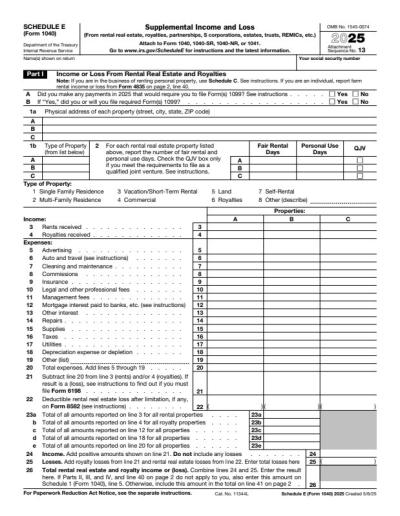
Schedule E (Form 1040), filled in online.
Supplemental Income and Loss
Type in the panel and watch each answer land on the page. Filling in and signing is free; downloading needs a free account, which includes 5 downloads a month.
Or fill it another way:
- Category
- Tax
- Fillable fields
- 185
- Pages
- 2
- Paper size
- US Letter, 8.5 × 11 in
Five ways to fill this form.
-
Fill it in here
Type in the panel and watch it land on the form. Sign it, then download.
Free to fill and sign Start filling -
Many at once, from a spreadsheet
One row per person, one finished PDF for each.
Paid plan · you can walk through it Start with a spreadsheet -
Send it to someone to fill in
Email a link. They fill it in without an account and you get the answers back.
Paid plan · you can walk through it Send a request -
From your own software
Fill it over the API. One request returns the finished PDF.
Paid plan -
Let an AI assistant do it
Connect ChatGPT or Claude once, then describe what goes on the form.
With a free account
Key facts
| Property | Details |
|---|---|
| Form number | Schedule E (Form 1040) |
| Official name | Supplemental Income and Loss |
| Issuing agency | Internal Revenue Service, Department of the Treasury |
| Current revision | 2025 revision; form shows Created 5/6/25 |
| Number of pages | 2 |
| Filing frequency | Annual, attached to the filer's federal income tax return |
| Related instructions | 2025 Instructions for Schedule E (Form 1040), IRS publication i1040se |
What is this form?
Schedule E (Form 1040), officially titled Supplemental Income and Loss, is the Internal Revenue Service attachment used to report income or loss from rental real estate, royalties, partnerships, S corporations, estates, trusts, and residual interests in real estate mortgage investment conduits (REMICs). The current official IRS form for this template is the 2025 revision, shown on the form as Schedule E (Form 1040) 2025 Created 5/6/25. It is filed with Form 1040, Form 1040-SR, Form 1040-NR, or Form 1041, depending on the filer.
The form is split into functional parts. Part I covers rental real estate and royalties, including lines 1a, 1b, and 2 for each property, income on lines 3 and 4, expenses on lines 5 through 20, and the subtotal and limitation lines 21 through 26. Part II reports partnership and S corporation items from Schedule K-1, Part III reports estate and trust items, Part IV reports REMIC residual holder items, and Part V summarizes the total that generally flows to Schedule 1 (Form 1040), line 5. The IRS instructions also cross-reference forms such as Form 8582, Form 6198, Form 4562, and Form 4835 when special rules apply.
Who needs to fill this out?
- Individuals, estates, and trusts with reportable supplemental income or loss use Schedule E when they have rental real estate income, royalty income, partnership income or loss, S corporation income or loss, estate or trust income, or REMIC residual interest income.
- Rental property owners generally use Part I if they rent out real estate and do not provide significant services to guests. If they own only part of a property, they report only their share of the income and expenses.
- Taxpayers who receive Schedule K-1 from a partnership, S corporation, or trust typically use Part II or Part III to report the items shown on that K-1.
- REMIC residual holders use Part IV and should receive Schedule Q (Form 1066) from the REMIC.
- Taxpayers who made payments requiring information returns must answer line A. The IRS instructions say that if you paid at least $600 for certain services, rents, prizes, medical payments, or other reportable amounts, you may also need to file Form 1099-NEC or Form 1099-MISC.
- People who generally do not use Schedule E include taxpayers in the business of renting personal property such as equipment or vehicles, because those amounts generally belong on Schedule C; individual farmers with crop-share rental income and no material participation, because that usually belongs on Form 4835; and taxpayers who rented a dwelling they used as a home for fewer than 15 days in 2025, because the IRS says they generally do not report that rental income or deduct the rental expenses.
Where and how to submit
Schedule E is not mailed separately. It is attached to the filer's federal return and sent to the Internal Revenue Service with Form 1040, 1040-SR, 1040-NR, or 1041. Most taxpayers file it electronically through IRS Free File, Direct File where available, commercial software, or an authorized e-file provider. For calendar-year individual filers using the 2025 version, the normal due date is April 15, 2026.
A timely Form 4868 extends the filing deadline to October 15, 2026, but not the time to pay tax.
Paper filers must use the same mailing address used for the main return. The IRS official 1040 address table gives exact addresses by state and payment status. For example, taxpayers in Alabama, Florida, Georgia, Louisiana, Mississippi, North Carolina, South Carolina, Tennessee, and Texas with no payment mail to Department of the Treasury, Internal Revenue Service, Austin, TX 73301-0002; with payment they mail to Internal Revenue Service, P.O. Box 1214, Charlotte, NC 28201-1214. Many northeastern and midwestern states without payment use Department of the Treasury, Internal Revenue Service, Kansas City, MO 64999-0002; most western states without payment use Department of the Treasury, Internal Revenue Service, Ogden, UT 84201-0002.
Taxpayers abroad who are not enclosing payment use Department of the Treasury, Internal Revenue Service, Austin, TX 73301-0215, USA; with payment they use Internal Revenue Service, P.O. Box 1303, Charlotte, NC 28201-1303, USA.
How to fill it out
- Step 1 — Header, lines A and B: Enter the Name(s) shown on return and Your social security number exactly as they appear on the main return. Then answer line A about payments made in 2025 that would require Forms 1099 and line B about whether those required forms were or will be filed.
- Step 2 — Part I, property setup: For each rental real estate property, complete line 1a with the physical address, line 1b with the IRS property code, and line 2 with Fair Rental Days and Personal Use Days. For royalty property, the instructions say to enter code 6 on line 1b and leave lines 1a and 2 blank. Check the QJV box only if the property qualifies as a qualified joint venture.
- Step 3 — Part I, income and expenses: Enter gross rental income on line 3 and royalty income on line 4. Then enter deductible expenses on lines 5 through 19, including Advertising, Auto and travel, Mortgage interest paid to banks, etc., Repairs, Taxes, and Depreciation expense or depletion. Add the expense lines on line 20.
- Step 4 — Part I, limitation and totals: Subtract expenses on line 21. If there is a rental real estate loss, use line 22 for the deductible loss after any limitation on Form 8582. Complete lines 23a through 23e for the required property totals, then compute line 24 for income, line 25 for losses, and line 26 for the total rental real estate and royalty income or loss.
- Step 5 — Part II, partnerships and S corporations: Use line 27 to determine whether you are reporting prior-year unallowed losses, unreimbursed partnership expenses, or other special items. On line 28, enter the entity name, whether it is a P or S, the EIN, and the passive and nonpassive amounts from the Schedule K-1. Then finish lines 29a through 32 to arrive at total partnership and S corporation income or loss.
- Step 6 — Parts III and IV, estates, trusts, and REMICs: In line 33, enter each estate or trust name and EIN, then complete lines 34a through 37 using passive and nonpassive amounts from Schedule K-1 (Form 1041). If you are a REMIC residual holder, complete line 38 with the name, EIN, excess inclusion, taxable income or net loss, and other Schedule Q amounts, then combine the allowed amounts on line 39.
- Step 7 — Part V, summary and carryover: Enter any net farm rental income or loss from Form 4835 on line 40. Add lines 26, 32, 37, 39, and 40 on line 41 and carry the result to Schedule 1 (Form 1040), line 5 when applicable. If line 42 or 43 applies, complete the farming and fishing reconciliation or the real estate professional reconciliation before filing.
Important deadlines & penalties
- 2025 individual return due date: File Schedule E with the 2025 Form 1040 package by April 15, 2026, unless a special rule or disaster relief changes the deadline.
- Automatic extension: File Form 4868 or use an IRS electronic extension method by April 15, 2026 to extend the filing deadline to October 15, 2026. The extension covers filing only, not payment.
- Late-filing penalty: The IRS states that for individuals and most business returns, the failure-to-file penalty is generally 5% of unpaid tax for each month or part of a month the return is late, up to 25%. If a Form 1040 return due after December 31, 2025 is more than 60 days late, the minimum penalty is generally $525 or 100% of the unpaid tax, whichever is less.
- Late-payment penalty: If tax is not paid by the original due date, the failure-to-pay penalty is generally 0.5% of unpaid tax per month, up to 25%. If both late-filing and late-payment penalties apply in the same month, the filing penalty is reduced by the payment penalty for that month.
- Form 1099 timing tied to lines A and B: If line A is answered yes because reportable payments were made, the IRS instructions say many Forms 1099-NEC and 1099-MISC must be furnished to recipients and filed on their own separate deadlines; for example, royalty payers often issue Form 1099-MISC and royalty recipients expecting at least $10 should generally receive it by January 31, 2026.
- Special farm rule from line 42: If gross farming or fishing income for 2024 or 2025 is at least two-thirds of gross income, the instructions say estimated tax penalties may be avoided by filing the 2025 return and paying tax due by March 2, 2026.
Common mistakes to avoid
- Using the wrong property code on line 1b: Entering a residential rental as code 6 or 8 instead of the correct property type causes classification errors and can affect how the IRS reads the return.
- Reporting rental days incorrectly on line 2: Leaving out Personal Use Days for a vacation property can overstate deductible expenses and trigger passive loss or vacation-home adjustments under the Schedule E instructions.
- Putting short-term rental business income on Schedule E when Schedule C is required: If significant services were provided to renters, the IRS says the activity generally belongs on Schedule C, not line 3 of Schedule E. Filing it on the wrong schedule can understate self-employment tax.
- Deducting improvements on line 14 instead of line 18: Major improvements such as replacing an entire HVAC system are not current repairs. Claiming them as Repairs instead of capitalizing and depreciating them can lead to disallowed deductions.
- Using line 12 for interest that belongs on line 13: Mortgage interest paid to a non-financial institution, or a shared mortgage where someone else received Form 1098, generally belongs on line 13 with an attached explanation, not on line 12.
- Skipping Form 8582, Form 6198, or Form 4562 when required: A loss on line 21 may require Form 6198; rental real estate loss limits may require Form 8582; and any auto expense on line 6 generally requires Form 4562, Part V. Missing attachments can delay processing or reduce the deduction.
- Mismatching K-1 amounts in Parts II or III: The IRS explicitly warns on page 2 that it compares Schedule E entries with Schedule K-1. If line 28 or line 33 does not match the entity reporting, the filer may receive an IRS notice of additional tax due.
Expert tips
- Use one Schedule E as the master copy when you have more than three properties: The IRS says you can attach additional Schedules E, but answer lines A and B and complete lines 23a through 26 on only one schedule.
- Remember the 2025 standard mileage rate on line 6: If you use the mileage method for rental travel, the 2025 instructions state the rate is 70 cents per mile, and parking fees and tolls may be added.
- Always complete lines 23c through 23e: Even if you have only one property, the instructions say total mortgage interest, depreciation, and total expenses must still be carried to lines 23c, 23d, and 23e.
- Keep line 12 and line 13 interest support: Save Form 1098, loan statements, and tracing records showing how borrowed funds were used. The IRS specifically says interest allocation depends on use of proceeds.
- Do not include REMIC excess inclusion in line 39: For Part IV, the instructions say the amount in column (c) is reported separately and is not included in the total on line 39.
- Check whether a property was used as a home before claiming full expenses: If personal use exceeds the greater of 14 days or 10% of fair-rental days, the vacation-home rules may limit deductions even when income is correctly reported on line 3.
- Use the right IRS references: Publication 527 helps with residential rental property, Publication 463 helps with travel and car costs, and Publication 925 explains passive activity and at-risk rules that affect lines 21, 22, 27, and 43.
Related forms & next steps
- Form 1040 — Main U.S. individual income tax return to which Schedule E is attached.
- Schedule 1 (Form 1040) — Additional Income and Adjustments to Income; Schedule E totals usually flow to line 5.
- Form 4835 — Farm Rental Income and Expenses, used by certain individual crop-share landlords instead of Schedule E.
- Form 8582 — Passive Activity Loss Limitations, used when rental or other passive losses are limited.
- Form 4562 — Depreciation and Amortization, and required for certain auto expense reporting tied to line 6 and depreciation on line 18.
- Form 6198 — At-Risk Limitations, required when losses on line 21 are limited by at-risk rules.
- Form 1041 — U.S. Income Tax Return for Estates and Trusts; beneficiaries use Schedule K-1 information from this return in Part III.
Frequently asked questions
What is Schedule E (Form 1040) used for?
It is used to report supplemental income and loss from rental real estate, royalties, partnerships, S corporations, estates, trusts, and REMIC residual interests.
Do I need Schedule E for rental property?
Usually yes, if you rent out real estate and do not provide significant services to tenants. If the activity is really a business similar to a hotel or you rent personal property instead of real estate, the income may belong on Schedule C instead.
Do I report Airbnb income on Schedule E or Schedule C?
It depends on the facts. If you are mainly renting real estate and not providing significant services, it is often reported on Schedule E. If you provide substantial guest services, the IRS instructions point toward Schedule C.
What if I have more than three rental properties?
The IRS allows you to attach additional Schedules E. However, you answer lines A and B and complete lines 23a through 26 on only one Schedule E that acts as the combined summary sheet.
Do I need Form 8582 with Schedule E?
Maybe. If you have passive losses from rental real estate or pass-through entities, Form 8582 may be required to limit the deductible amount reported through Schedule E, especially at line 22 or in Part II and Part III.
Where does Schedule E go on my tax return?
Part I may flow through to Schedule 1 (Form 1040), line 5, and the page 2 summary on line 41 generally carries to the same place when Parts II through V apply.
Can I create Schedule E (Form 1040) in bulk?
Yes. PDFengine supports bulk generation of Schedule E (Form 1040) via Excel or CSV upload — upload a spreadsheet with one row per entry and PDFengine generates all PDFs at once. You can also automate bulk creation programmatically via the PDFengine API.
Ready to fill it in?
Fill in this formOfficial sources
- About Schedule E (Form 1040) — IRS overview of the form, purpose, and current products.
- 2025 Schedule E (Form 1040) PDF — Official 2-page form with Parts I through V and the line references used for filing.
- 2025 Instructions for Schedule E (Form 1040) — Official line instructions, passive loss rules, property codes, and related form references.
- Where to file addresses for taxpayers filing Form 1040 — Official IRS paper-filing addresses by state and payment status.
- IRS Failure to File Penalty — Official late-filing penalty percentages, caps, and minimum penalty amounts for Form 1040 returns.



