
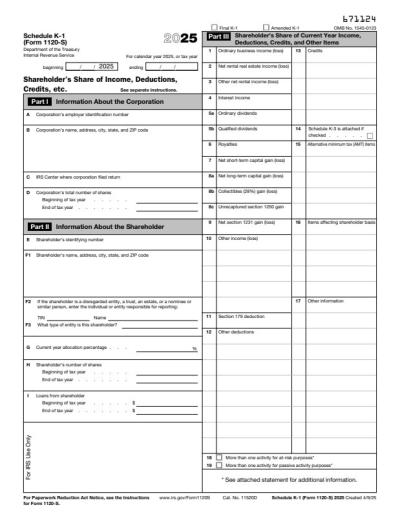
Schedule K 1 Form 1120 S, filled in online.
Schedule K 1 Form 1120 S — official fillable PDF form
Type in the panel and watch each answer land on the page. Filling in and signing is free; downloading needs a free account, which includes 5 downloads a month.
Or fill it another way:
- Category
- Tax
- Fillable fields
- 114
- Pages
- 1
- Paper size
- US Letter, 8.5 × 11 in
Five ways to fill this form.
-
Fill it in here
Type in the panel and watch it land on the form. Sign it, then download.
Free to fill and sign Start filling -
Many at once, from a spreadsheet
One row per person, one finished PDF for each.
Paid plan · you can walk through it Start with a spreadsheet -
Send it to someone to fill in
Email a link. They fill it in without an account and you get the answers back.
Paid plan · you can walk through it Send a request -
From your own software
Fill it over the API. One request returns the finished PDF.
Paid plan -
Let an AI assistant do it
Connect ChatGPT or Claude once, then describe what goes on the form.
With a free account
What is this form?
Schedule K-1 (Form 1120-S), Shareholder's Share of Income, Deductions, Credits, etc., reports one shareholder's allocated items from an S corporation for a tax year. The corporation prepares a separate K-1 for each person who was a shareholder during the year and includes the schedules with Form 1120-S. Each shareholder uses the issued copy, accompanying statements, and basis records to prepare their own federal and, where applicable, state tax returns.
The schedule reports pass-through information rather than the amount of cash distributed. Ordinary business income, rental items, interest, dividends, capital gains, deductions, credits, foreign information, alternative minimum tax items, tax-exempt income, distributions, and other data may all affect the shareholder differently. Items can require codes and supplemental statements, and limitations involving stock basis, debt basis, at-risk rules, passive activity, or excess business losses are generally applied at shareholder level.
Prepare the form only after the corporation's books, ownership ledger, shareholder changes, tax classifications, and Form 1120-S schedules are reconciled. PDFengine helps populate the official PDF; it does not calculate allocation percentages, maintain basis, choose tax codes, generate required statements, or file the corporate return. Use the IRS instructions for the exact revision and tax year.
Who needs to fill this out?
- S corporations preparing an original, final, or amended Schedule K-1 for every shareholder who held stock during the tax year.
- Tax professionals allocating Form 1120-S income, deductions, credits, distributions, and supplemental items among shareholders.
- Shareholders reviewing the K-1 they received before reporting pass-through items on an individual or entity return.
- Corporate officers reconciling ownership dates, stock percentages, loans, distributions, and shareholder identifying information.
Where and how to submit
The corporation files Schedule K-1 with Form 1120-S through its IRS-authorized electronic filing provider and furnishes a copy, with all applicable statements, directly to the shareholder. A shareholder normally does not attach the K-1 to an individual return unless the return instructions specifically require it, but must report the items and retain the schedule. The regular due date follows Form 1120-S, generally the 15th day of the third month after the tax year ends, subject to weekends, holidays, and valid extensions. Correct errors promptly with an amended K-1 and amended corporate filing when required, and clearly identify the corrected information.
How to fill it out
- Step 1 — Tax year and status: Enter the Beginning month, Beginning day, Ending month, Ending day, and Ending year shown on Form 1120-S. Mark Final K-1 only when no later K-1 is expected for that shareholder and Amended K-1 only when correcting a previously furnished schedule.
- Step 2 — Corporation information: Enter the Corporation's employer identification number, legal name, address, and IRS center or e-file information requested by the current form. Match the filed Form 1120-S exactly.
- Step 3 — Shareholder information: Complete the shareholder's identifying number, name, address, entity type, residency information where requested, and beginning and ending ownership percentages. Reconcile these entries with the stock ledger and acquisition or disposition dates.
- Step 4 — Core income items: Transfer Line 1 Ordinary business income (loss), Line 2 Net rental real estate income (loss), Line 3 Other net rental income (loss), Line 4 Interest income, and Lines 5a and 5b dividend amounts from the corporate return workpapers.
- Step 5 — Gains, deductions, and credits: Enter the shareholder's allocated capital gains, section 1231 items, section 179 deduction, other deductions, and Line 13 Credits code and amount. Use each IRS code exactly and provide a referenced statement when the instructions require detail.
- Step 6 — Other and international information: Complete foreign transactions, alternative minimum tax items, tax-exempt income, nondeductible expenses, distributions, investment income, and other information fields that apply. Do not combine unlike codes merely to fit the form.
- Step 7 — Reconcile and furnish: Confirm that all shareholder K-1 allocations total the amounts on Form 1120-S, attach every required statement, and review identifying numbers and percentages. Furnish the shareholder copy by the applicable deadline and retain the corporation's copy with the filed return.
Frequently asked questions
Is Schedule K-1 the same as Form 1120-S?
No. Form 1120-S is the corporation's return; Schedule K-1 reports one shareholder's allocated share of selected items from that return.
Does a distribution equal the income shown on the K-1?
No. Pass-through taxable income and cash or property distributions are separate concepts and can differ substantially.
What if the shareholder sold stock during the year?
Use the allocation method permitted by the tax rules and the actual ownership dates. Document any qualifying election and ensure beginning and ending percentages reflect the corporate records.
Can a shareholder deduct every loss reported?
Not necessarily. Stock and debt basis, at-risk, passive-activity, and other limitations may defer or disallow a loss; the shareholder applies those rules.
When should I mark Amended K-1?
Mark it when correcting a K-1 already furnished for the same shareholder and year. Provide the corrected schedule and statements and follow the amended-return instructions.
Why are codes and statements important?
Many lines group different tax items under letter or number codes. The code and any required statement tell the shareholder how to report and limit the item.
Can I create Schedule K-1 (Form 1120-S) in bulk?
Yes. PDFengine supports bulk generation of Schedule K-1 (Form 1120-S) via Excel or CSV upload — upload a spreadsheet with one row per shareholder and PDFengine generates all PDFs at once. You can also automate bulk creation programmatically via the PDFengine API.
Ready to fill it in?
Fill in this form


