
Taxpayer Return Request Form RET 001, filled in online.
Taxpayer Return Request Form RET 001 — official fillable PDF form
Type in the panel and watch each answer land on the page. Filling in and signing is free; downloading needs a free account, which includes 5 downloads a month.
Or fill it another way:
- Category
- Tax
- Fillable fields
- 32
- Pages
- 1
- Paper size
- US Letter, 8.5 × 11 in
Five ways to fill this form.
-
Fill it in here
Type in the panel and watch it land on the form. Sign it, then download.
Free to fill and sign Start filling -
Many at once, from a spreadsheet
One row per person, one finished PDF for each.
Paid plan · you can walk through it Start with a spreadsheet -
Send it to someone to fill in
Email a link. They fill it in without an account and you get the answers back.
Paid plan · you can walk through it Send a request -
From your own software
Fill it over the API. One request returns the finished PDF.
Paid plan -
Let an AI assistant do it
Connect ChatGPT or Claude once, then describe what goes on the form.
With a free account
What is this form?
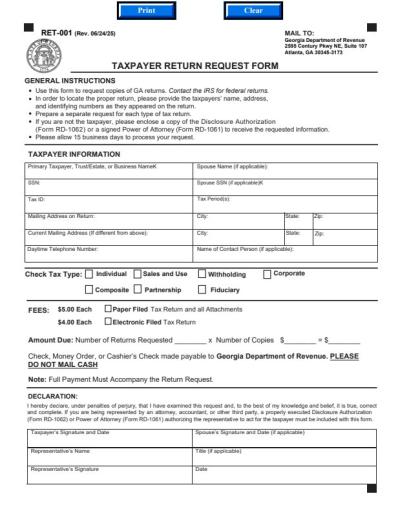
Form RET-001 is used to request copies or information from previously filed tax returns for an individual, spouse, trust, estate, or business. It identifies the taxpayer, tax identifiers, periods requested, addresses, delivery preference, and the person authorized to receive the material. Because tax returns contain protected information, the request must establish identity and authority and may require fees or supporting documents. This fillable version helps you prepare a legible working copy, but it does not replace the current instructions, eligibility rules, required evidence, or review by the receiving authority. Use the edition requested for the relevant transaction or reporting period and compare the completed PDF with the official source before submission.
Information should come from source records rather than memory or estimates. Names, identifiers, dates, amounts, addresses, and selections must agree with the supporting documents for the case. A technically complete PDF can still be rejected when an answer is inaccurate, a required attachment is missing, or a signature belongs to the wrong person. Save the original records and document any calculation used to produce an amount.
Who needs to fill this out?
- Individual taxpayers requesting their own prior return records.
- Spouses seeking a jointly filed return or information they are legally entitled to receive.
- Business, trust, or estate representatives with documented authority.
- Authorized third parties requesting delivery under a valid power of attorney or other accepted authorization.
Before starting, confirm that Taxpayer Return Request Form RET-001 is the form requested by the issuing or receiving organization. Assign one person to reconcile the entries when several people provide information. Do not enter placeholder data simply to make a field look complete. If a question does not apply, follow the printed instructions for leaving it blank or marking it not applicable, because a blank field and a zero can have different meanings.
Where and how to submit
Submit RET-001 to the tax authority, records unit, or office identified on the current form, using an accepted secure portal, mail, fax, or in-person method. Do not send full tax identifiers to an unverified email address. Processing times and fees vary by record type and age. Delivery to a representative generally requires accepted authorization, and an address entered only for delivery may not change the account’s permanent address. Use only a submission channel accepted by the receiving organization, and verify the address, portal, email, or office against current official instructions. Keep a complete copy together with attachments and proof of delivery or electronic confirmation. If the recipient returns the form for correction, amend the inaccurate entry transparently and resubmit the complete package; do not discard the version that shows what was originally delivered.
Review the generated PDF at normal size and at high zoom. Confirm that long values are not clipped, checkboxes show the intended choice, dates use the requested format, and every signature and attachment is present. Protect the file because it may contain personal, financial, medical, or transaction information. Share it only with people and systems authorized to handle the submission.
How to fill it out
- Step 1 — Primary Taxpayer, Trust/Estate, or Business Name: Enter the legal name exactly as it appeared on the requested return, including the entity suffix where applicable.
- Step 2 — Spouse Name, SSN, Spouse SSN, and Tax ID: Complete only the identifiers relevant to the return type and protect them from unnecessary disclosure. Recheck every digit.
- Step 3 — Tax Period(s): List each year or filing period requested in the agency’s accepted format. Distinguish calendar years from fiscal or periodic tax returns.
- Step 4 — Mailing Address on Return: Enter the street, city, state, and ZIP code used on the original filing to help the agency match the record.
- Step 5 — Current Mailing Address: Complete the current address fields when they differ from the filed return. This does not necessarily update the taxpayer’s official address for other purposes.
- Step 6 — Return type and delivery request: Select or describe the exact return, transcript, schedule, or account information requested and the authorized delivery destination. Avoid requesting broader records than needed.
- Step 7 — Certification, authority, and signature: Sign and date as the taxpayer or authorized representative, include a daytime contact, and attach identification, power of attorney, fiduciary papers, or fee payment when required.
Frequently asked questions
Is a return copy the same as a transcript?
No. A copy reproduces the filed return, while a transcript or account record may summarize selected data and later adjustments.
Can a spouse request a joint return?
Rights depend on the return, period, and agency rules; provide the spouse information and signature or authorization required by the form.
How many periods can be requested?
List every requested period clearly and follow any limit or separate-form requirement in the current instructions.
Does entering a new address update the tax account?
Not necessarily. Complete the authority’s separate address-change procedure when one is required.
Can I use an electronic signature?
Use an electronic signature only when the recipient and the applicable instructions accept it. A typed name is not automatically equivalent to a valid signature, and some filings require an original, witnessed, notarized, or professional signature.
What should I check before submitting?
Reconcile identifiers, dates, amounts, selected options, attachments, and signatures against the source records. Then inspect the final PDF for clipped text, blank required fields, duplicate selections, and pages in the wrong order.
Should I keep a copy of the completed form?
Yes. Keep the exact submitted version, supporting records, and delivery confirmation for the retention period that applies. Store the files securely because the form may contain sensitive information.
Can I create Taxpayer Return Request Form RET-001 in bulk?
Yes. PDFengine supports bulk generation of Taxpayer Return Request Form RET-001 via Excel or CSV upload — upload a spreadsheet with one row per form and PDFengine generates all PDFs at once. You can also automate bulk creation programmatically via the PDFengine API. Each generated form must still be individually reviewed and, where required, signed.
Ready to fill it in?
Fill in this form


